- Most existing fences in Los Angeles CAN support an automatic gate — but the corner posts almost always need upgrading to 4-inch or 6-inch steel for motor torque loads.
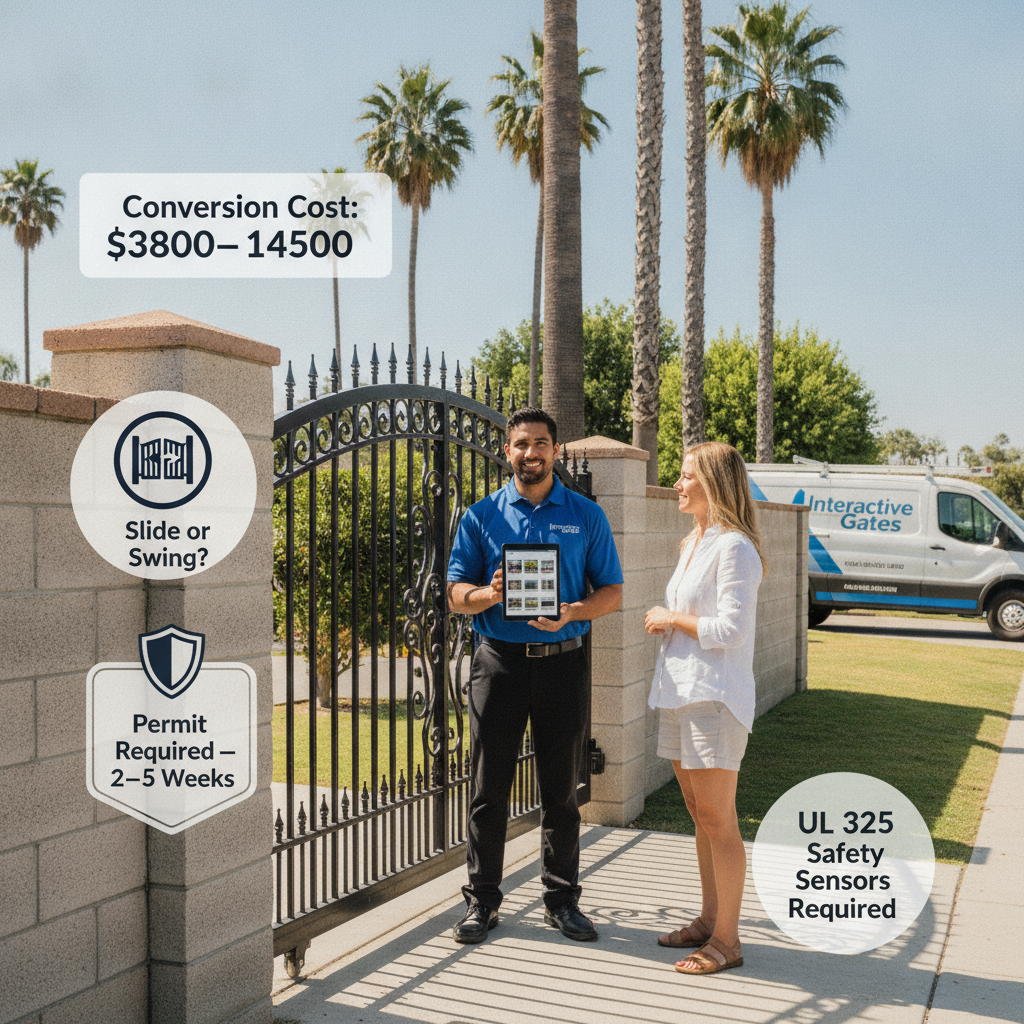
- Gate conversion projects typically run $3,800–$14,500 installed in the LA metro depending on gate width, material, and access-control add-ons.
- Slide gates are the default choice for flat lots in the San Fernando Valley and Long Beach; swing gates suit hillside lots in Palos Verdes and the canyons — but require 8–12 ft of clear swing arc.
- LA County and most city jurisdictions require a permit for any motorized gate on residential or commercial property; turnaround is typically 2–5 weeks.
- LiftMaster, FAAC, and Viking are the three most-installed motor brands in Southern California — each has a model suited to heat, dust, and salt-air environments.
- UL 325 photo-eye and edge-sensor compliance is mandatory in California; non-compliant gates can void homeowner insurance and expose HOAs to liability.
- Most conversion installs take 1–2 days once permits are pulled; post reinforcement adds a half-day to the schedule.
- Adding access control (keypad, intercom, app) during install costs $400–$2,200 more — far cheaper than retrofitting later.
Can I Add an Automatic Gate to My Existing Fence in Los Angeles?
You already have the fence. Maybe it is a wrought-iron perimeter around a Encino ranch home, a cedar board-on-board in Torrance, or a block-wall surround on a Whittier commercial lot. The question you are Googling is: can I just add an automatic gate to what I already have, or do I have to start over? The short answer is yes — in the vast majority of cases — but the details matter a lot in Los Angeles, where lot grades, HOA CC&Rs, city permit offices, and California-specific safety codes all intersect. This guide walks you through every decision point so you know exactly what to expect before a single call is made.
What Does 'Adding a Gate to an Existing Fence' Actually Involve?
Converting an existing fence opening into a motorized automatic gate involves four distinct scopes of work that any reputable installer will address: structural post evaluation and upgrade, gate fabrication or selection, motor and hardware mounting, and access-control wiring. Skipping any one of these steps is where conversions go wrong — and where callbacks happen six months later.
The existing fence only plays a supporting role. The gate posts bear all the dynamic load: a 14-ft wrought-iron slide gate can weigh 800–1,100 lbs and cycle 20–40 times a day in a busy household. The posts holding that gate must be set in concrete footings at least 36 inches deep (48 inches in hillside zones per LA County grading ordinances) and should be 4-inch-square steel tube at minimum for swing gates or 6-inch for heavy slide applications. If your existing posts are standard 2-inch fence posts, they will need to be replaced or sistered before any motor goes on.
How Much Does It Cost to Add an Automatic Gate to an Existing Fence in Los Angeles in 2026?
Here is a realistic cost breakdown for the LA metro market as of mid-2026. These are installed prices including materials, labor, permit fees, and standard access control (keypad or loop detector). Luxury finishes, intercoms, and video systems are listed separately below.
- Single swing gate, steel or aluminum, up to 10 ft wide: $3,800–$6,500
- Dual swing gate, steel or aluminum, 10–16 ft total width: $5,500–$9,200
- Single slide gate, steel, up to 12 ft wide: $4,800–$7,800
- Cantilever slide gate, 14–20 ft wide (common for RV driveways in Chatsworth, Northridge): $7,500–$14,500
- Post reinforcement or replacement (per post): $650–$1,400
- Permit fees, LA County or city municipalities: $180–$420 typical
- Keypad or proximity-card reader add-on: $400–$750
- Video intercom (ButterflyMX, DoorKing, Aiphone): $900–$2,200 installed
The biggest price driver after gate size is post condition. If your existing masonry columns or steel posts pass a structural inspection, you save $1,300–$2,800. If they need full replacement — common with older block walls in East LA, Montebello, and Downey — budget accordingly.
Pro Tip: Get the post inspection done before you select your gate. Many homeowners fall in love with a heavy ornamental iron design only to discover the post upgrade adds $2,000 to the project. Knowing your structural baseline first lets you match the gate weight to what the site can support affordably.
What Permits Do I Need in Los Angeles for a Gate Conversion?
In the City of Los Angeles, any automatic vehicle gate on a residential or commercial property requires a building permit under LAMC Section 91.106. The permit covers structural footings, electrical wiring for the motor, and UL 325 safety-device compliance. LA County unincorporated areas use a nearly identical code. Municipalities like Torrance, Santa Monica, and Long Beach have their own building departments but all adopt the California Building Code (CBC) which mandates the same UL 325 entrapment-protection requirements.
Permit turnaround in 2026 runs approximately 2–5 weeks for standard residential projects submitted online through the LA Department of Building and Safety (LADBS) PermitLA portal. Expedited plan check is available for an additional $350–$600 fee and can compress the wait to 5–10 business days. Some cities — Glendale and Burbank notably — process simple gate permits over the counter in one visit.
HOA communities have an additional layer: the architectural review committee (ARC) must approve gate design, finish, and color before a permit application is submitted. Expect 2–4 weeks for ARC review on top of city timelines. If your property is in a historic overlay zone (West Adams, Angelino Heights, parts of Pasadena), a Certificate of Appropriateness may also be required.
Which Gate Style Works Best With My Existing Fence in LA?
Lot geometry is the primary selector in Los Angeles because the metro is so topographically diverse. Here is how to match gate style to your property type:
- Flat Valley floors (Sherman Oaks, Van Nuys, Hawthorne, Compton): Slide gates or cantilever gates are ideal. No swing arc needed, works with narrow setbacks, and handles the long driveways common in Ranch-style homes.
- Hillside lots (Hollywood Hills, Mount Washington, Palos Verdes Estates, Malibu Canyon): Swing gates are preferred where a level approach pad of at least 3 ft exists behind the gate plane. On steep grades, a vertical-pivot or vertical-lift gate avoids grade-change headaches entirely, though these start at $11,000 installed.
- Corner lots and alley-access properties (Culver City, Mid-City, Koreatown): Slide gates tucked along the fence line keep the sidewalk clear and satisfy city encroachment rules. Track clearance of at least 1.5× the gate width is required along the fence.
- Existing block-wall or CMU fences (common throughout the Inland Empire fringe cities — Whittier, La Puente, Pico Rivera): Swing gates mounted into block pilasters with embedded steel sleeves work very well. The block itself provides mass for the hinge side; the latch-side pilaster must be reinforced.
What Motor Should I Choose for an LA-Area Gate Conversion?
Southern California's climate stresses gate operators in ways that differ from the Pacific Northwest. Heat is the dominant factor: the San Fernando Valley routinely hits 105–112°F in July and August. Coastal areas add salt-air corrosion (Malibu, San Pedro, Long Beach). Dust and PM2.5 from Santa Ana winds clog vents and filters. Here is how the leading brands perform in this environment:
- LiftMaster LA500 / LA400 series: The most-installed residential slide-gate operator in Southern California. Rated for 100 cycles per day, thermal protection shuts it down before heat damage occurs, and MyQ app integration is native. MSRP $1,100–$1,600 for the operator alone. Best for medium-duty residential and light commercial.
- FAAC 844 / 740 series: Italian-engineered hydraulic operators with oil-bath lubrication that handles heat exceptionally well — the hydraulic fluid absorbs thermal shock that would wear out a standard gear motor. Popular in Rolling Hills and upscale Bel Air estates. Operator MSRP $1,400–$2,200. Rated 200+ cycles per day.
- Viking Access G40 / G70: Made in the USA with a strong dealer network in the LA metro. The G70 handles gates up to 2,000 lbs and 40 ft — ideal for large cantilever gates on commercial properties in Commerce, Vernon, and City of Industry. MSRP $1,800–$2,800. Built-in diagnostics and cloud connectivity.
- Apollo 1500 / 1550: Budget-to-mid-range swing-gate operator, good for single residential swing gates under 16 ft and 850 lbs. Solar-ready out of the box, which matters for detached side-yard gates without easy conduit runs. MSRP $600–$950.
Pro Tip: In ZIP codes prone to power outages during heat events — think Woodland Hills, Chatsworth, and the eastern Antelope Valley fringe — specify a battery-backup operator (LiftMaster LA500 with BBUL or FAAC with integrated UPS). A gate that won't open during a grid outage is a safety risk, not just an inconvenience.
What Safety Features Are Required in California?
California Health & Safety Code Section 19890 and UL 325 (6th edition, enforced in California since 2016) require all automatic vehicular gates to have entrapment protection on BOTH sides of the gate travel path. For a conversion project, this means your installer must add:
- Photo-eye sensors (retroreflective or through-beam) at vehicle bumper height (12–18 inches) on both the opening and closing sides
- Monitored contact-edge sensors on the leading edge of the gate panel
- A listed control board that monitors these devices and stops/reverses on obstruction
- Warning placards posted at the gate explaining entrapment hazard
For pedestrian gates within 6 ft of a vehicular gate, a secondary photo-eye at 30–36 inches must also be present. This is commonly missed on conversions where the pedestrian pass-through was an afterthought. California state law holds property owners — and HOA boards — liable for injuries from non-compliant gates. Do not skip this line item to save $300.
How Long Does a Gate Conversion Take From Start to Finish?
Here is a realistic timeline for a Los Angeles gate conversion in 2026:
- Week 1: Site assessment, structural inspection, design selection, permit application submitted
- Weeks 2–5: Permit review period (use expedited check to compress to weeks 2–3)
- During permit period: Gate fabrication (custom ornamental iron takes 3–5 weeks; prefab aluminum panel gates are stock or 1-week lead)
- Installation day(s): Post work day 1, gate hang and motor mount day 2, access-control wiring and commissioning day 2 or 3
- Total elapsed time: 4–8 weeks for a custom project; 2–3 weeks for a prefab gate with expedited permit
Can an HOA in Los Angeles Add a Gate to an Existing Perimeter Fence?
Yes, and HOA-managed conversions follow the same structural and permit rules but at a larger scale. Gated communities in areas like Orange, Rolling Hills, and San Clemente frequently upgrade legacy swing-arm barriers to full vehicle gates as communities age and security needs evolve. The main HOA-specific considerations are: dual-gate configurations for entry and exit lanes, emergency-service access (Knox Box or fire-department radio override required in most LA County fire districts), visitor management integration (license-plate recognition, QR-code intercoms), and resident credential management at scale.
Commercial-grade operators like the FAAC 617 or Viking G100 handle the 300–500 daily cycle demands of a busy HOA entrance. Budget $18,000–$65,000 for a full dual-gate HOA entry system with LPR, video intercom, and cloud-based access management. For a detailed breakdown, see the HOA and commercial gate page.
In One Minute: Adding an Automatic Gate to an Existing Fence in Los Angeles
Most existing LA fences can be converted to automatic gate systems without tearing out the entire fence line. The fence stays; the corner posts likely need upgrading to steel tube set in deep concrete. Budget $3,800–$14,500 installed depending on gate size, material, and access control. You will need a city or county building permit (2–5 weeks) and, if in an HOA, ARC approval before that. Choose your motor based on cycle count and heat tolerance — LiftMaster for everyday residential, FAAC for high-end estates, Viking for heavy commercial. Every California gate must meet UL 325 safety requirements: photo eyes and edge sensors on both sides of travel. Installation takes 1–2 days once permits are in hand; total project timeline is 4–8 weeks for custom work. Adding access control during the install (keypads, intercoms, app access) is far cheaper than retrofitting. The result is a property that is more secure, more convenient, and meaningfully higher in curb appeal and resale value.
Frequently Asked Questions
Do I need to replace my entire fence to add an automatic gate in Los Angeles?
No. In the vast majority of cases the existing fence remains completely intact. The work is concentrated at the gate opening: the two corner posts are inspected and often upgraded, the gate panel itself is new, and the motor mounts to one of those posts or to a dedicated pad. Fence panels on either side are untouched unless they are in poor condition or need to be temporarily removed for equipment access during the post upgrade.
How wide can an automatic gate opening be on a residential lot in LA?
Residential driveway gates in Los Angeles are most commonly 10–16 ft wide for single-car driveways and 16–20 ft for double-wide or RV driveways. Most city zoning codes restrict gate openings to no wider than the driveway apron as approved on the original grading permit. Cantilever slide gates can span up to 40 ft, but anything over 20 ft typically crosses into a commercial permit classification.
Can I add solar power to a gate conversion if there is no nearby electrical outlet?
Yes, and this is a popular solution for side-yard or rear-alley gates in Los Angeles where running conduit from the main panel would cost $1,500–$3,000. Apollo and LiftMaster both offer solar-ready operators. A 20-watt panel paired with a 12V sealed battery handles 30–50 cycles per day reliably even in December when LA's solar irradiance is lowest. Solar kits add $350–$700 to the project cost, far less than trenching new conduit.
How do I know if my existing block-wall pilasters can support a gate motor?
A qualified gate installer will probe the pilaster for an embedded steel sleeve or rebar cage. Solid CMU block with a 4-inch steel sleeve grouted in can typically support swing gates up to 600 lbs and 12 ft wide. Without a steel sleeve, the pilaster is at risk of cracking under repeated torsional load. The fix is core-drilling the pilaster and grouting in a steel post — a $700–$1,200 repair that is well worth doing before hanging a motor.
Will adding an automatic gate increase my home's value in Los Angeles?
Real estate data from comparable sales in gated vs. non-gated properties in LA neighborhoods consistently shows a 3–7% premium for homes with functional automatic gate systems, particularly in the $800K–$2.5M range common in the Valley, South Bay, and foothill communities. The premium is higher in neighborhoods where gated properties are the norm (Beverly Hills Post Office area, Hidden Hills, Rancho Palos Verdes) and lower where gates are rare. Beyond resale, gated properties in LA typically see lower comprehensive insurance premiums by 5–12% through carriers like Chubb and PURE who actively underwrite security features.
What is the best access-control option when converting an existing fence gate for a rental property?
For single-family rentals and small multi-unit properties in Los Angeles, a keypad with a rolling-code PIN (LiftMaster KPWR or Viking KP-200) is the simplest and most cost-effective option at $400–$650 installed. The PIN can be changed between tenants without rekeying hardware. For larger multi-family properties or short-term rentals (Airbnb-permitted zones in West Hollywood, Venice), a cloud-based intercom like ButterflyMX ($1,200–$2,200 installed) lets you issue temporary QR-code access to guests from a phone app and log every entry event.
Ready to See What Works for Your Property?
If you are in Los Angeles, Laguna Beach, or anywhere across Southern California and want to turn that existing fence into a complete gated entry, the best first step is a site walkthrough. Our team evaluates post condition, lot grade, driveway geometry, and permit requirements before any proposal is written — so the number you get reflects your actual project, not a generic estimate. You can also design your gate style online to get a feel for materials and finishes before committing. When you are ready to talk specifics, reach out here and we will schedule a free on-site assessment. See what others have built in the project gallery for inspiration — there is no pressure, just real information to help you make the right call.