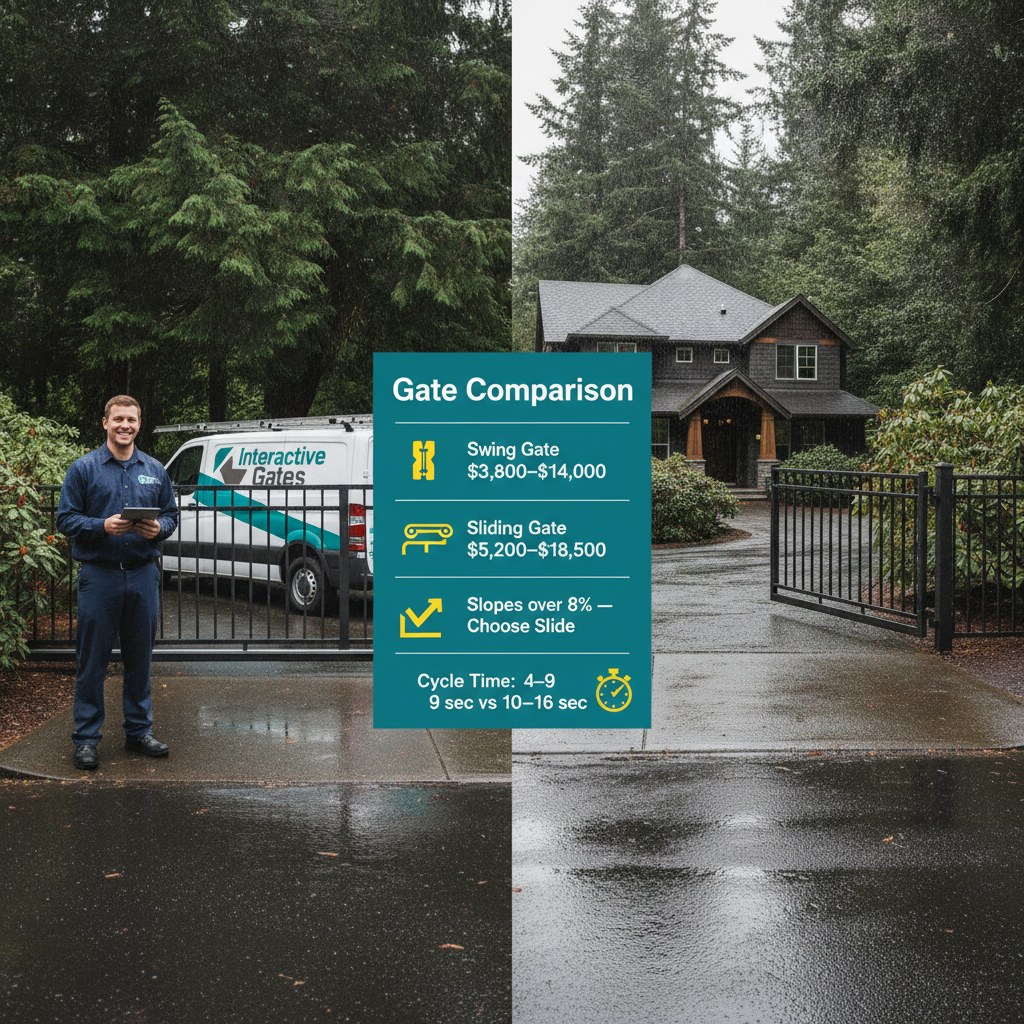
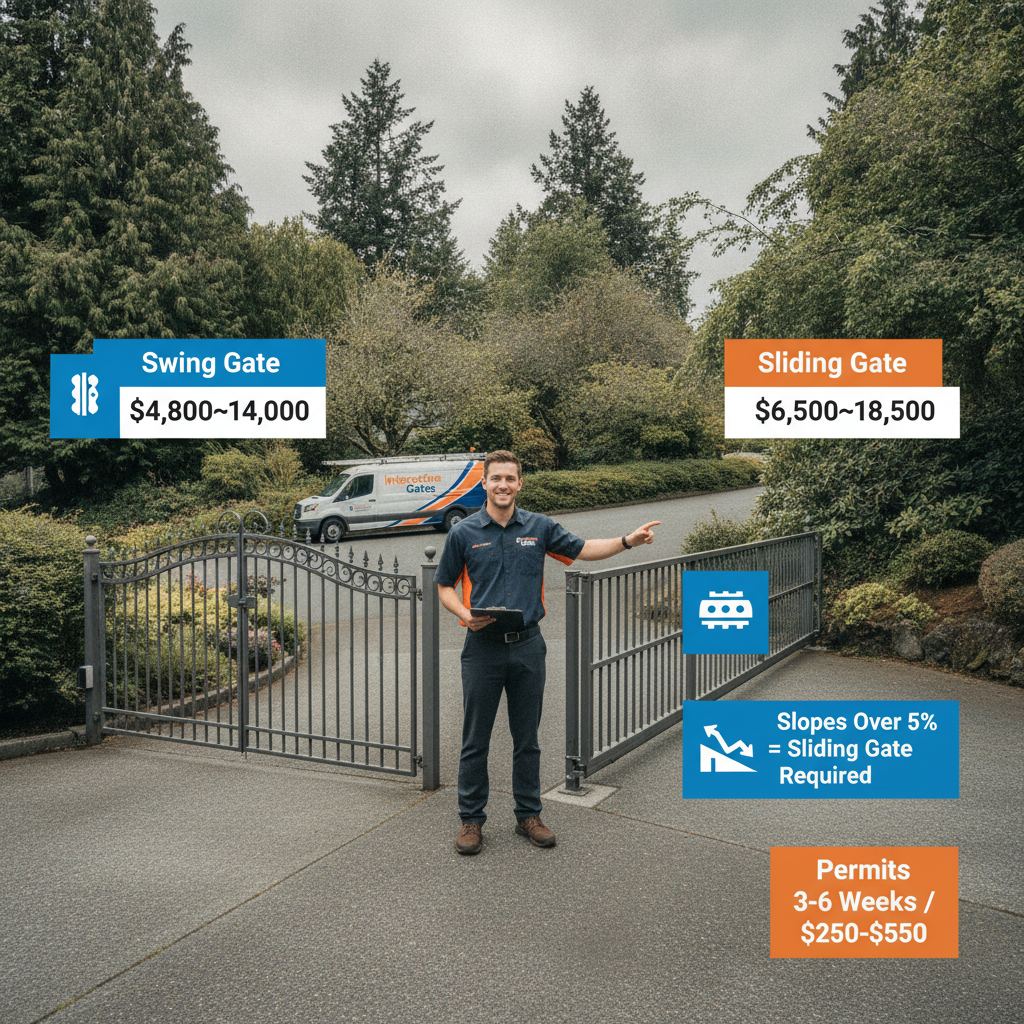
- Swing gates are the most popular choice in Portland, but they need 8–14 ft of clearance behind the opening and struggle on slopes steeper than 8%.
- Sliding gates handle Portland's hilly lots and tight driveways better, requiring only a flat 2–3 ft of side clearance and costing $4,800–$14,000 installed for single-family homes.
- Vertical pivot lift (VPL) gates are gaining ground in 2026 for properties with zero side clearance — installed prices start around $9,500.
- Bi-fold (speed gate) options are now practical for residential use and clear a 12 ft opening in under 3 seconds.
- Portland's clay-heavy soil and 140+ annual rain days influence which operator and hinge system you should choose — this matters more than aesthetics.
- HOAs in Lake Oswego and West Hills often restrict gate color, material, and maximum height to 6 ft — check CC&Rs before you spec anything.
- LiftMaster, FAAC, and Viking all make operators optimized for specific gate styles — matching the operator to the gate type can double your cycle life.
- Most residential gate style decisions can be finalized in a 45–90 minute site assessment; lead times for fabricated panels run 3–6 weeks in 2026.
Swing Gate, Slide Gate, or Something Else? How Portland Homeowners Are Choosing in 2026
You've finally decided you want an automatic gate. Now comes the question nobody warned you about: which type? Portland homeowners search 'swing gate vs sliding gate driveway,' 'do I have room for a swing gate on a sloped lot,' and 'electric gate styles Portland hillside' more than almost any other gate question. And it makes sense — the wrong gate style means a system that binds, stalls, or outright fails within a few years. This guide breaks down every major residential gate style available in 2026, maps each one to the Portland neighborhoods and lot types where it works best, and gives you real installed prices so you can plan an actual budget.
What Are the Main Electric Gate Styles Available in Portland in 2026?
In 2026 the residential market in the Portland metro has settled around five main movement types. Each has a mechanical logic that either matches or fights your property's terrain.
- Single swing gate: One panel hinged on one post, swinging inward or outward across the driveway opening. Best for openings up to 16 ft and flat or gently graded driveways.
- Dual swing (bi-parting) gate: Two panels, each hinged on opposite posts, meeting in the center. Handles openings from 10 ft to 24 ft. Requires clearance on both sides of the driveway.
- Cantilever slide gate: A panel that slides horizontally parallel to the fence line on a wheeled trolley — no ground track, so it handles gravel, ice, and uneven pavement well.
- V-groove track slide gate: Similar to cantilever but runs on an embedded steel track. Less common for new Portland installs due to debris clogging in wet winters but still used in commercial settings.
- Vertical pivot lift (VPL): The entire panel rotates upward on a pivot arm, folding roughly parallel to the ground. Zero side clearance needed — great for tight urban lots in Sellwood, Hawthorne, or Beaverton infills.
- Bi-fold speed gate: The panel folds at a central hinge, reducing the footprint of a swing gate by roughly 50%. Increasingly popular on lots with 4–6 ft of inward clearance.
A smaller niche — overhead lift gates — exists for commercial properties but is rarely installed residentially in Portland because of structural cost. We will skip it here.
How Do I Know If My Portland Lot Can Handle a Swing Gate?
Swing gates are elegant and they are still the number-one choice for flat residential lots in Portland suburbs like Lake Oswego, Hillsboro, and Gresham. But they impose hard geometry constraints that trip up a lot of buyers.
The fundamental rule: a swing gate panel must have clearance equal to its own width behind the pivot point as it opens. A 10 ft single-panel gate swinging inward needs 10 ft of flat, obstruction-free driveway inside the property line before it hits a fence corner, a parked car, or a slope drop. For a dual-swing gate covering a 16 ft opening, each 8 ft panel needs 8 ft of clearance — but those clearance zones diverge at an angle, so your driveway needs to be at least 14–16 ft wide at the hinge points.
Slope is the bigger killer. Portland's West Hills, Tualatin Hills, and neighborhoods around Council Crest see driveway grades of 10–18%. At 8% grade or steeper, a standard swing operator like a LiftMaster LA500 or FAAC 415 begins to strain because gravity is fighting the panel on the close cycle. Installers either add a second operator (cost: +$600–$1,200), use a heavy-duty linear actuator rated for slopes, or recommend switching to a slide gate entirely. On a 15% grade, a swing gate is almost always the wrong answer regardless of how much the homeowner likes the look.
Pro Tip: Before you fall in love with a dual swing wrought-iron gate, walk your driveway with a tape measure and a cheap digital level (under $15 at any hardware store). If your grade reads above 6% and your inward clearance is less than 12 ft, budget for a slide gate from the start — retrofitting costs $1,500–$3,000 more than speccing it correctly the first time.
When Does a Sliding Gate Make More Sense for a Portland Property?
Sliding gates sidestep the swing clearance problem entirely. Instead of sweeping an arc into the property, the panel travels parallel to the fence line, requiring only a 'stack zone' of roughly 110–120% of the opening width alongside the driveway. A 12 ft opening needs about 14 ft of fence run to park the gate panel when open.
This makes sliding gates the default recommendation for:
- Hillside lots in Southwest Portland, Raleigh Hills, and Tigard where grades exceed 8%
- Urban infill lots in Sellwood, Division, and inner Beaverton where inward driveway depth is less than 10 ft
- Properties with Gresham or Oregon City gravel driveways — cantilever slides don't need a ground track, so gravel and mud don't jam the mechanism the way they would in a swing gate ground pivot
- High-cycle commercial or multi-unit residential in Portland's Pearl District or Lloyd District where gates may cycle 40–80 times daily
In 2026, cantilever slide gates dominate new Portland residential installs. The most common operator pairing is the Viking G4000 or FAAC 740 rack-drive operator, both of which handle gates up to 1,400 lb and are rated for 800–1,200 cycles per day. For a residential 10–14 ft steel cantilever gate, installed cost in the Portland metro currently runs:
- Basic steel tube frame, powder-coat finish, Viking or LiftMaster operator: $4,800–$7,500
- Ornamental steel or aluminum with upgraded FAAC operator and keypad: $7,500–$11,000
- Custom laser-cut steel or corten panel with FAAC 740 and full access-control integration: $11,000–$14,000+
See how slide gate systems look in real Portland and Beaverton installs in our project portfolio.
What Is a Vertical Pivot Lift Gate and Should Portland Homeowners Consider One?
Vertical pivot lift (VPL) gates are the quiet disruptors of residential gate design in 2026. The panel is mounted on a counter-weighted arm that pivots upward — imagine a parking arm at a garage but instead of a bar, it's your full decorative gate panel rising to roughly 45 degrees above horizontal.
VPL gates solve two problems simultaneously: they need almost no side clearance (the panel doesn't travel left or right at all) and they handle any driveway slope because the panel moves vertically, not along the grade. For Portland lots where there's literally nowhere to put a swing arc and no fence run to park a sliding panel, VPL is often the only clean solution.
The tradeoffs: VPL systems are mechanically more complex, the counterweight arm adds height above the post (typically 3–5 ft above the panel top), and they're more expensive. In 2026, residential VPL installs in the Portland metro run $9,500–$18,000 depending on panel size and operator brand. FAAC's VPL 500 and BFT's IGEA are the most commonly specified operators locally.
Portland neighborhoods where VPL comes up frequently: tight urban lots near Hawthorne and Belmont, steep access roads in Lake Oswego's Uplands neighborhood, and infill ADU developments in Hillsboro where the city's setback rules leave almost no driveway depth.
How Do Portland's Climate and Soil Affect Gate Style Choice?
Portland averages 144 rainy days per year and gets about 36 inches of precipitation annually — mostly as persistent drizzle rather than downpours. That has specific mechanical implications most gate guides ignore.
- Ground-track slide gates collect leaf debris, pine needles, and fine grit in the V-groove, causing derailment. Cantilever slides, which have no ground track, are strongly preferred for wooded lots in Snohomish-adjacent areas, Lake Oswego, and Sauvie Island approaches.
- Clay soil heave is a serious issue in Portland's West Hills and parts of Gresham. Posts set less than 42 inches deep in expansive clay can shift 1–2 inches over a wet winter, misaligning swing gate hinges. Quality installs in these areas use 48–54 inch concrete footings and stainless-steel adjustable hinges.
- Rust and corrosion: Powder-coat over steel holds up well for 8–12 years in Portland's mild-acidic rain. Bare steel welds oxidize within 18 months. Ask for a two-coat powder process (primer + topcoat) or specify 6061-T6 aluminum framing if you want a 20+ year finish life without repainting.
- Operator weatherproofing: All operators should be rated IP44 or better for Portland. FAAC and LiftMaster commercial-line operators come IP55 as standard. Viking's residential operators are IP44 — adequate but worth confirming with your installer if the operator housing faces prevailing southwest rain.
Pro Tip: In Portland's clay-heavy neighborhoods, always ask your installer to show you the footing depth on the permit drawings. A 36-inch footing that was fine in summer may allow post movement by February. The code minimum is 18 inches in most Portland jurisdictions, but best practice for ornamental swing gates is 48 inches.
What Gate Styles Work Best for HOAs and Gated Communities in Portland?
HOA communities in Lake Oswego, Oregon City, and Hillsboro typically operate dual-swing or bi-parting slide gates at community entry points. The choice is almost always driven by the width of the throat (entry lane): single-lane entries up to 14 ft usually get dual swing; two-lane or wide entries of 20–28 ft almost always get slide gates because dual swing at that width requires massive hinges and very powerful operators.
For HOA-scale projects, operators rated for continuous-duty high-cycle use are required. The FAAC 844 ER and LiftMaster CSW200 are the two most specified operators for Portland HOA swing-gate entries in 2026. Both handle gates up to 1,200 lb per leaf and are rated for 600+ cycles per day. At the community level, the operator is just one line item — access control (keypads, intercoms, license-plate recognition) often represents 30–50% of total project cost.
If you manage or sit on the board of an HOA anywhere in the Portland area, our HOA and commercial gate page has a full breakdown of what community-scale projects require.
How Much Does Each Gate Style Cost Installed in Portland in 2026?
Here is a realistic price table for residential gate installations in the Portland metro as of mid-2026. These are installed totals including operator, one access device (keypad or remote), standard wiring, and concrete work for posts:
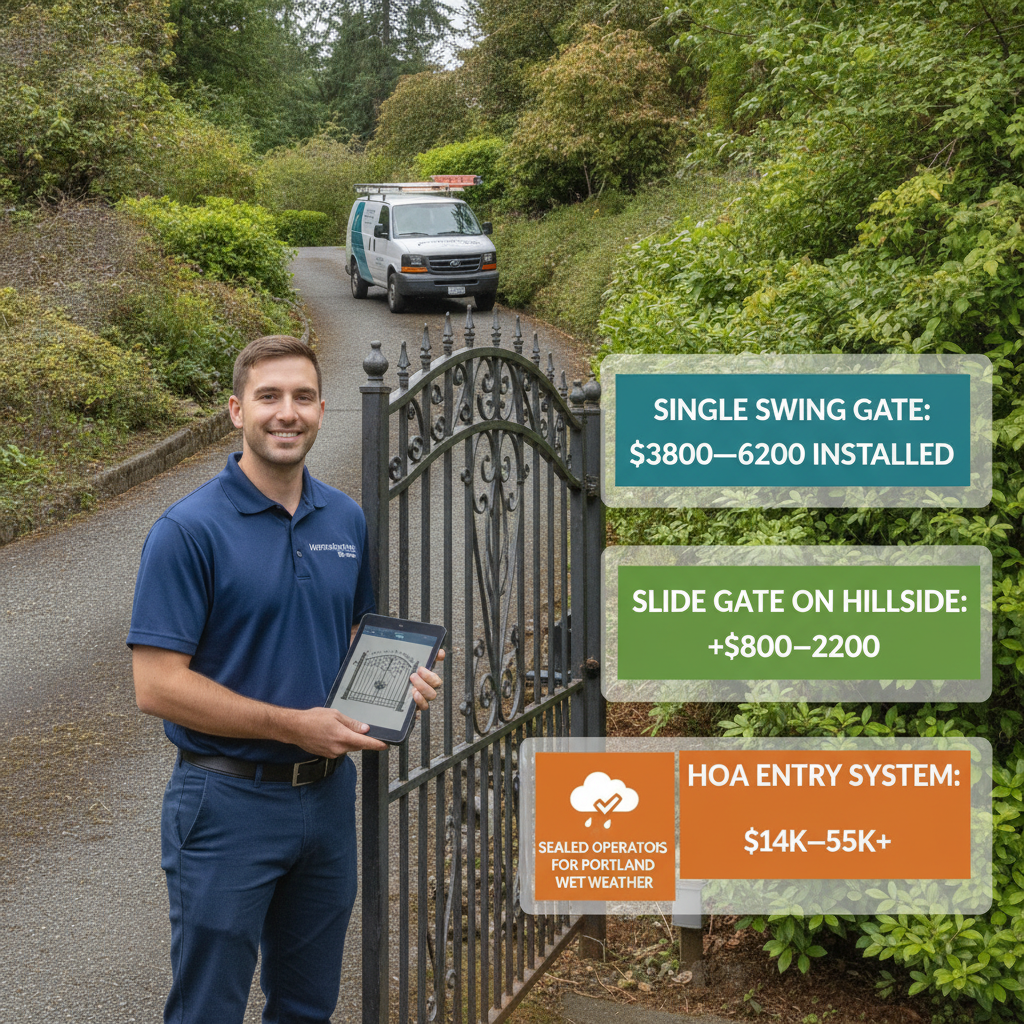
- Single swing gate, 10–12 ft, steel, LiftMaster LA500: $3,800–$6,500
- Dual swing gate, 14–18 ft, ornamental steel, FAAC 415: $6,500–$11,500
- Cantilever slide gate, 12–16 ft, steel, Viking G4000: $5,200–$9,500
- Cantilever slide gate, 12–16 ft, ornamental aluminum, FAAC 740: $8,000–$14,000
- Bi-fold speed gate, 10–14 ft, steel: $7,500–$13,000
- Vertical pivot lift (VPL), 10–14 ft, FAAC VPL 500: $9,500–$18,000
These prices do not include access control upgrades (telephone entry, LPR camera, video intercom), which add $800–$6,000 depending on complexity. Permits in Portland, Beaverton, and Hillsboro typically add $150–$400 to project cost and are required for any gate with an automated operator.
Want to visualize what different gate styles would look like on your actual driveway? Try the Interactive Gates gate designer tool — you can upload a photo of your property and see ornamental, flat-panel, and privacy styles side by side before committing to anything.
Which Portland Neighborhoods Have Specific Gate Style Preferences?
Local context shapes gate design more than most homeowners realize:
- Lake Oswego (Uplands, Westlake): Dual swing ornamental iron is the dominant aesthetic, but steep lots force frequent slide-gate substitutions. HOA rules in many Lake Oswego subdivisions cap gate height at 6 ft and restrict dark colors. See Lake Oswego gate projects.
- Beaverton (Murrayhill, Sexton Mountain): Newer construction with flatter lots — dual swing aluminum is popular and fits the neighborhood's contemporary architecture. See Beaverton gate projects.
- Oregon City (Beavercreek Road area): Rural-adjacent properties often run long driveways — single swing or cantilever slide with solar operators (Mighty Mule MM571W or FAAC solar kit) to avoid trenching 200+ ft of wire. See Oregon City gate projects.
- Hillsboro (South Hillsboro): New-build communities are specifying horizontal-slat aluminum sliding gates that match the modern farmhouse aesthetic dominating new construction. See Hillsboro gate projects.
In One Minute: Gate Style Cheat Sheet for Portland Homeowners
Flat lot, 10+ ft inward clearance, classic look → dual swing gate, $6,500–$11,500. Sloped driveway above 8% or tight urban lot → cantilever slide gate, $5,200–$14,000. Zero side clearance and no swing room → vertical pivot lift, $9,500–$18,000. Limited clearance but don't want VPL cost → bi-fold gate, $7,500–$13,000. HOA community entry, single lane → dual swing, FAAC 844 ER or LiftMaster CSW200. HOA community entry, two lanes → cantilever slide, FAAC 740 or Viking G4000. All Portland gate installs need permits; clay-soil lots need 48-inch footings; cantilever beats track-slide for wet-weather reliability.
Frequently Asked Questions: Electric Gate Styles in Portland
Can I install a swing gate on a sloped Portland driveway?
Yes, but only up to about 8% grade before the operator begins fighting gravity on every close cycle. Above 8%, you should either use a heavy-duty slope-rated linear actuator (adding roughly $600–$1,200 to project cost) or switch to a cantilever slide gate, which is unaffected by grade. Most installers in the Portland metro will measure your grade during the site assessment and advise accordingly. On grades above 12–15%, a slide or VPL gate is almost always the right choice.
How much clearance do I need behind a swing gate?
You need clearance equal to the panel width from the hinge pivot inward. A 14 ft dual-swing gate (two 7 ft panels) needs 7 ft of flat clearance behind each hinge point measured along the panel's swing arc. That translates to roughly 12–14 ft of driveway depth at the gate line in practice. If your car, a retaining wall, or a slope break sits within that zone, the gate will hit it. A cantilever slide gate requires zero inward clearance — only a stack zone to one side of the opening.
Do Portland HOAs restrict what kind of gate style I can install?
Many do. HOAs in Lake Oswego, West Hills, and Hillsboro master-planned communities often cap gate height (typically 5–6 ft), restrict materials (no chain-link or corrugated metal), and sometimes specify that gates must be open-style (ornamental, not solid privacy panels) to maintain a neighborhood's visual character. Always review your CC&Rs before purchasing any gate materials. Your installer should also confirm local zoning — Portland's Title 28 and Washington County's equivalent development codes both have provisions governing driveway gates.
How long do each of these gate styles last in Portland's climate?
Steel swing and slide gates with quality two-coat powder finish last 15–25 years for the panel itself; aluminum panels can last 30+ years without refinishing. Operators typically last 7–15 years depending on cycle count and maintenance frequency. The weakest links in Portland's climate are: ground-track rollers on V-groove slide gates (debris clogging accelerates wear), swing gate hinges on clay-heave lots (misalignment causes stress fractures in weld joints), and unprotected wiring conduit that allows moisture ingress. Annual lubrication and a spring inspection extend all of these lifespans significantly.
Is a solar-powered gate practical for a Portland property?
Solar gates work better in Portland than most people expect, even with 144 annual rainy days, because modern operators draw very little current per cycle. A properly sized solar kit (typically a 20W panel + 20Ah battery) handles 10–20 cycles per day year-round in the Portland area without issue. Problems arise when a shaded south-facing installation gets less than 2 hours of direct sun per winter day — in those cases, a small supplemental trickle charge from grid power is advisable. Solar is most popular for rural Oregon City and Gresham properties where trenching power 150+ ft to the gate would cost $2,000–$5,000.
How long does a gate installation take in Portland in 2026?
The physical installation for a residential single-gate system takes 1–2 days once materials arrive. Lead times for fabricated ornamental steel or custom aluminum panels run 3–6 weeks in 2026 from local fabricators in the Portland-Gresham manufacturing corridor. Permits (required in Portland, Beaverton, Hillsboro, Lake Oswego, and Oregon City for automated gates) add 1–3 weeks to the timeline if not submitted early. Total time from signed contract to operational gate: typically 5–9 weeks for standard residential projects.
Ready to Figure Out Which Gate Style Fits Your Portland Property?
The best gate style isn't the one with the prettiest photo — it's the one that matches your lot's geometry, your driveway grade, and your local HOA rules. If you'd like a second set of eyes on your specific property, our team does free site assessments across the Portland metro, from inner Southeast to Lake Oswego to Hillsboro. No pressure, just measurements and honest recommendations. You can also browse completed local projects on our portfolio page or get started designing your gate at the gate designer tool before your first call.