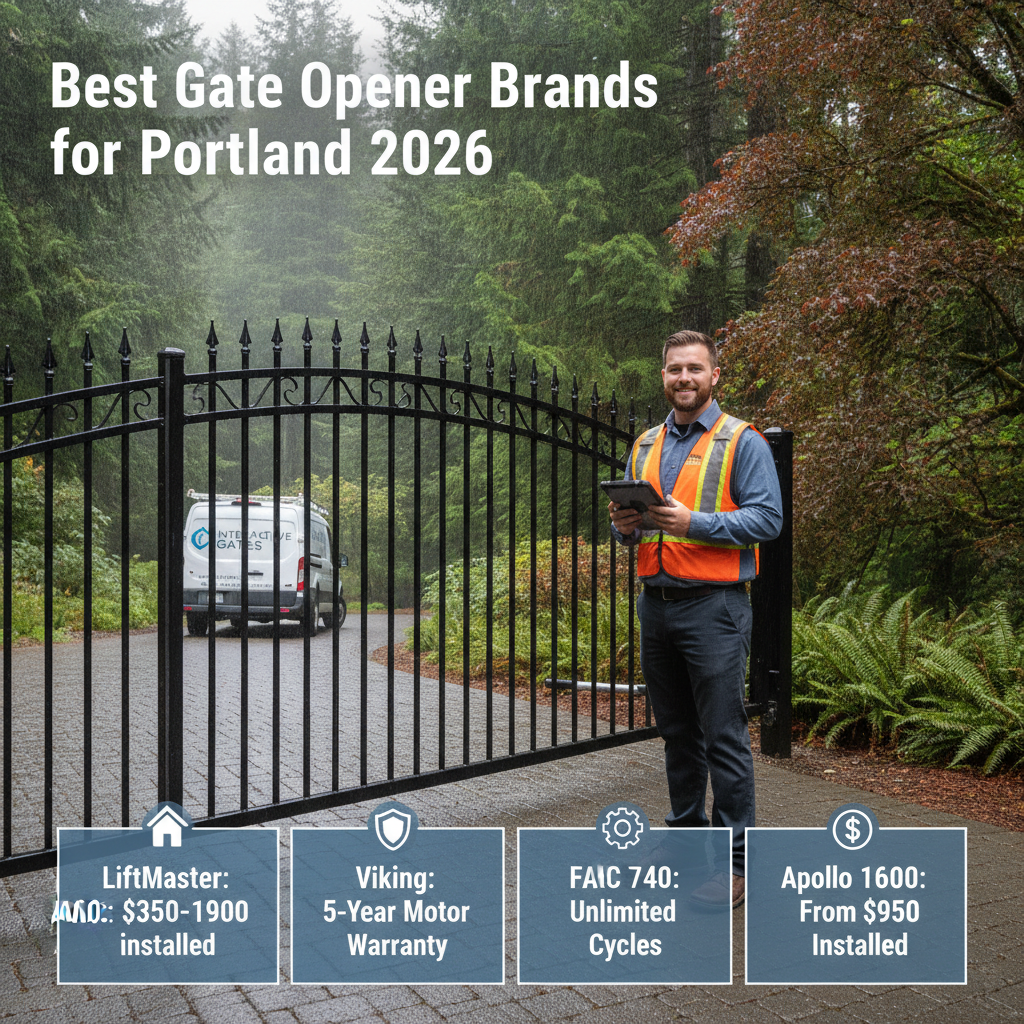
- LiftMaster 24V DC swing and slide operators dominate Portland residential installs in 2026, starting around $1,100–$1,600 installed.
- FAAC remains the top choice for heavy ornamental iron gates weighing 800–1,200 lbs, priced $1,800–$2,800 installed.
- Viking Access and Apollo are strong mid-range picks for standard residential and light-commercial gates, typically $950–$1,700 installed.
- Portland's wet climate demands sealed, IP55-rated or higher motor housings — most failures here are moisture-related, not mechanical.
- Cycle-count ratings matter in Portland HOAs: residential motors are rated 50–200 cycles/day; commercial-duty motors handle 500–1,000+ cycles/day.
- LiftMaster's myQ connectivity and FAAC's E124 Smart Board both offer cloud-based diagnostics that save a service call worth $150–$225.
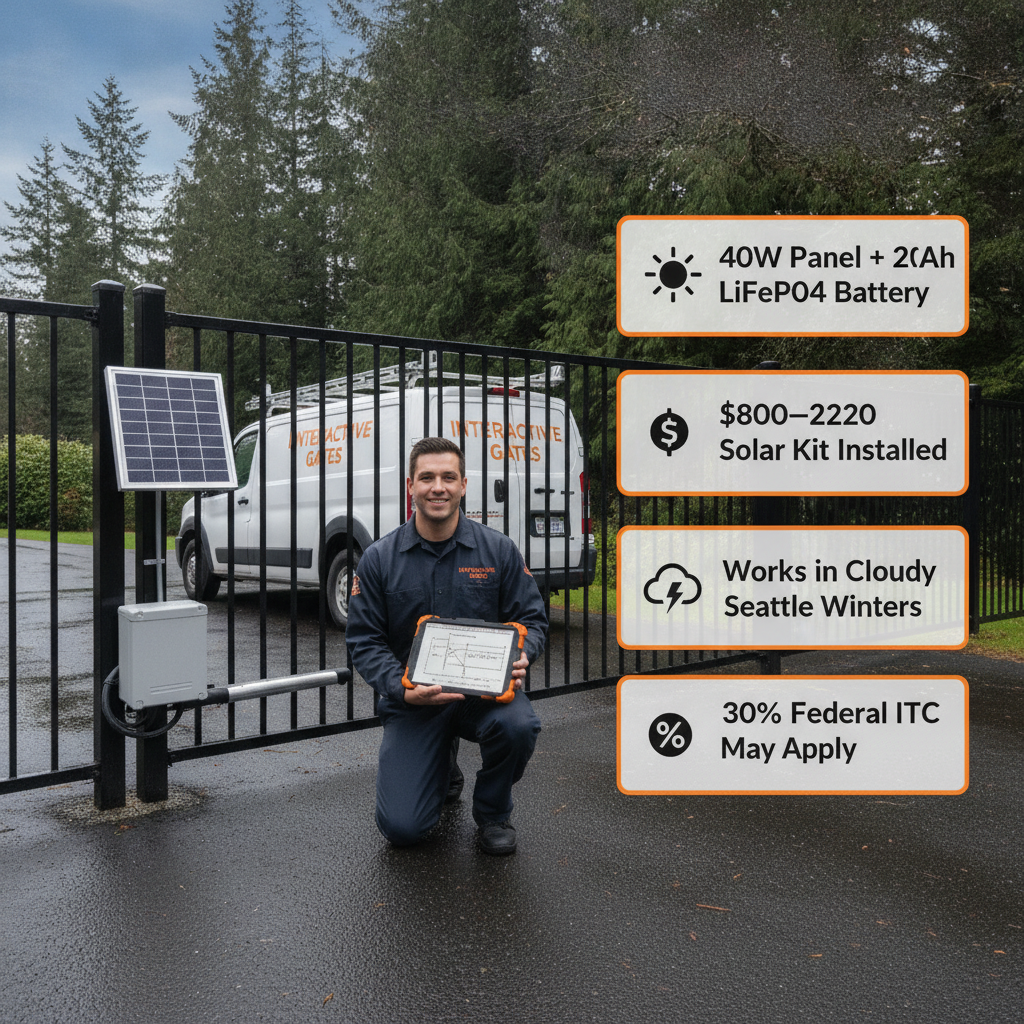
- Solar-ready operators from Viking and Apollo are increasingly popular in Portland's new eco-builds, offsetting grid draw with a 30W–80W panel add-on.
- Most Portland opener warranties run 2–5 years on parts; labor warranties through a certified dealer add another 1–2 years on workmanship.
What's the best automatic gate opener for a Portland home? Which brands hold up in the rain? Is LiftMaster worth the premium over Apollo? These are the questions Portland homeowners type into Google before making a $1,000-plus decision — and this guide gives you straight answers.
Portland's climate is unlike almost anywhere else in the Pacific Northwest. You get nine months of low-grade drizzle, occasional ice storms in the West Hills and Lake Oswego foothills, and humid summers that push seals and circuit boards to their limits. The opener brand that's 'good enough' in Phoenix or San Diego can fail within two seasons here. This breakdown is built for Portland specifically, with real 2026 pricing, local installer context, and honest comparisons across the four brands that dominate the market right now.
Why Does Gate Opener Brand Actually Matter in Portland?
A gate panel — whether it's custom wrought iron or a wood-framed swing gate — is only as reliable as the motor behind it. In Portland, moisture is enemy number one. Control boards corrode, capacitors swell, worm gears develop rust, and limit switches stick. The brands that have earned market share here have done so by engineering specifically for wet, temperate climates. Brands that cut corners on housing seals or use bare-PCB control boards tend to wash out (literally) within 24–36 months at Portland install sites.
The four brands we see most at Portland job sites in 2026: LiftMaster (Chamberlain Group), FAAC Group, Viking Access Systems, and Apollo Gate Operators. Each fills a different niche on the price-performance spectrum.
LiftMaster Gate Operators: Best All-Around for Portland Residential Gates in 2026
LiftMaster's LA400 and LA500 series swing gate operators have been workhorses in Portland for the better part of a decade, and the 2026 refresh adds 24V DC brushless motors that consume roughly 40% less power than earlier AC models. For a typical Lake Oswego driveway with a dual-leaf iron swing gate, expect an installed price of $1,350–$1,900 for the LA500UL pair, including mounting hardware and a two-year dealer labor warranty.
The RSW12U slide gate operator handles single gates up to 1,000 lbs and 40 feet of track — well suited for the longer flat driveways you find in Beaverton and Hillsboro subdivisions. Installed cost: $1,100–$1,600. Cycle rating: up to 300 cycles/day in commercial mode, 100/day in standard residential mode.
What sets LiftMaster apart in Portland is the myQ ecosystem: cloud-based diagnostics, smartphone open/close from anywhere, and real-time alerts if the gate reverses unexpectedly or a photobeam is blocked. For a household where both partners commute and no one is home to notice a stuck-open gate in a November rainstorm, this matters. The control boards are potted and sealed to IP44; the housings on the LA series are IP55. That's industry-standard for residential-grade outdoor use in a wet climate.
Pro Tip: Request LiftMaster's CSW200UL if your Portland property has a concrete-walled entry column — its compact swing-arm design clears tight column profiles that the bulkier LA400 can't fit into without expensive column modification.
FAAC Gate Operators: The Heavy-Iron Specialist for Portland's Steeper Properties
FAAC (Italian-engineered, assembled for the North American market) is the brand most Portland installers reach for when a gate is unusually heavy, unusually steep, or unusually demanding. The FAAC 391 and 740 series handle swing gates from 500 lbs up to 2,200 lbs per leaf, and the FAAC C720 slide operator handles gates up to 1,760 lbs on runs up to 24 meters.
For properties in the West Hills, Tualatin Hills, or the hilly corridors of SW Portland, where 12–18% driveway grades are common and a gate might weigh 900 lbs because of ornamental ironwork or stone-panel cladding, FAAC's hydraulic and electromechanical operators are in a different performance class than any U.S.-assembled brand. Installed pricing for a dual FAAC 391 setup: $1,800–$2,400. For the 740 series on a heavy estate gate: $2,400–$3,200.
FAAC's E124 Smart Board (standard on all 2025–2026 North American units) supports IoT connectivity, loop detector integration, and up to four access-control devices — keypads, intercoms, proximity readers — on a single board with no add-on relay boxes. That simplicity reduces wiring failure points, which matters in Portland's wet trenching environment.
Cycle rating on the FAAC 740 hydraulic: unlimited cycles — the hydraulic oil bath self-lubricates under continuous use. That's why you see it specified for gated communities in Oregon City and Gresham where community gates open and close 400–600 times daily.
Viking Access Systems: Best Mid-Range Value for Portland Residential & Light Commercial
Viking's V2000 swing operator and F-Series slide operators hit a sweet spot that a lot of Portland homeowners end up in: more durable than an entry-level opener, less expensive than FAAC. The V2000 handles swing gates up to 850 lbs per leaf and is rated 500 cycles/day — residential AND light-commercial duty from the same unit. Installed cost for a dual V2000 swing setup: $1,200–$1,700.
The Viking F5000 slide operator is a consistent performer on single-slide gates up to 1,500 lbs — common in Portland light-commercial and multi-family contexts. Installed: $1,300–$1,900. Viking boards use conformal-coated PCBs as standard on all 2024–2026 models, which is a step up from bare-board construction and a meaningful advantage in Portland's humidity.
Viking's five-year motor warranty is the best standard warranty of any brand in this comparison. The catch: Viking's dealer network in Portland is smaller than LiftMaster's, so parts availability for a board swap can be 3–5 business days versus same-day for LiftMaster. If minimizing downtime is a priority, factor that in.
Pro Tip: Viking's solar-ready F-Series and V-Series operators pair cleanly with a 40W panel and a 12V AGM battery backup — a popular combo on new eco-builds and ADUs in SE Portland neighborhoods where homeowners want zero gate-related grid draw.
Apollo Gate Operators: Best Entry-Level Pick for Simple Portland Driveways
Apollo's 1500 and 1600 series swing operators are the most affordable professional-grade option on this list — and 'professional-grade' is important here. Apollo is not a big-box store opener; it's a dedicated gate operator with a 100-cycle/day rating and a capacity of 500 lbs per leaf. Installed dual-swing cost: $950–$1,350.
Where Apollo makes sense in Portland: a newer construction home in Beaverton or Hillsboro with a lightweight aluminum driveway gate, a homeowner on a tighter budget, or a rental property where the priority is reliable basic function over smart-home features. The 1600 series added a built-in battery backup in 2024 — a welcome update for Portland's outage-prone winter storms.
Apollo's weaknesses are honest ones: no native app/cloud integration (third-party add-ons exist but add cost), and the 500-lb per-leaf limit disqualifies it for most ornamental iron gates. The two-year parts warranty is adequate but not impressive. As a starter system on a property where future upgrade is planned, Apollo gets the job done. As a long-term solution for a demanding install, you'll want to step up.
Side-by-Side Comparison: Which Brand for Which Portland Property?
To make this practical: a Lake Oswego estate with dual 800-lb iron swing gates on a sloped driveway → FAAC 740, $2,400–$3,000 installed. A Beaverton new-build with a 400-lb aluminum single-swing → LiftMaster LA400 or Apollo 1600, $900–$1,400 installed. A Hillsboro light-industrial property with a 1,200-lb slide gate → Viking F5000 or LiftMaster RSW12U, $1,300–$1,900 installed. A Portland HOA community gate doing 500 cycles/day → FAAC C720 or Viking F5000 in commercial mode, $1,800–$2,600 installed. See our HOA and commercial gate solutions page for community-gate specific guidance.
What Do Portland Installers Actually Recommend in 2026?
The honest installer answer is: brand matters less than matching the operator to the gate's actual weight, cycle demand, and site conditions. Every brand on this list has failed in Portland when misapplied — an Apollo on a 700-lb gate, a LiftMaster LA400 on a 15% grade without a manual release, a FAAC board left unsealed in a non-weatherproof column. The spec has to match the install.
That said, for pure reliability across Portland's full range of residential installs, most experienced local technicians lean LiftMaster for straightforward residential, FAAC for heavy or high-cycle applications, Viking when budget and cycle-count meet in the middle, and Apollo for simple, lightweight, cost-sensitive projects. Browse completed Portland-area gate projects in our project portfolio to see how these systems look in the field.
In One Minute: Portland Gate Opener Brand Recap
LiftMaster: Best all-around residential choice. myQ smart connectivity, IP55 housing, $1,100–$1,900 installed, 2-year dealer warranty. FAAC: Heavy iron gates and steep Portland driveways. Hydraulic models rated unlimited cycles, $1,800–$3,200 installed. Viking: Best mid-range durability, 5-year motor warranty, conformal-coated boards, $1,200–$1,900 installed. Apollo: Best entry-level for lightweight gates, built-in battery backup, $950–$1,350 installed. Moisture is Portland's main gate-killer — choose a housing rated IP44 minimum, IP55 preferred, on every install.
Frequently Asked Questions: Automatic Gate Openers in Portland
Which automatic gate opener brand is best for Portland's rainy climate?
LiftMaster and FAAC lead the field for weather resistance in Portland. LiftMaster's LA and RSW housings are IP55-rated, and FAAC's hydraulic models use an oil-bath mechanism that's inherently moisture-resistant. Viking's conformal-coated PCBs are also a strong choice. Apollo is adequate for covered or semi-protected installs but should be paired with a weatherproof enclosure on fully exposed columns in Portland's westside foothills.
How much does it cost to install an automatic gate opener in Portland in 2026?
Residential gate opener installation in Portland in 2026 ranges from $950 to $3,200 installed, depending on brand, gate type, gate weight, and access-control add-ons. Entry-level Apollo single-swing installs start near $950–$1,100. LiftMaster dual-swing installs run $1,350–$1,900. FAAC heavy-gate installs run $1,800–$3,200. Viking mid-range installs fall between $1,200 and $1,900. These figures include operator hardware, mounting, wiring, and basic safety-device integration.
How long do gate opener motors last in Portland?
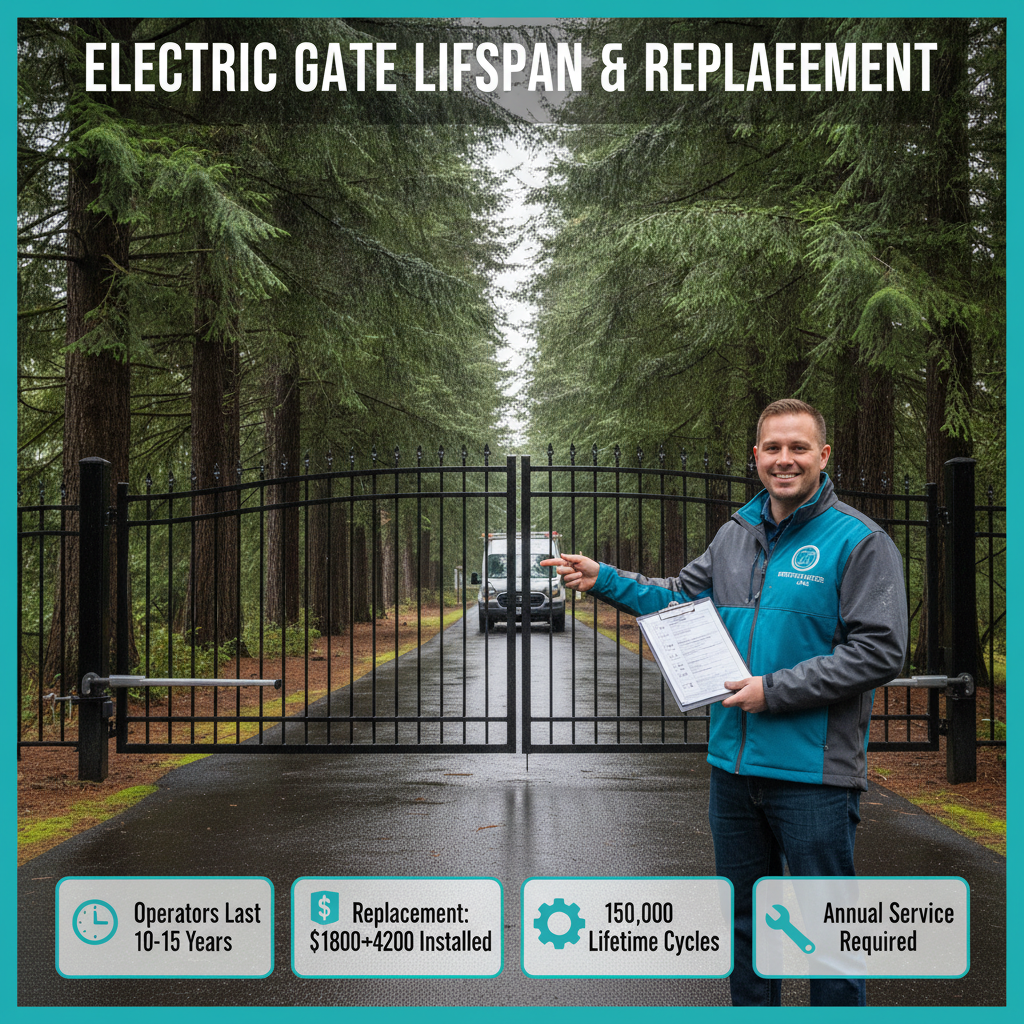
Most residential gate opener motors last 8–15 years in Portland with annual maintenance. FAAC hydraulic operators often exceed 15 years. Moisture-related failures (corroded boards, swollen capacitors) are the leading cause of early failure and are preventable with proper housing selection and annual servicing. LiftMaster and Viking both offer remote diagnostics that can flag a failing capacitor before it becomes a dead gate.
Can I add smart home integration to a Portland gate opener?
Yes. LiftMaster's myQ platform works natively with Google Home, Amazon Alexa, and Apple HomeKit via a $49–$79 myQ Home Bridge. FAAC's E124 Smart Board supports third-party integrations via Wiegand and RS-485 outputs. Viking operators can be paired with Z-Wave or Zigbee bridges from third-party vendors. Apollo requires a third-party relay module for smart-home integration — functional but less seamless.
What is the best gate opener for a steep driveway in Portland or Lake Oswego?
For driveways with grades above 10%, FAAC's hydraulic series (391 or 740) is the top recommendation. Hydraulic operators maintain consistent torque across the full arc of a gate's swing regardless of gravity load, which electromechanical operators can struggle with on steep grades. LiftMaster's LA500UL with a properly tensioned counterbalance arm is an acceptable alternative on grades up to 15% for gates under 500 lbs per leaf.
How do I choose between a swing gate operator and a slide gate operator for my Portland home?
The choice is mostly determined by your driveway geometry. Swing gates require 10–14 feet of clearance behind the gate leaf to open fully — common in residential settings but impossible on driveways where a vehicle parks close to the gate. Slide gates require a flat, level track run equal to 1.1–1.2 times the gate width alongside the driveway — common in Portland's flatter east-side neighborhoods. On sloped or constrained driveways, a cantilever slide gate (no ground track) is often the cleanest solution and is supported by both LiftMaster and Viking slide operators.
Ready to Choose the Right Gate Opener for Your Portland Property?
Picking the right brand is step one — getting it installed correctly for Portland's specific conditions is step two. If you'd like a professional opinion on which operator fits your gate weight, driveway grade, and budget, reach out to our Portland team for a no-pressure site assessment. You can also explore gate styles and see how different systems look on properties similar to yours using our free interactive gate designer. There's no obligation — just better information before you commit.