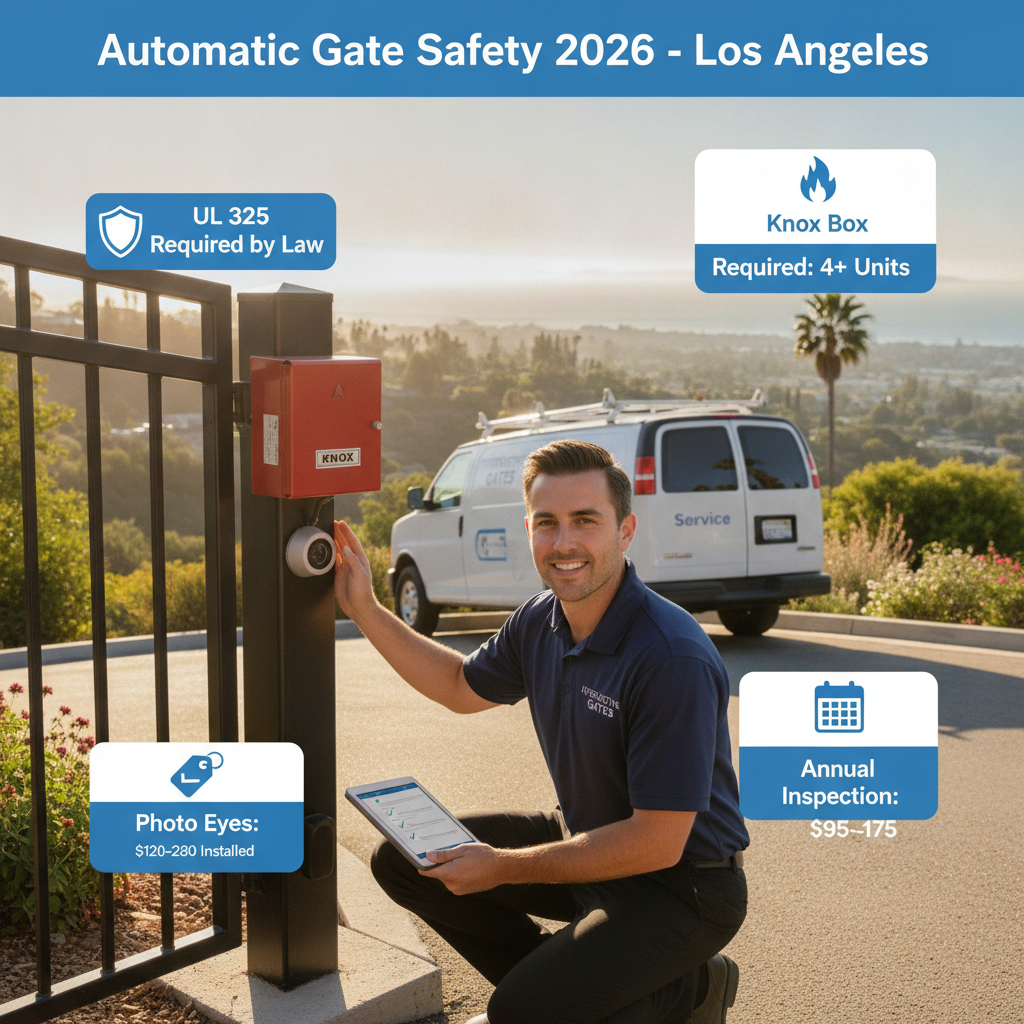
- UL 325 compliance is mandatory for every new automatic gate installation in Los Angeles County and all incorporated cities.
- Entrapment protection devices — at minimum one, but code recommends two — must be installed and tested at commissioning.
- Photo-eye sensors cost $120–$280 installed and are the single most common safety add-on specified by LA inspectors.
- Edge sensors on swing gates add $180–$350 and dramatically reduce crush-injury liability for HOAs and commercial properties.
- NEMA 4X-rated control boards handle Southern California coastal salt air better than standard NEMA 1 boxes — critical within 1 mile of the coast.
- Residential solar-powered gates must still meet UL 325 even when grid power is absent — a detail many installers overlook.
- LA County fire-access rules require gates on emergency-vehicle routes to accept Knox Box overrides or hold-open signals from Fire Station dispatch systems.
- Annual safety inspections run $95–$175 and are strongly recommended by the California Building Code commentary for Class I–IV gate operators.
What Safety Features Does an Automatic Gate Actually Need in Los Angeles in 2026?
You're searching 'do I need photo eyes on my driveway gate Los Angeles,' or maybe 'automatic gate safety code LA 2026,' or even 'what happens if my HOA gate hits someone.' These are exactly the right questions to ask before you spend $4,000–$18,000 on a new gate system — or before you find out the hard way that your ten-year-old opener is out of compliance. Los Angeles has its own overlay of requirements on top of the national UL 325 standard, and the stakes are higher here than in most U.S. cities: dense population, active HOA communities, coastal environments, steep hillside driveways, and a litigation culture that makes safety documentation more than a paperwork exercise. This guide breaks down what the law requires, what industry best practice recommends, and what you can skip.
What Does UL 325 Actually Require for Automatic Gates in Los Angeles?
UL 325 is the Underwriters Laboratories standard that governs residential and commercial gate operators across the United States. In Los Angeles, it is enforced through the California Electrical Code (CEC), which adopts it by reference, and through local permit processes administered by LADBS (Los Angeles Department of Building and Safety) or county DPW for unincorporated areas. Any gate operator installed after January 1, 1993 must comply, and any replacement operator installed today on an existing gate must also comply — there is no grandfather clause for the opener itself.
Under UL 325, automatic gate operators are classified by application: Class I (residential, 1–4 family), Class II (commercial/general access), Class III (industrial), and Class IV (restricted access). Most homeowners and HOAs in Bel Air, Rolling Hills, Laguna Beach, and San Clemente fall under Class I or Class II. Each class requires:
- A minimum of one entrapment-protection device (EPD) on the operator itself — either a non-contact sensor, a contact sensor, or an inherent-force-limiting system.
- An automatic-stop function when the gate meets resistance exceeding specified force limits (typically 40 lbs of dynamic force, 130 lbs of static force for Class I).
- A clearly labeled manual-release mechanism accessible from outside during a power failure.
- A warning placard affixed to the gate listing hazard zones and emergency procedures.
- Wiring and control panels meeting CEC Chapter 3 ampacity and GFCI requirements.
What UL 325 does NOT specify is how many entrapment-protection devices you need beyond the minimum one. That is where California best practice, local AHJ (Authority Having Jurisdiction) interpretation, and your insurance carrier's requirements can push you to two or even three devices.
Pro Tip: LADBS plan-checkers routinely require two independent EPDs on any gate that crosses a pedestrian path — even if it is technically a vehicle gate. If your driveway gate is also used by people walking to your front door, budget for dual sensors from day one.
What Are the Required vs. Optional Safety Devices for LA Gates in 2026?
Let's separate 'required by code' from 'required by best practice' from 'nice to have.'
Required
- At least one entrapment-protection device — photo eyes, edge sensors, or a loop detector with inherent-force limiting. Not optional. Period.
- Automatic operator cutoff when the gate detects an obstruction exceeding force limits.
- Manual-release mechanism — a keyed release or T-handle accessible from outside, clearly labeled.
- Warning placards in English (and in California, Spanish is strongly recommended for commercial sites) per UL 325 Section 42.
- Knox Box or fire-department override for any gate on a fire-access road or serving four or more dwelling units — required by LAFD guideline and California Fire Code Section 503.6.
Strongly Recommended / Often Required by HOA Bylaws or Insurance
- Secondary photo-eye or edge sensor — adds redundancy and is required by many HOA master policies.
- Audible and visual alarm during gate travel — a $45–$110 add-on that dramatically reduces pedestrian strikes.
- Vehicle-detection loop or ground loop sensor — prevents the gate from closing on a car that is still in the opening; required by some LA County commercial permits.
- Anti-tailgate barrier or secondary swing arm — common in gated communities in Rolling Hills and Palos Verdes Estates.
Optional / Value-Added
- Intercom and video access-control integration (Ring, Doorbird, Linear, 2N) — $350–$1,800 installed.
- License-plate recognition (LPR) cameras — popular in luxury properties around Laguna Beach and San Clemente.
- Battery backup on the operator — $180–$420 installed, especially important in areas with rolling blackouts.
- Solar charging panels on remote or rural gate sites.
How Does Southern California's Climate Affect Gate Safety Hardware?
This is the question most national guides completely ignore. Los Angeles is not one climate — it's five. The marine layer in Santa Monica and coastal Orange County generates persistent salt air that corrodes standard NEMA 1 or NEMA 3R enclosures within 3–5 years, causing control boards to fail in ways that bypass safety circuits. Inland areas like the San Fernando Valley and Riverside-adjacent communities see heat spikes above 105°F that degrade photo-eye lens coatings and can cause false-trigger loops in low-end sensors.
- Coastal (within 1 mile of ocean): Specify NEMA 4X (fiberglass or 316 stainless) control enclosures. LiftMaster's CSL24U and FAAC's 844 series come in stainless configurations. Add UV-stabilized conduit and stainless hardware throughout. Budget an extra $300–$600 on materials vs. a standard inland install.
- Inland valley / high-heat zones: Shade the control board where possible. Use Class 2 wiring rated to 90°C. Viking Access and FAAC both publish high-temperature derating specs — ask your installer for them.
- Hillside / wildfire-interface zones: Gates in Topanga Canyon, Malibu, or the foothills above Pasadena may be subject to LA County's Fuel Modification Plan requirements. Fire-safe gate designs sometimes require non-combustible infill panels and a hold-open feature wired to a local smoke/heat detector.
- Earthquake considerations: A swing gate on a hillside driveway should be anchored with post bases rated for Seismic Design Category D (LA is SDC D). Operators with internal slip-clutch mechanisms (FAAC 402 series, LiftMaster LA500) handle post-shift misalignment better than rigid-drive units.
Pro Tip: After the 2024 and early 2025 wind events in the hills above Los Angeles, we saw a spike in gates whose safety sensors had been knocked out of alignment, turning the gate into an unpowered obstacle during evacuation. A spring-loaded mounting bracket for your photo eyes — about $35 extra per pair — lets a first responder kick the sensor bracket aside without tools.
What Are the Real Costs of Gate Safety Devices in Los Angeles in 2026?
Prices below reflect installed costs (parts + labor) for a standard residential single-swing or slide gate in the greater LA area. Labor rates here run $95–$130/hour, higher than Portland or Seattle.
- Photo-eye sensor pair (standard, e.g., FAAC XP20 or LiftMaster 41A5034): $120–$185 installed.
- Photo-eye pair (NEMA 4X coastal-rated): $210–$280 installed.
- Edge sensor (contact strip, one leading edge): $180–$260 installed.
- Edge sensor (both leading and trailing edges, swing gate): $310–$450 installed.
- Vehicle detection loop (single loop, cut into existing asphalt): $280–$420 installed.
- Audible alarm / flashing warning light combo: $55–$110 installed.
- Battery backup module (LiftMaster 485LM or FAAC equivalent): $185–$390 installed.
- Knox Box (LAFD-approved, Model 3200 series) with wiring to gate controller: $320–$520 installed.
- Annual safety inspection and sensor re-calibration: $95–$175.
For a full code-compliant residential install with dual EPDs, vehicle loop, battery backup, and Knox Box, budget $900–$1,600 in safety hardware on top of the gate and operator cost. For an HOA or commercial property requiring full UL 325 Class II compliance with LPR cameras and anti-tailgate barriers, safety hardware alone can run $2,500–$6,000.
What Do HOA and Commercial Properties in LA Need Beyond Residential Code?
HOA gates in communities like those in Rolling Hills or Orange are almost always Class II operators, which triggers more stringent requirements. Beyond the residential checklist above, Class II sites typically need:
- A minimum of two independent EPDs (non-contact sensors on the open side, contact/edge sensors on the close side is the gold-standard configuration).
- A monitored access-control system with an audit trail — important for liability documentation. Linear, Brivo, and DoorKing systems are common choices in LA HOA communities.
- Emergency-vehicle pre-emption (EVP) where the gate serves 10+ units — required under California Vehicle Code 21101.6 interpretation by LAFD.
- Monthly operational testing documented and kept on file per LAFD Fire Prevention Bureau guidance.
- ADA-compliant call-box height (15–48 inches above finish grade to the operable controls) if the gate serves any publicly accessible area.
Visit our commercial and HOA gate page for a deeper breakdown of what LA-area communities typically spend and specify.
In One Minute: Los Angeles Automatic Gate Safety in 2026
- UL 325 is the law. Every new or replaced operator must comply — no exceptions, no grandfathering.
- You need at least one entrapment-protection device; two is the practical standard for any LA pedestrian-accessible gate.
- Coastal properties need NEMA 4X enclosures — standard boxes corrode within 3–5 years near the ocean.
- Knox Box / LAFD override is required for gates serving 4+ units or on fire-access roads.
- Safety hardware for a full residential setup adds $900–$1,600 to your project; HOA/commercial sites add $2,500–$6,000.
- Annual inspection ($95–$175) is your cheapest liability-management tool.
- Get everything documented — LA's litigation environment makes a paper trail worth more than the inspection itself.
Curious what a code-compliant gate would look like on your specific property? Browse real installed examples in our project portfolio or design your own with our gate visualizer tool.
Frequently Asked Questions: Automatic Gate Safety in Los Angeles
Is a photo-eye sensor required by law on every automatic gate in Los Angeles?
Yes, under UL 325 (adopted by the California Electrical Code), every automatic gate operator must have at least one entrapment-protection device. Photo eyes are the most common choice, but edge sensors or inherent-force-limiting systems also satisfy the requirement. LADBS inspectors will flag a missing EPD and require correction before approving a permit final.
Do solar-powered automatic gates still need to meet UL 325 safety requirements?
Absolutely. UL 325 applies to the operator regardless of its power source. A solar-powered gate that lacks entrapment protection is just as non-compliant as a grid-powered one. The inverter and battery storage system must also meet NEC and CEC requirements for the applicable equipment class.
How often should I test the safety sensors on my LA-area gate?
Industry best practice and the UL 325 standard recommend testing all entrapment-protection devices monthly. For HOA and commercial gates, documented monthly testing is strongly recommended by the LAFD Fire Prevention Bureau. A simple wave-through test with a 2x4 board costs nothing and confirms the system is working. Annual professional inspection ($95–$175) adds calibration and documentation.
What is a Knox Box and does my gate in Los Angeles need one?
A Knox Box is a high-security key vault installed near a gate or door that allows the Los Angeles Fire Department to access a property without forced entry. Under California Fire Code Section 503.6 and LAFD local amendments, any gate on a designated fire-access road or serving four or more dwelling units must provide an approved override. The Knox Box Model 3200 series with gate-controller wiring runs $320–$520 installed. Your AHJ (LADBS or county DPW) will confirm whether your specific address triggers the requirement.
Can I add safety sensors to my existing older gate opener, or do I need a new one?
Many operators manufactured after 2000 have auxiliary input terminals that accept add-on photo eyes or edge sensors. LiftMaster, FAAC, and Viking Access all sell retrofit sensor kits for their existing product lines. However, if your operator predates 1993 or lacks an inherent-force-limiting mechanism, adding sensors alone may not bring it into UL 325 compliance — a new operator may be the only path to full compliance. A service technician can evaluate your specific unit in about 30 minutes.
What are the liability risks for an LA homeowner or HOA if the gate safety features fail?
California premises-liability law (Civil Code 1714) holds property owners responsible for injuries caused by unsafe conditions they knew or should have known about. A gate that strikes a person because the photo-eye was misaligned or broken creates a direct negligence claim. In Los Angeles County, settlements for gate-strike injuries have ranged from $45,000 to over $400,000 depending on severity. Documented regular inspections and prompt sensor repairs are your strongest legal defense — and your insurer will likely ask for them at renewal.
Ready to Make Sure Your Gate Is Fully Up to Code?
Whether you are a homeowner in the hills above LA, a property manager in Orange County, or an HOA board in San Clemente, getting your gate safety features right in 2026 is not optional — and it's not as complicated or expensive as it sounds when you work with someone who knows the local requirements. Our team at Interactive Gates installs and services code-compliant gate systems throughout Los Angeles and Southern California. When you are ready to talk specifics, our contact page is the easiest place to start.