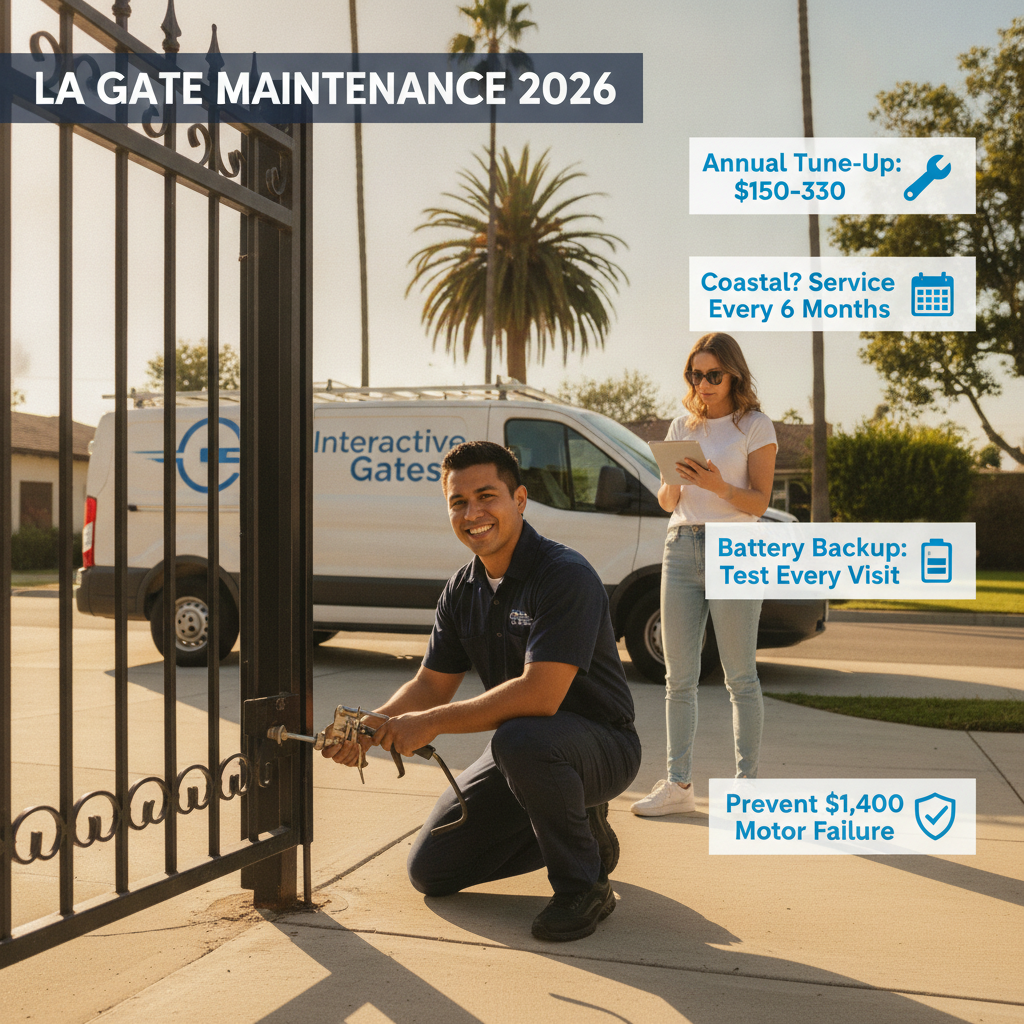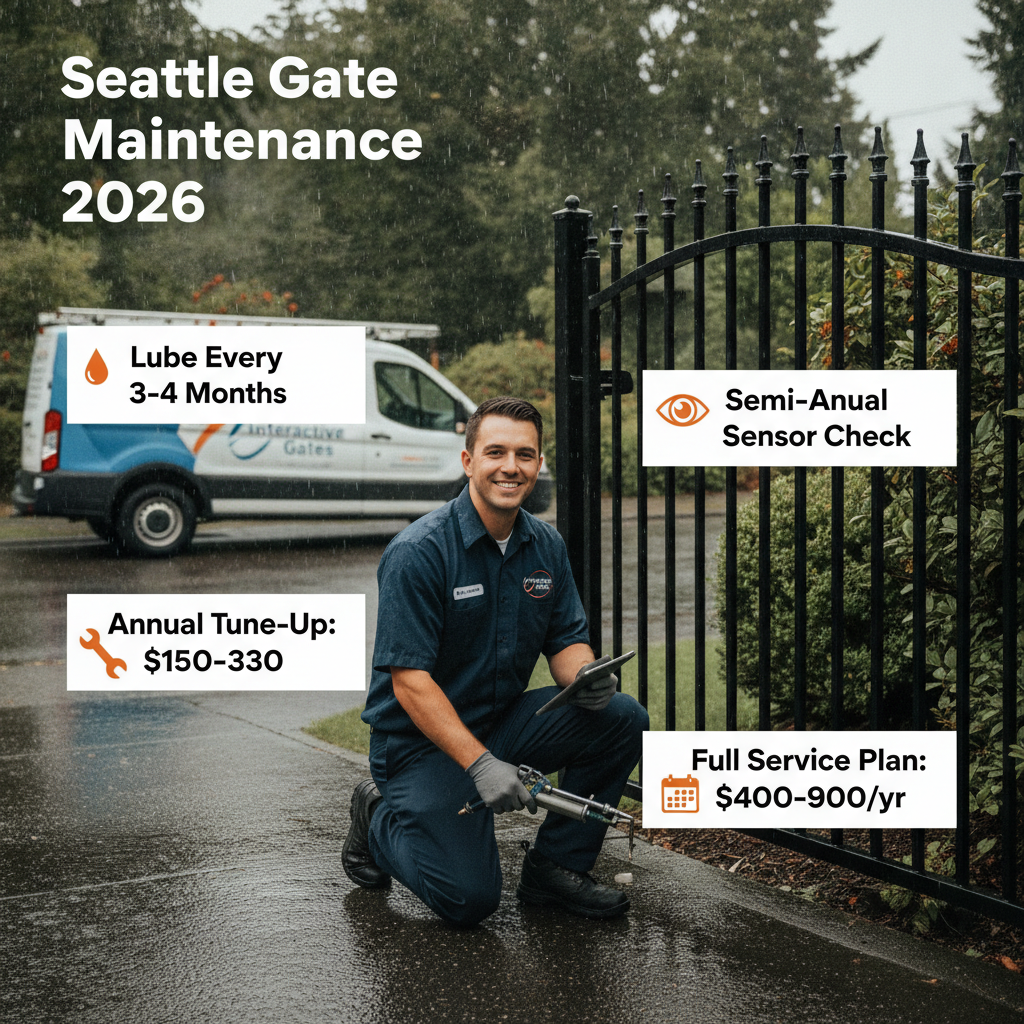
- Annual professional tune-ups in Seattle run $150–$350 depending on gate type and operator brand.
- Seattle's wet climate demands lubrication every 3–4 months — roughly twice as often as drier climates — to fight rust and corrosion.
- Swing gate hinges are the most neglected wear point locally; seized hinges account for about 40% of Seattle repair calls.
- LiftMaster, FAAC, and Viking operators each have manufacturer-recommended service intervals between 10,000 and 25,000 cycles.
- DIY maintenance kits (lithium grease, silicone spray, chain lube) cost $30–$60 and can extend service life by 2–3 years.
- Safety-sensor testing should happen every 6 months; misaligned sensors are the #1 cause of gate reversal failures in rainy conditions.
- Budget $400–$900 per year for a full-service maintenance plan covering labor, parts, and priority dispatch in the Seattle metro.
- Neglected gates fail 3–5 years earlier than maintained ones — a $500/year habit that protects a $6,000–$18,000 investment.
Why Does My Automatic Gate Need Special Maintenance in Seattle?
If you've ever Googled 'why does my electric gate keep stopping in the rain' or 'how often should I service my automatic gate in Seattle,' you already know the Pacific Northwest is uniquely hard on gate hardware. Seattle averages 38 inches of rain per year, with persistent drizzle from October through April that penetrates every unsealed joint, corrodes bare metal, and washes lubricant off moving parts faster than almost any other major U.S. market. Add in salt air along the Puget Sound corridor — from West Seattle and Magnolia down to Tacoma and Gig Harbor — and you have a recipe for accelerated wear. This guide gives Seattle homeowners, property managers, and HOA boards a complete 2026 maintenance roadmap: what to service, how often, and exactly what it will cost.
What Parts of an Automatic Gate System Need Regular Maintenance?
A fully automated gate is actually five or six subsystems working together. Miss one, and the whole thing fails. Here's what a proper maintenance visit covers:
- Gate operator / motor unit: Internal lubrication of gear assemblies, inspection of motor brushes (on DC units), firmware check, and torque calibration. Brands like FAAC and LiftMaster have sealed gear boxes that still require periodic internal grease replacement every 2–3 years.
- Drive mechanism: Chain, belt, rack-and-pinion, or hydraulic ram — each has its own lube spec. Rack-and-pinion systems (common on Viking slide gates) need food-grade or lithium-based grease every 3 months in Seattle's wet season. Chains need dedicated chain lubricant, not WD-40.
- Hinges and pivot points (swing gates): Heavy-duty butt hinges and adjustable pivots corrode quickly in Seattle's damp air. They need grease injection every 3–4 months and visual inspection for hairline cracks annually.
- Safety edges and photo-eye sensors: Rain and spider webs are the two biggest enemies of photo-eye sensors. Seattle technicians frequently find sensor lenses fogged or misaligned after a wet winter. Test monthly; clean and realign every 6 months.
- Control board and wiring: Moisture infiltrates conduit seals over time. Annual inspection of the control box, terminal connections, and weatherproofing is essential in any coastal or high-rainfall market.
- Access control hardware: Keypads, intercoms, card readers, and loop detectors all need annual cleaning and functional testing. Loop detectors embedded in asphalt driveways in neighborhoods like Bellevue and Kirkland can delaminate from freeze-thaw cycles.
- Gate structure itself: Touch up paint and primer on bare steel; inspect weld seams on ornamental iron; check aluminum for oxidation blistering.
How Often Should You Service an Automatic Gate in Seattle?
Seattle's climate compresses the standard maintenance calendar. Here's a practical 2026 schedule for local homeowners:
- Monthly (DIY, 10 minutes): Visually inspect the gate for debris on the track or in the operator cabinet. Test open/close cycle with remote and keypad. Wave a hand through the photo-eye beam to confirm auto-reverse. Check for rust spots on hinges.
- Every 3–4 months (DIY or pro): Lubricate hinges, rack, chain or belt, and all pivot points. Wipe photo-eye lenses. Clear leaves and grit from slide gate track. Apply silicone spray to rubber seals on the operator cabinet.
- Every 6 months (professional strongly recommended): Full safety-system test, sensor alignment, torque setting verification, control board inspection, and access-control functional test. This is the minimum viable professional interval for Seattle's climate.
- Annually (professional — the comprehensive tune-up): All of the above, plus internal operator lubrication, electrical connection tightening, firmware updates (LiftMaster myQ, FAAC 746, Viking operators all push updates), structural weld inspection, and a written condition report. Budget $150–$350 for a residential annual tune-up, $300–$600 for a commercial or HOA gate with high-cycle usage.
Pro Tip: Schedule your annual professional tune-up in September or early October — right before Seattle's rainy season ramps up. A well-lubricated, properly sealed gate entering winter will outperform one serviced in the spring by a significant margin. Most technicians have more availability in fall than in the spring 'break-fix' rush.
How Much Does Gate Maintenance Cost in Seattle in 2026?
Here are real 2026 price ranges for the Seattle metro, from DIY supplies to full-service contracts:
- DIY maintenance kit: $30–$60. Includes lithium grease cartridge, silicone spray, chain lube, microfiber cloths, and a sensor-cleaning solution. Buy once, use for a year.
- Single professional tune-up visit (residential): $150–$350. Covers a 1–2 hour comprehensive service call. Prices trend higher in Snohomish, Everett, and outer-ring suburbs due to drive time.
- Semi-annual service plan (two visits/year): $280–$550 bundled. Most Seattle-area gate companies offer a discount of 10–20% when you pre-purchase two visits.
- Annual full-service maintenance contract: $400–$900 for residential gates. Includes 2 professional visits, priority dispatch, discounted parts, and a written condition report. HOA and commercial gates with 50+ daily cycles run $900–$2,400/year.
- Parts replaced during maintenance: Limit switches $25–$60 each; safety edge strips $80–$180; photo-eye sensor pairs $60–$140; control boards $200–$600 depending on brand (LiftMaster boards tend to be more affordable than FAAC at the residential tier).
- Emergency callout (no maintenance contract): $175–$350 service fee plus parts — a compelling argument for the annual plan.
What Happens If You Skip Gate Maintenance in Seattle?
The cost of neglect compounds quickly in a wet climate. Here's what Seattle technicians see most often on gates that missed their service windows:
- Seized hinges on swing gates: A hinge that hasn't been greased through a Seattle winter can seize solid, stripping the operator gearbox when the motor tries to force it open. Gearbox replacement alone costs $350–$700, versus $5 of grease applied quarterly.
- Corroded rack teeth: On slide gates, a corroded rack-and-pinion causes the drive pinion to skip, creating jerky movement and eventually stripping the pinion gear. Rack replacement runs $200–$500 in labor and parts.
- Control board water damage: A cracked or improperly sealed operator cabinet lets condensation reach the control board. Board replacement is $200–$600 and is almost always avoidable with annual cabinet inspection and weatherstrip replacement.
- Photo-eye failure: A gate that won't detect obstructions is a liability. In Washington State, residential automatic gates are required to have functional entrapment protection under UL 325 standards. A failed safety system can void your homeowner's insurance coverage for gate-related incidents.
- Premature motor burnout: An operator working against seized hinges or a corroded rack draws 2–3x its normal current load. LiftMaster RSL12U and FAAC 400 operators rated for 10–12 years routinely fail in 5–6 years on poorly maintained Seattle-area gates.
Pro Tip: Keep a simple maintenance log — a notes app entry or a paper card taped inside the operator cabinet — recording each lube date, service visit, and any unusual sounds or behaviors. Technicians can diagnose problems 30–40% faster when they have a service history, which saves you money on diagnostic time billed at $95–$150/hour.
Which Gate Types Need the Most Maintenance in Seattle's Climate?
- Ornamental iron swing gates: Highest maintenance demand. Bare steel welds and surface scratches rust within one Seattle winter without annual touch-up painting and quarterly hinge lubrication. Budget $200–$400/year in professional upkeep.
- Aluminum swing or slide gates: Lower maintenance than iron but not zero. Aluminum oxidizes into a white chalky film that etches into the surface if not cleaned annually. Hinges still need quarterly grease. Budget $100–$200/year.
- Vinyl or PVC gates: Least corrosion-prone but UV and freeze-thaw cycling crack panels over time. Annual inspection of post inserts and hinge mounts is sufficient. Budget $80–$150/year in professional time.
- Slide gates on exposed tracks: Track-collection of debris (leaves, pine needles, gravel) is a Seattle-specific problem. Monthly track cleaning is non-negotiable. Budget $150–$300/year for professional service.
DIY vs. Professional Gate Maintenance in Seattle: What Can You Do Yourself?
Most homeowners can handle the monthly visual check and the quarterly lubrication routine safely. Use a lithium-based grease (Superlube 21030 or Lucas Red-N-Tacky are popular with Seattle techs) for hinges and racks, and a dedicated chain lubricant for chain-drive operators — never petroleum-based WD-40 on chains, as it strips existing lube and attracts grit. Sensor cleaning with a lint-free cloth and isopropyl alcohol is also a safe DIY task.
Leave electrical work, torque calibration, control board diagnostics, and safety-edge compliance testing to licensed professionals. In Washington State, gate operators connected to household electrical circuits must be installed and serviced by an electrician or a licensed low-voltage contractor. Improper wiring is both a safety hazard and an insurance issue. Browse the portfolio of completed Seattle-area installations to see the quality benchmark that proper professional installation and maintenance produces.
In One Minute: Seattle Gate Maintenance 2026 Recap
- Lubricate all moving parts every 3–4 months — Seattle's rain washes grease away faster than in dry climates.
- Test photo-eye sensors monthly; have them professionally aligned every 6 months.
- Book one professional tune-up per year minimum; twice per year for high-use or HOA gates.
- Annual residential tune-ups cost $150–$350; full-service contracts run $400–$900/year.
- Neglect costs 3–5 years of gate lifespan and can void UL 325 safety compliance.
- Ornamental iron gates need the most attention; aluminum and vinyl need the least.
- A simple maintenance log saves money on every future service call.
Frequently Asked Questions About Gate Maintenance in Seattle
How much does a gate maintenance visit cost in Seattle in 2026?
A single professional residential maintenance visit in the Seattle metro runs $150–$350 in 2026, depending on gate size, operator brand, and whether any parts need replacement. Semi-annual bundled plans reduce the per-visit cost by 10–20%, and annual contracts covering two visits plus priority dispatch typically run $400–$900 for residential gates. High-cycle commercial and HOA gates cost more — typically $900–$2,400/year under a full-service agreement.
How often should I lubricate my automatic gate in Seattle?
Every 3–4 months — roughly quarterly — is the right interval for Seattle's wet climate. This is roughly twice as frequent as the 6-month interval recommended in drier markets like Southern California. Focus on hinges, rack teeth or chain, roller bearings on slide gates, and all pivot points. Use lithium-based grease or dedicated chain lubricant; avoid WD-40 on metal-to-metal contact surfaces.
What are the most common gate maintenance problems in Seattle?
The top five issues Seattle technicians encounter are: (1) seized or corroded hinges on swing gates, (2) debris-blocked slide gate tracks from fall leaf accumulation, (3) fogged or misaligned photo-eye sensors from rain and condensation, (4) water-damaged control boards from cracked operator cabinet seals, and (5) corroded rack teeth on rack-and-pinion slide gate drives. All five are largely preventable with a consistent quarterly DIY routine and an annual professional tune-up.
Is gate maintenance required by law in Washington State?
Washington State does not mandate a specific maintenance schedule for residential automatic gates by statute, but it does require that automatic gate operators meet UL 325 entrapment-protection standards — which means safety sensors must be functional at all times. A gate with failed photo-eye sensors or a non-functional safety edge is technically out of compliance, which can affect your liability coverage under homeowner's insurance. Many HOA communities in Seattle also include gate maintenance obligations in their CC&Rs.
Can I maintain my automatic gate myself, or do I need a professional?
Most homeowners can safely perform monthly visual inspections, quarterly lubrication, photo-eye cleaning, and track debris removal. These DIY tasks require no special tools beyond a grease gun or spray lubricant and a lint-free cloth. However, electrical diagnostics, torque and limit-switch calibration, control board servicing, and safety-edge compliance testing should be handled by a licensed professional. Attempting electrical work without proper licensing can void your operator warranty and create insurance issues in Washington State.
Does Seattle's salt air affect gate maintenance needs near the water?
Yes, significantly. Properties within about 1–2 miles of Puget Sound — including neighborhoods in West Seattle, Magnolia, and communities along the water in Gig Harbor and Tacoma — experience measurably faster corrosion on bare steel and uncoated aluminum than inland properties. For waterfront or near-water homes, increase lubrication frequency to every 2–3 months, use marine-grade corrosion inhibitor (Boeshield T-9 is a favorite among local technicians), and inspect weld seams and paint integrity every 6 months rather than annually.
Ready to Get Your Seattle Gate on a Maintenance Schedule?
A well-maintained automatic gate is a quiet, reliable part of your home's security and curb appeal — one that you only really notice when it stops working. If your gate is overdue for service, or you'd like to set up a recurring maintenance plan before Seattle's rainy season arrives, the team at Interactive Gates serves homeowners and property managers across the entire Seattle metro, from Seattle and Bellevue to Lynnwood and beyond. You can also explore gate styles and configurations using the Interactive Gates design tool or reach out directly to discuss a maintenance plan tailored to your gate type and usage level — no pressure, just honest local expertise.