
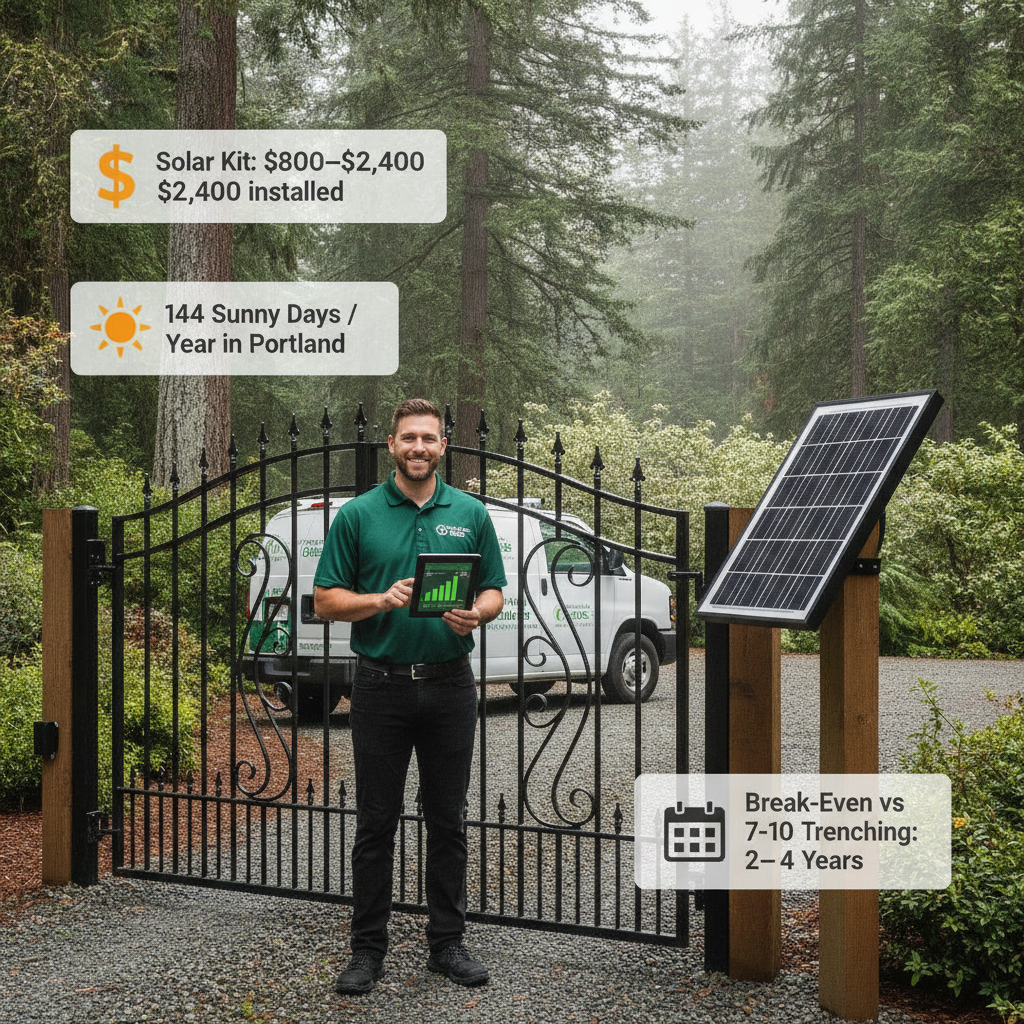
- Solar gate kits in Portland typically add $800–$2,400 to the base installation cost, depending on panel wattage and battery bank size.
- Portland averages 144 sunny days per year, which is enough to reliably power a low-to-moderate-traffic gate with the right battery buffer.
- A 20W panel paired with a 18–35Ah AGM or lithium battery covers most residential swing gates cycling 10–30 times per day.
- LiftMaster, FAAC, and Viking all offer factory solar-ready operators with built-in charge controllers for 2026 model lines.
- Trenching a power run to a remote gate costs $12–$22 per linear foot in Portland — solar often pays back within 3–5 years on long runs.
- Oregon's Residential Energy Tax Credit may offset 10–15% of qualifying solar components installed in 2026.
- Battery replacement every 3–5 years (AGM) or 7–10 years (lithium) is the main recurring cost most buyers overlook.
- Properties in West Hills, Lake Oswego, and rural Hillsboro are the most common solar gate candidates due to long driveway runs and limited trench access.
Is a Solar-Powered Automatic Gate Actually Practical in Portland's Climate?
Can a solar panel really power an electric gate in the Pacific Northwest? Does the rain kill it? Will it still work in January? These are the exact questions Portland homeowners and property managers type into Google — and they deserve straight answers, not marketing fluff. This guide breaks down exactly how solar gate systems work, what they cost in 2026, which operators support them, and whether your specific Portland property is a good candidate.
How Do Solar-Powered Gate Openers Work?
A solar gate system is not complicated in concept. A photovoltaic panel — typically 10W to 80W depending on the operator — charges a sealed lead-acid (AGM) or lithium iron phosphate (LiFePO4) battery. The battery powers the gate operator continuously, day and night. The panel simply keeps the battery topped up. On cloudy days, the system runs entirely on stored battery power. On sunny days, the panel replenishes what was used and then some. The charge controller (built into most modern operators or sold as a separate component) prevents overcharging and deep discharge, which are the two things that kill batteries prematurely.
The critical design variable is the depth of discharge per cycle. Every time a swing arm or slide motor opens and closes your gate, it draws a burst of current — typically 2–8 amps depending on gate weight and operator model. A well-sized battery bank should never drop below 50% state of charge on your heaviest-use days. If it does, battery life drops from years to months.
Does Portland Get Enough Sun for a Solar Gate?
This is the question that stops most Portland homeowners. The honest answer: yes, with the right battery buffer. Portland receives approximately 144 days of measurable sunshine annually and averages 3.0–3.4 peak sun hours per day on an annual basis (per NREL data for the Portland metro). That figure drops to roughly 1.5–2.0 peak sun hours in December and January — the real design constraint.
The practical solution is to size your battery bank for 3–5 days of autonomy (operation without any solar input at all). A residential gate cycling 20 times per day with a mid-range operator like a LiftMaster LA412DC or FAAC 402 CBC typically consumes 10–20 watt-hours per day in operation plus idle draw. A 35Ah AGM battery at 12V stores roughly 210Wh usable (at 50% DoD), giving you 10+ days of reserve — more than enough to bridge a stretch of November overcast. Pair that with a 20–30W panel tilted at Portland's optimal fixed angle of 45 degrees south, and the system is genuinely reliable year-round.
Pro Tip: Orient your solar panel due south and tilt it steeply — 45–50 degrees — rather than the flatter angles used in sunnier climates. The steep tilt maximizes winter sun capture when Portland's sun is low on the horizon, and it also sheds rain and moss naturally, which matters here.
What Does a Solar Gate System Cost in Portland in 2026?
Solar gate pricing in Portland breaks into two buckets: the solar kit itself, and the gate operator and installation. Here is a realistic breakdown for 2026:
- Entry-level solar kit (20W panel + 18Ah AGM battery + controller): $300–$550 as a standalone add-on. Suitable for lightweight aluminum swing gates with low cycle counts (under 15 per day).
- Mid-range solar kit (30–40W panel + 35Ah AGM or 20Ah LiFePO4 battery): $550–$950. The sweet spot for most Portland residential properties.
- High-capacity solar kit (60–80W panel + 50–100Ah lithium bank): $950–$2,000+. Used for dual-leaf swing gates, heavy ornamental iron, or commercial/HOA low-traffic applications.
- Labor to mount panel, wire to operator, and commission system: $350–$600 in Portland metro. Add $150–$250 if panel mounting requires a dedicated ground pole rather than a post or fence attachment.
- Full solar gate system installed (operator + solar kit + labor): $2,800–$7,500 for residential, depending on gate type, size, and access difficulty.
Compare that to the alternative: trenching conduit from your home's electrical panel to a remote gate location. Portland electricians and gate installers typically charge $12–$22 per linear foot for trenching, conduit, and low-voltage wire — and a 150-foot driveway run adds $1,800–$3,300 to your project before you even pay for the electrical panel tap. On any run longer than 80–100 feet, solar math starts looking very favorable. You can explore project examples on the Interactive Gates portfolio to see how other Portland-area installs have handled power routing.
Which Gate Operators Are Solar-Compatible in 2026?
Most quality DC-motor gate operators can run on solar because they already operate on 12V or 24V DC battery-backed power. The distinction is whether the operator has a built-in solar charge input or requires an external controller. Here is where the major brands stand in 2026:
- LiftMaster LA412DC / LA512DC: Factory solar-ready with a built-in charge input. The LA412DC is rated for up to 500 cycles per day, handles gates up to 16 feet and 550 lbs, and includes a solar input port. LiftMaster recommends a minimum 10W panel; Portland installers typically spec 20–30W. Price for dual-gate kit: $1,100–$1,500 operator only.
- FAAC 402 CBC and 414 CBC: These Italian-made swing gate operators run on 24V DC and accept solar charging via their battery backup circuitry. The 402 CBC handles gates up to 13 feet and 440 lbs. FAAC operators are well-regarded for quiet operation and longevity — a good fit for the residential neighborhoods in Lake Oswego and Beaverton where noise is a consideration. Operator pricing: $900–$1,300 for a single-leaf kit.
- Viking Access G40, G60, and SL-2000 series: Viking's DC operators all support solar charging. The G40 is a compact swing gate operator popular on lighter aluminum driveway gates; the SL-2000 is Viking's residential slide gate workhorse. Viking includes a solar-ready charging port and recommends minimum 10W per operator. Portland installers often spec 20W per operator for winter reliability. Operator pricing: $750–$1,200 depending on model.
- Apollo 1550 ETL and 835 series: Apollo's budget-friendly DC operators support basic solar setups. They are a common choice for cost-conscious homeowners with lighter gates. Note: Apollo's charge controller logic is less sophisticated than FAAC or LiftMaster, so battery sizing matters more. Operator pricing: $400–$700.
- Linear LDCO800 and Pro series: Linear's commercial DC operators support solar but are typically spec'd for higher-volume properties. Less common on Portland residential projects but worth considering for small HOAs or apartment access points.
For HOA communities or commercial properties in Hillsboro or Gresham, a commercial or HOA gate system may call for a higher-capacity solar array and lithium storage rather than AGM, particularly if the gate cycles 50+ times per day.
What Are the Best Portland Neighborhoods and Property Types for Solar Gates?
Solar gate systems are not the right answer for every property. They make the most sense where running utility power to the gate location is expensive, impractical, or invasive. In the Portland metro, that typically means:
- West Hills and Sylvan: Long winding driveways on steep terrain where trenching is expensive and disruptive to mature landscaping. Solar-on-a-post is often the cleanest solution.
- Lake Oswego acreage lots: Large wooded parcels with gates set 100–300 feet from the home. The math on trenching versus solar strongly favors solar at these distances. See the Lake Oswego gate installation page for local context.
- Rural Hillsboro and unincorporated Washington County: Properties on agricultural land or large rural lots often lack easy electrical access at the driveway entrance. Solar paired with a cellular-enabled access control panel (like a DoorKing 1837 or Liftmaster CAPXLV) creates a fully self-contained system. More on Hillsboro installs at the Hillsboro service page.
- Gresham and East County acreage: Similar story to Hillsboro — larger lots, older electrical infrastructure, and long driveway setbacks make solar a practical first choice. Gresham homeowners frequently ask about solar as an alternative to costly panel upgrades.
- Oregon City and Canby-area rural properties: Properties on Molalla Road and similar rural routes often have gates set far from the house with no conduit in place. Solar avoids a full electrical sub-panel run to the gate. See Oregon City gate service for neighborhood-specific guidance.
Conversely, solar is usually not the best choice if: your gate is within 40 feet of an existing exterior outlet or panel; your gate cycles more than 80 times per day (high-traffic commercial); or your property is heavily shaded by tall conifers on all southern exposures — a real issue in some forested West Hills parcels where panel siting becomes impractical.
What About Oregon's Solar Incentives — Do They Apply to Gate Systems?
Oregon's Residential Energy Tax Credit (RETC) program, as structured for 2026, covers qualifying solar electric equipment installed in Oregon residential properties. Gate solar systems occupy a gray zone: the photovoltaic panel and charge controller may qualify as solar energy property if they directly generate and store electricity, but the gate operator itself does not qualify. Most Portland installers recommend having your tax professional review the itemized invoice before filing. The potential credit is 10–12% of qualifying component costs, which on a $1,200 solar kit translates to $120–$145 — modest but worth capturing. The federal Residential Clean Energy Credit (30% of qualifying solar equipment cost) may also apply to the panel and battery storage components if they meet IRS criteria for standalone solar storage systems. Again, confirm with your accountant — this is not a blanket guarantee, and the gate application is not a standard residential rooftop solar scenario.
Pro Tip: Ask your installer to provide a line-itemed invoice separating the solar panel, charge controller, and battery costs from the gate operator and mechanical hardware. This separation makes any tax credit claim cleaner and easier to substantiate with Oregon DOR or the IRS.
What Does Battery Maintenance and Replacement Look Like?
The most overlooked long-term cost of a solar gate system is battery replacement. Here is what Portland owners should budget:
- AGM sealed lead-acid batteries: Lifespan of 3–5 years in a solar gate application (shorter if regularly over-discharged or exposed to freezing temperatures). Replacement cost: $80–$180 for a typical 18–35Ah battery, plus $75–$150 labor if the compartment requires disassembly.
- LiFePO4 lithium batteries: Lifespan of 7–12 years with proper charge management. Replacement cost: $200–$600 depending on capacity, but the longer service life typically makes them cheaper per year of service. Most LiftMaster and FAAC solar kits can be upgraded to lithium with a compatible charger profile.
- Panel cleaning: Portland's moss, pollen, and winter grime noticeably reduce output. A quick panel wipe-down every 3–4 months is all that is needed — no professional service required.
- Annual system check: A gate technician should verify battery state of health, charge controller voltage settings, and panel output once a year, typically bundled into a standard gate maintenance visit at $120–$200.
In One Minute: Solar Gate Systems in Portland
Portland gets enough sun to reliably power a residential gate year-round — if you size the battery for 3–5 days of autonomy and tilt the panel steeply south. Solar is most cost-effective on driveways longer than 80–100 feet where trenching runs $1,800–$3,300 or more. Expect to add $800–$2,400 to your gate project for a complete solar kit and labor. LiftMaster, FAAC, Viking, and Apollo all offer compatible DC operators. AGM batteries need replacement every 3–5 years; lithium every 7–10 years. Oregon's RETC may offset a portion of qualifying solar component costs. West Hills, Lake Oswego, Hillsboro, Gresham, and Oregon City acreage properties are the most common and cost-justified candidates in the Portland metro.
Frequently Asked Questions
Will a solar gate opener work during Portland's rainy winters?
Yes, reliably — but only if the battery bank is sized correctly. The system runs on stored battery power during extended overcast stretches. A 35Ah AGM or 20Ah LiFePO4 battery paired with a 20–30W panel gives most residential gates 7–14 days of reserve, which comfortably bridges Portland's cloudiest January weeks. The panel recharges the battery on any partially sunny day, even through thin clouds.
How many cycles per day can a solar gate handle?
A well-designed residential solar system can handle 15–40 cycles per day sustainably. High-volume applications — commercial parking lots, large HOA communities, or apartment complexes — typically need utility power or a generator backup because solar battery sizing becomes impractically large above 60–80 cycles per day. For low-to-moderate residential traffic, solar is fully adequate.
Can I add solar to my existing electric gate instead of replacing the whole system?
Sometimes. If your current operator is a DC-motor model (LiftMaster LA series, Viking G-series, Apollo 1550, FAAC 402 CBC), it almost certainly has a solar input port and can be retrofitted with a panel and battery bank for $600–$1,400 installed. If your operator is an AC-motor model (older slide gate motors, many commercial operators), it cannot run on solar without full replacement — DC conversion is not practical on AC motors.
Do I need a permit for a solar gate in Portland?
The gate installation itself typically requires a building permit from the City of Portland Bureau of Development Services or the applicable county office, depending on your municipality. The solar panel component is generally below the threshold that triggers an electrical permit in Oregon when it is a low-voltage (12V or 24V) battery-charging system — but this varies by jurisdiction. Your installer should pull the appropriate permits. Hillsboro, Lake Oswego, and unincorporated Washington County each have their own permit offices with slightly different thresholds.
What is the payback period for a solar gate system versus trenching power?
On a 150-foot driveway, trenching costs $1,800–$3,300 and carries ongoing electricity costs of roughly $15–$30 per year (minimal but real). A solar upgrade adds $800–$2,400 upfront with near-zero ongoing energy cost. Payback on the solar premium versus trenching ranges from 2–4 years on long runs. On short runs under 60 feet, trenching is usually cheaper over a 10-year horizon once battery replacement costs are factored in.
Can I use a cellular or app-based access system with a solar gate?
Yes — and this is actually one of the most practical combinations for remote Portland properties. Operators like the LiftMaster CAPXLV or DoorKing 1837 include cellular connectivity and can be powered entirely by a solar-charged battery bank. This eliminates the need for both electrical trenching and phone line trenching, making fully off-grid access control practical for rural lots in Hillsboro, Gresham, and Oregon City. Explore access control options on the residential gate page.
Ready to Find Out If Solar Makes Sense for Your Portland Gate?
Every property is different — driveway length, gate weight, cycle count, and panel siting all determine whether solar is the smart call or whether running utility power makes more economic sense. If you are weighing the options, the best first step is a site assessment from an installer who will give you honest numbers for both paths. Reach out to Interactive Gates and describe your property — or use the gate designer tool to start thinking through gate style and configuration before your consultation.


