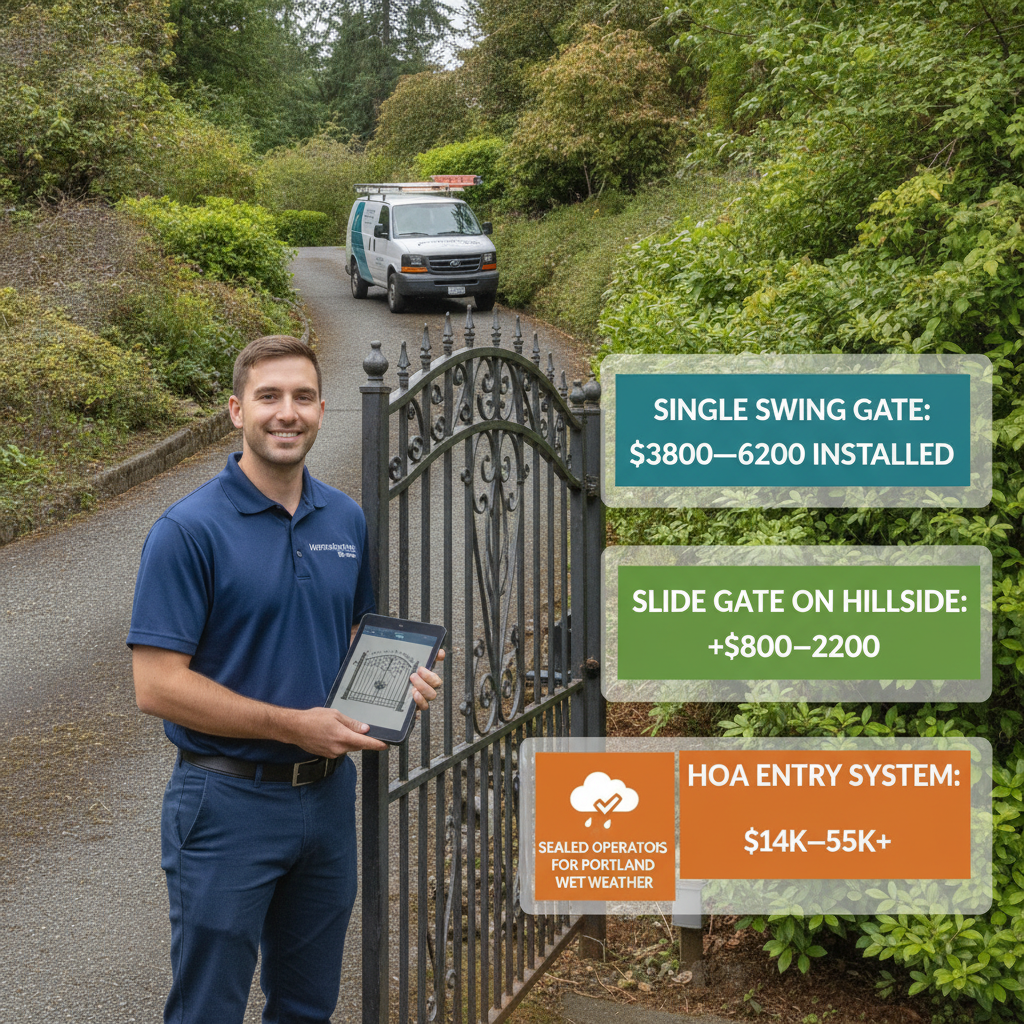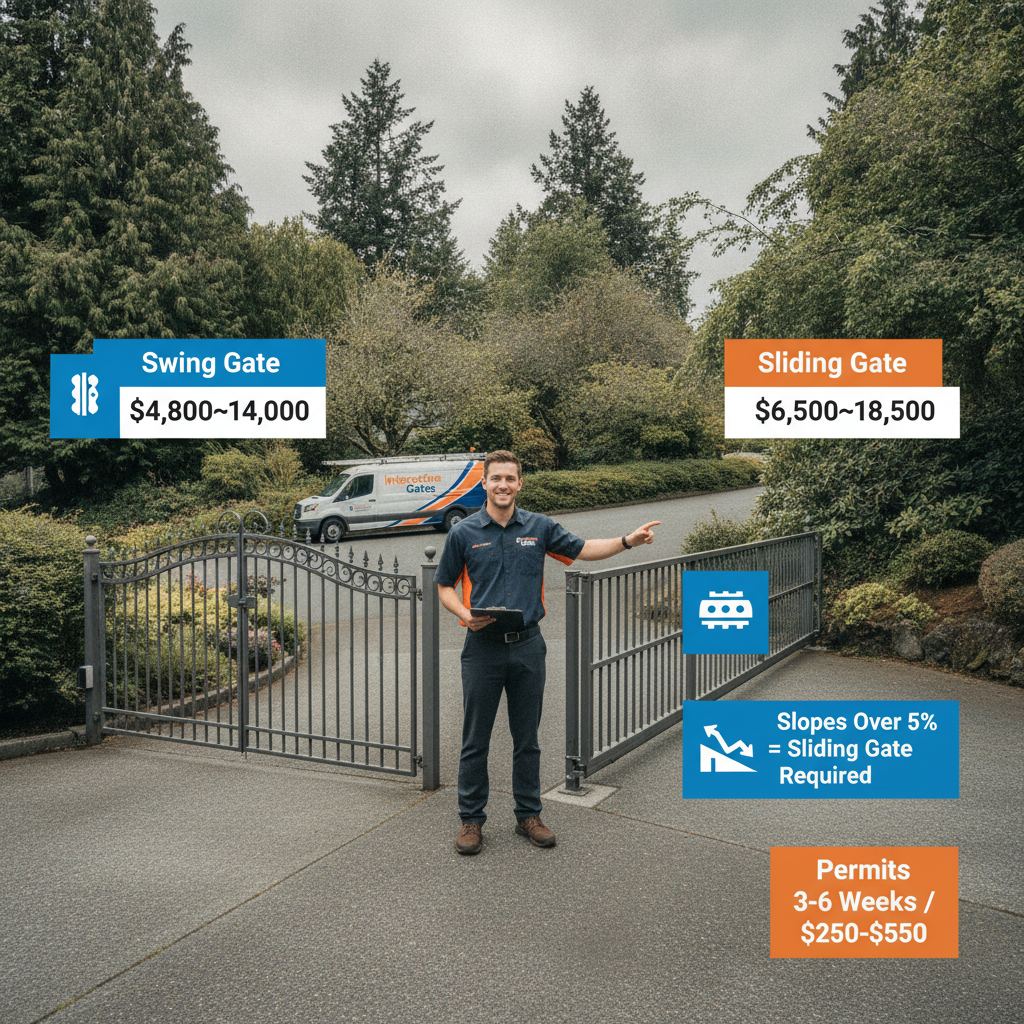
- Swing gates cost $4,800–$14,000 installed in Seattle; sliding gates run $6,500–$18,500 depending on width, material, and motor brand.
- Slope is the deciding factor — driveways with more than a 4–5% grade (common in Capitol Hill, Queen Anne, and Bellevue hillsides) almost always require a sliding gate.
- Swing gates need 10–14 feet of clear swing arc per leaf; if your driveway or landscaping eats that space, a slide track is your only realistic option.
- LiftMaster LA500, FAAC 402, and Viking VK500 are the most commonly installed residential swing operators in Seattle in 2026; for sliding gates, LiftMaster SL595 and FAAC 844 lead the market.
- Sliding gates handle Seattle's 38–42 inches of annual rainfall better long-term because they have no pivot hardware buried in wet soil to rust or shift.
- Swing gates are faster to install — typically 1–2 days vs. 2–4 days for a sliding gate with concrete track footer work.
- Motor cycle life is 500,000–1,000,000 cycles for commercial-grade operators; most residential households log 8–14 cycles per day, meaning a quality motor lasts 15–25 years.
- Permits are required for most Seattle and Bellevue installations — budget $250–$650 and 3–6 weeks for approval through the Seattle DCI or Bellevue Development Services.
Sliding Gate or Swing Gate for My Seattle Driveway — Which Should I Choose?
It's one of the first questions homeowners type into Google when they start shopping for an automatic gate: Do I need a sliding gate or a swing gate? Which one is cheaper? Which one works on a hill? If your property is anywhere from Magnolia to Mercer Island, from a flat Redmond cul-de-sac to a steep Queen Anne slope, the answer is almost never one-size-fits-all. This guide walks through every factor — cost, lot geometry, Seattle's climate, local code, and operator brands — so you can make a confident decision before you spend a dollar.
What Is the Actual Difference Between a Sliding Gate and a Swing Gate?
A swing gate pivots on hinges mounted to posts, exactly like a large door. Single-leaf swing gates cover openings up to about 16 feet; dual-leaf (bi-parting) gates split in the middle and cover openings up to 20–24 feet. The motor — typically a linear actuator or underground ram unit — pushes each leaf open through an arc. The entire mechanism is simple, proven, and easy to service.
A sliding gate travels laterally on a track or cantilevered rail alongside the fence line. It requires a 'run-back' space equal to (or slightly greater than) the gate opening width — so a 14-foot gate needs roughly 15–16 feet of clear fence line to park against when open. A rack-and-pinion motor mounted to the gate frame drives it along the track. Cantilever sliding gates — which float above the ground on rollers rather than riding a ground track — are increasingly popular in Seattle because they handle the mild frost heave and root-disturbed soil common in older neighborhoods like Ravenna, Maple Leaf, and Wedgwood.
How Does Seattle's Terrain Affect the Swing vs. Slide Decision?
Greater Seattle is famously hilly. The city itself sits on a series of ridges and valleys carved by glaciers, and the surrounding suburbs — Bellevue, Kirkland, Gig Harbor, and Snohomish — often feature equally pronounced grades. Slope is the single biggest technical constraint when choosing a gate type.
A swing gate opens uphill or downhill, which means the bottom of the leaf must clear the driveway surface throughout its entire arc. On a driveway with a 6–8% grade (relatively common on the west face of Queen Anne Hill or in parts of Bellevue's Somerset neighborhood), a swing gate that is 5 feet tall may sweep the ground mid-arc unless the installer raises the hinge point and adjusts the leaf geometry — adding fabrication cost and sometimes creating an unsightly gap at the bottom when the gate is closed. On grades above roughly 10%, swing gates become impractical without expensive custom engineering.
Sliding gates are grade-agnostic as long as the run-back fence line is reasonably level. The gate travels parallel to the fence, so the driveway grade is essentially irrelevant. This is why sliding gates dominate steeper neighborhoods. If your driveway slopes noticeably and you're unsure of the exact percentage, a tape measure and a level — or a quick call to a gate installer for a site assessment — will tell you what you need to know before you commit to either style.
Pro Tip: Google Street View can give you a rough visual read of your driveway grade before you ever schedule a site visit. Look at how your current driveway meets the street curb — a sharp angle versus a gradual transition tells you a lot about what you're working with.
How Much Does a Swing Gate Cost vs. a Sliding Gate in Seattle in 2026?
Prices below are fully installed ranges — hardware, operator, wiring, basic access control (keypad or remote), and standard labor. They do not include permit fees, custom powder-coat finishes, video intercoms, or solar backup systems, which each add cost.
Swing Gate — Single Leaf (up to 14 ft opening):
- Aluminum powder-coated: $4,800–$7,500
- Steel/wrought iron: $6,000–$10,500
- Wood-clad steel frame: $7,200–$12,000
Swing Gate — Dual Leaf / Bi-Parting (14–24 ft opening):
- Aluminum: $7,500–$11,000
- Steel/wrought iron: $9,500–$14,000
Sliding Gate — Standard Ground-Track (up to 16 ft opening):
- Aluminum: $6,500–$9,500
- Steel: $8,000–$13,000
Sliding Gate — Cantilever (up to 20 ft opening):
- Aluminum: $8,500–$12,000
- Steel: $11,000–$18,500
Why do sliding gates cost more? Two reasons: more steel (the counterbalance section behind the post adds 50–80% to the gate's physical length) and more labor (concrete footer work for the track or cantilever posts adds a half to a full day of crew time). In Seattle, waterfront properties and hillside lots in Bellevue or Gig Harbor can push those numbers higher if the installation requires rock drilling, retaining-wall penetrations, or extended conduit runs.
Which Operator Brands Work Best for Seattle's Rain and Cold?
Seattle's climate is not extreme — winters rarely drop below 28°F and summers top out around 80°F — but the sustained dampness (October through May is essentially one long drizzle season) means operator components need solid moisture ingress ratings. Here's how the leading brands stack up in 2026:
For swing gates:
- LiftMaster LA500 / LA400: The most-installed residential swing operator in the region. IP44-rated, reliable in wet conditions, integrates with myQ app control. Motor replacement cost: $380–$520 parts. Cycle rating: 500,000.
- FAAC 402 / 412: Italian-engineered, hydraulic-damped actuator. Exceptionally quiet and smooth. IP67-rated — better rain resistance than most competitors. Ideal for upscale properties in Bellevue or Medina. Motor cost: $480–$680 parts. Cycle rating: 1,000,000+.
- Viking VK500: U.S.-built, budget-friendly, parts widely available locally. Good for standard residential use. IP44. Motor cost: $280–$420. Cycle rating: 300,000.
- Apollo 1500 / 1600: Underground ram operators — completely hidden below the post cap. Premium aesthetic for custom estate gates. Require proper drainage around the cylinder; extra important in Seattle's high water-table soils near Lake Washington or Lake Sammamish. Motor cost: $600–$900 parts. Cycle rating: 500,000.
For sliding gates:
- LiftMaster SL595 / SL3000: Industry-standard rack-and-pinion, heavy-duty enough for gates up to 2,000 lbs. Integrated obstacle detection. Widely stocked locally. Motor cost: $520–$750 parts.
- FAAC 844 / 746: Commercial-grade, IP55-rated. Preferred for HOA and multi-family properties in Everett, Lynnwood, and Tacoma. Motor cost: $600–$900 parts.
- Elite EL25 / EL2000: Mid-range, good value. Parts availability improved significantly in 2025–2026. Motor cost: $380–$560 parts.
How Much Clearance Do I Actually Need for Each Gate Type?
This is where a lot of homeowners get surprised. Measuring your opening width is step one, but the gate type determines how much additional space you must dedicate.
Swing gate clearance requirements: Each leaf sweeps a 90° arc (or up to 110° with an outswing). For a 14-foot single-leaf gate, you need 14 feet of unobstructed arc — no shrubs, parked cars, utility meters, or retaining walls. If you have a curved driveway approaching the gate from the street, confirm the arc clears your widest vehicle. For a dual-leaf gate on a 20-foot opening, each 10-foot leaf needs 10 feet of arc space on each side.
Sliding gate clearance requirements: You need run-back space equal to 105–110% of the gate opening. A 14-foot opening requires ~15–16 feet of clear fence line (no cross-fencing, utility boxes, or corners) on the sliding side. Cantilever gates need slightly more run-back than ground-track versions but eliminate the ground track entirely — a major advantage on gravel driveways or properties with uneven paving.
At Snohomish and Auburn properties with large parcels and long fence lines, run-back space is almost never a constraint. In tighter urban lots in Seattle proper — Ballard, Fremont, Phinney Ridge — it frequently is, and swing gates win by default.
What Are the Maintenance Differences Over 10–15 Years?
Both gate types need annual professional servicing — lubrication, hardware tightening, limit-switch calibration, and safety-sensor testing. Expect to pay $150–$280 per annual visit in the Seattle market in 2026. But the type of wear differs:
Swing gates: Hinge pins and hinge plates take all the leverage load. In Seattle's wet soil, posts can shift subtly over 5–10 years, causing hinge misalignment and the classic 'gate dragging' problem. Underground ram operators (like Apollo) are particularly vulnerable if their drainage chambers fill with water. Plan for hinge replacement or adjustment at the 7–10 year mark: $180–$350 per hinge pair.
Sliding gates: Ground-track rollers accumulate debris (gravel, leaves, the Pacific Northwest's abundance of pine needles) and need cleaning every 3–4 months. Track replacement runs $400–$800. Cantilever gate rollers last longer but the cantilever beam itself can develop fatigue cracks at the 12–15 year mark on heavy steel gates — inspection is important. Rack-and-pinion gear replacement: $200–$450.
Pro Tip: Schedule your annual gate service in September — before the heavy rain season arrives. A pre-winter tune-up catches corroded terminals, weakened springs, and misaligned limits before Seattle's November deluges turn a minor issue into an emergency call-out at premium rates.
Do I Need a Permit for Either Type in Seattle in 2026?
Yes — in most cases. The Seattle Department of Construction and Inspections (SDCI) requires a building permit for any motorized gate or fence/gate combination that exceeds 6 feet in height, or that involves electrical work (virtually all automatic gates do). Permit fees typically run $250–$500 for a residential single-family installation, with commercial or HOA projects running $400–$650+. Timeline: 3–6 weeks for standard over-the-counter review; longer if your property is in a Shoreline Management Zone near Puget Sound, Lake Washington, or Lake Union, or if it's subject to a design review overlay (common in historic districts).
Bellevue, Kirkland, and Renton each have their own building departments with slightly different submittal requirements — your installer should pull the permit on your behalf as part of the project. Always confirm this is included in your quote. See the residential gate services page for what a full-service installation covers, and browse completed local projects in the project portfolio.
In One Minute: Swing Gate vs. Sliding Gate in Seattle
Choose a swing gate if: Your driveway is flat or has less than a 4% grade, you have 10–14+ feet of clear arc space on each side, your opening is under 20 feet wide, and budget is a primary concern. Expect to spend $4,800–$14,000 installed.
Choose a sliding gate if: Your driveway slopes more than 4–5%, your lot is tight and arc space is limited, your opening exceeds 16 feet, you want lower long-term pivot-hardware maintenance, or your HOA or property manager prefers the security profile of a laterally traveling gate. Expect to spend $6,500–$18,500 installed.
Either way: Plan for a permit ($250–$650, 3–6 weeks), annual service visits ($150–$280/year), and an operator from a brand with strong local parts availability — LiftMaster, FAAC, or Viking. If you're not sure which type fits your specific lot, a site assessment from a local installer is the right first step. You can also experiment with gate styles and configurations using the Interactive Gates visualizer tool before you commit.
Frequently Asked Questions: Sliding vs. Swing Gates in Seattle
Can a swing gate work on a sloped driveway in Seattle?
It depends on the degree of slope. Driveways with grades up to about 4% can usually accommodate a swing gate with proper hinge-point adjustment and leaf geometry. Grades above 5–6% — common on Queen Anne, Capitol Hill, and many Bellevue hillside lots — typically require a sliding gate. Your installer should measure the grade with a digital level during the site visit and show you where the leaf bottom will be at mid-arc before you commit to a swing design.
How much does it cost to convert a swing gate to a sliding gate in Seattle?
Conversion is a full replacement project, not a simple swap. Expect to spend $8,000–$16,000 in 2026 for a complete removal, new gate fabrication, track or cantilever rail installation, new operator, and access-control wiring. The original gate and motor have minimal salvage value. If conversion is on your radar within the next few years, it's almost always cheaper to install a sliding gate correctly from the start.
Do sliding gates or swing gates need more maintenance in Seattle's rainy climate?
Both need annual servicing, but the failure modes differ. Swing gates suffer most from hinge-pin corrosion and post-shift misalignment in Seattle's wet soil. Sliding gates suffer most from debris accumulation in ground tracks and rack-and-pinion gear wear. Cantilever sliding gates — which have no ground track — tend to have the lowest weather-related maintenance burden in the Pacific Northwest's rain-heavy environment.
What is the best automatic gate operator for a sliding gate on a Seattle residential property?
For most homes, the LiftMaster SL595 is the most practical choice in 2026 — widely available locally, well-supported for service, and rated for gates up to 2,000 lbs with 500,000+ cycle life. For upscale properties or HOA applications in Bellevue, Kirkland, or Gig Harbor, the FAAC 844 offers superior moisture resistance (IP55) and near-silent operation. Both brands are fully compatible with keypad, remote, and app-based access control systems.
How long does it take to install a sliding gate vs. a swing gate in Seattle?
A swing gate installation typically takes 1–2 days for a standard residential opening. A sliding gate — especially a cantilever model requiring concrete footer work — usually takes 2–4 days. Add 1–2 days if conduit trenching is required for electrical supply runs longer than 50 feet, which is common on larger lots in Snohomish, Auburn, or Gig Harbor. Permit approval adds 3–6 weeks to the front end of the project timeline regardless of gate type.
Is a sliding gate or swing gate better for an HOA in the Seattle area?
HOA applications — gated communities, townhome complexes, apartment entries — almost universally favor sliding gates. Wider openings (18–24 feet for two-lane entries), higher daily cycle counts (50–200+ per day), and the need for robust commercial operators all point to sliding gate design. Sliding gates also allow one motor to control the full opening, simplifying maintenance contracts. For HOA-specific guidance and pricing, see the commercial and HOA gate page.
Ready to Figure Out Which Gate Fits Your Property?
Every lot in Seattle — from a compact Ballard bungalow to a sprawling Snohomish acreage — has its own geometry, grade, and neighborhood code context. The sliding-vs.-swing question is answerable with the right site information, and the best way to get that information is a no-pressure, on-site conversation with an installer who knows the local terrain. Browse real installations in the project portfolio, read what Seattle-area homeowners say on the reviews page, or reach out through the contact page to schedule a free assessment. There's no obligation — just clarity on what your driveway actually needs.