- Swing gates in LA's dry climate last 18–25 years on the panel but operators average only 10–15 years before needing replacement.
- Slide gates outlast swing gates mechanically — a quality steel slide gate can run 20–30 years with proper maintenance on flat lots.
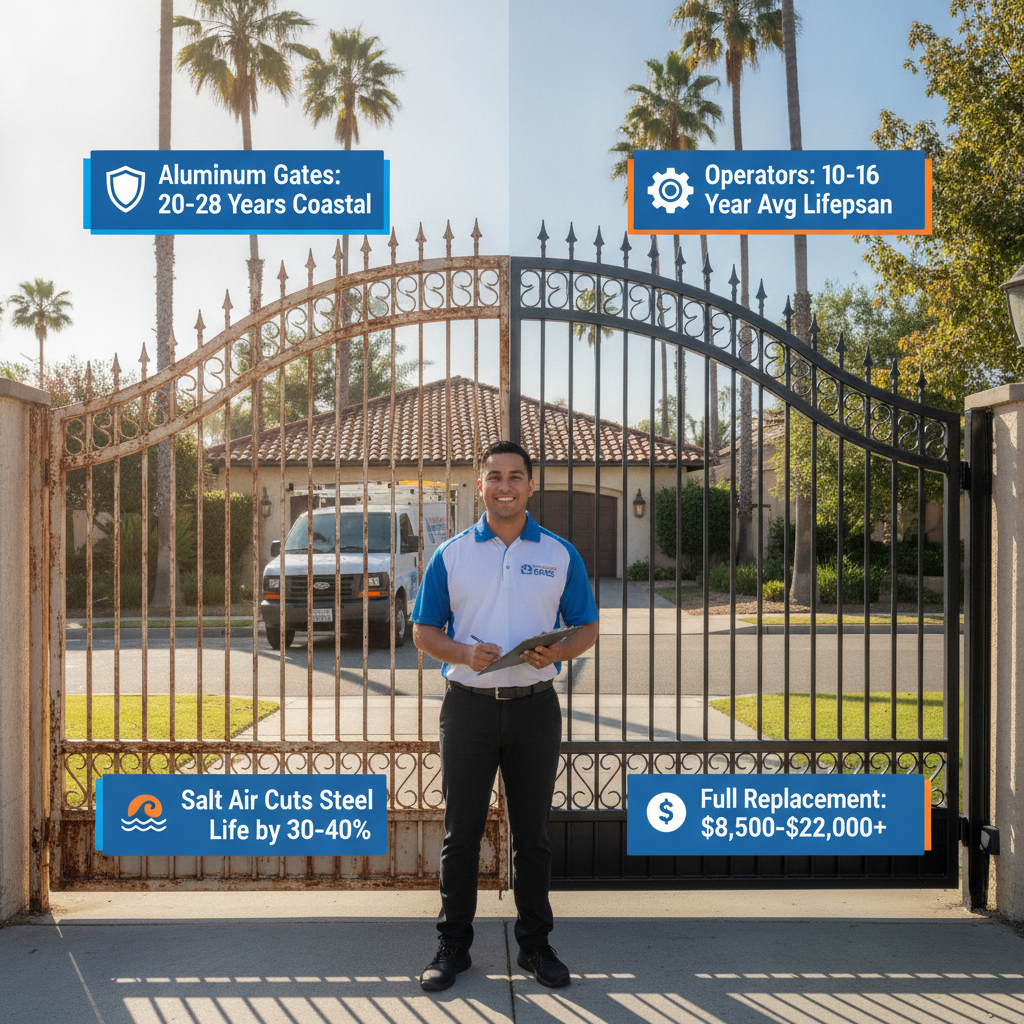
- Salt-air corrosion in coastal neighborhoods like Laguna Beach and San Clemente cuts raw-steel gate lifespan by 30–40% compared to inland areas.
- Aluminum gates resist coastal corrosion best and typically last 20–25 years near the coast with almost no rust treatment needed.
- Operators cycle-rated at 500,000 cycles (LiftMaster, FAAC) can last 12–18 years for an average residential property doing 15–20 cycles per day.
- UV degradation is LA's silent killer — powder-coat finishes on steel gates in the San Fernando Valley or Inland Empire fade and crack within 8–12 years without recoating.
- Budget $3,500–$6,500 for a full operator replacement in 2026, or $8,500–$22,000+ to replace the full gate-and-operator system depending on material and width.
- Most gates need replacement or major overhaul at the 15-year mark — not because the metal fails, but because safety codes, access-control technology, and motor reliability all converge to make a full upgrade the smarter financial move.
How long does an electric gate last in Los Angeles? Does the coastal air in Laguna Beach wreck a steel gate faster than one sitting in Pasadena? And when does it actually make more financial sense to replace your gate system than keep repairing it? These are the questions LA homeowners, property managers, and HOA boards are typing into Google — and the answers are more nuanced than any manufacturer spec sheet will tell you. This guide breaks down lifespan by gate type, material, neighborhood climate zone, and operator brand so you can plan intelligently in 2026.
How Long Does an Electric Gate Last in Los Angeles — Really?
The honest answer is: it depends on three separate systems — the gate panel itself, the operator (motor), and the access-control electronics — and each one ages at a completely different rate. Conflating all three is where most homeowners go wrong when they try to budget for gate longevity.
The gate panel (the physical steel, aluminum, or iron structure) is the longest-lived component. A well-built wrought iron or heavy-gauge steel driveway gate in an inland LA neighborhood like Glendale or the San Gabriel Valley can structurally last 25–35 years before the frame warps, welds crack, or corrosion penetrates the core. Aluminum panels in coastal areas like San Clemente or Laguna Beach routinely hit 20–28 years.
The gate operator — the motor, gearbox, and drive system — is a completely different story. Even a commercial-grade LiftMaster SL3000 or FAAC 844 rated for 500,000+ cycles will wear out in 10–18 years on an active residential property. A household doing 20 cycles per day (10 open/close pairs) hits 500,000 cycles in roughly 68 years on paper — but real-world heat cycling in the LA basin, dust intrusion, and power-surge degradation cut that dramatically. On properties with delivery vehicles, landscaping crews, and family traffic doing 40–60 cycles per day, operators commonly need replacement in 8–12 years.
The access-control electronics — keypads, intercoms, telephone-entry systems, and app-based controllers — have the shortest lifespan of all. Expect to replace or significantly upgrade these systems every 6–10 years as cellular networks, app ecosystems, and security standards evolve. A 2G/3G telephone-entry system installed in 2015 is already obsolete and may be non-functional if it relied on a carrier that has sunset those networks.
How Does LA's Climate Affect Gate Lifespan by Neighborhood?
Southern California is often sold as a mild, gate-friendly climate — and compared to the Pacific Northwest, it is. But LA is not a monolith. There are at least four distinct micro-climates that affect gate longevity differently.
Coastal zones (Laguna Beach, San Clemente, Orange, Malibu adjacent areas): Salt-laden air is the primary threat. Salt particles accelerate oxidation of ferrous metals exponentially. A standard powder-coated steel gate that would last 20 years in Pasadena may show surface rust within 3–5 years and structural corrosion within 10–12 years two blocks from the ocean. Aluminum and marine-grade galvanized steel dramatically outperform standard mild steel here. If you live in coastal Orange County and you have a raw-steel gate without annual wax sealing and biennial recoating, you're on borrowed time by year eight.
Inland valley and desert-edge zones (San Fernando Valley, Pomona, Riverside-adjacent): The threat here is UV radiation and extreme heat cycling — not moisture. Summer temperatures regularly exceed 105°F in the Valley. This relentless heat expansion and contraction stresses welds, loosens hardware, and bakes powder-coat finishes into a chalky, cracked surface that allows moisture intrusion. Operators in shaded enclosures last significantly longer than those mounted in full sun. A black powder-coated operator housing in full western sun exposure in Van Nuys can reach internal temperatures of 140–160°F on summer afternoons, dramatically shortening capacitor and circuit-board life.
Hillside and canyon zones (Rolling Hills, Bel-Air, Hollywood Hills): The challenge here is terrain stress. Gates on steep driveways work significantly harder than flat-lot gates. A swing gate opening on a 10–15% grade puts asymmetric load on hinges and operator arms with every single cycle. Hinge wear is 40–60% faster than on a flat driveway. Slide gates on sloped terrain require precision track installation and more powerful operators from day one — a 1/2 HP residential opener simply isn't adequate for a 600-lb gate on a 12% grade.
Mid-city and established neighborhoods (Los Angeles proper, Pasadena, Burbank): This is the most gate-friendly zone in the metro. Moderate temperatures, lower coastal humidity, and flat-to-gentle grades mean gates here genuinely can hit the upper end of lifespan estimates. A properly maintained wrought iron swing gate in Los Feliz or Silver Lake, powder-coated and lubricated annually, can realistically run 25+ years on the panel and 14–16 years on a quality operator.
How Long Do Specific Gate Types Last in Los Angeles in 2026?
Wrought iron swing gates: Panel lifespan of 20–30 years inland, 12–18 years coastal without aggressive corrosion treatment. Operators: 10–15 years. Most common failure points are hinge wear (years 8–12), broken weld joints at picket bases, and operator arm pivot bushings.
Aluminum swing or slide gates: Panel lifespan of 20–28 years in virtually any LA micro-climate, including coastal. Aluminum does not rust. It oxidizes (white powdery surface film) but this is purely cosmetic and easily cleaned. Best long-term value in coastal zip codes. The tradeoff: aluminum is softer, dents more easily from vehicle impact, and doesn't carry the same high-end aesthetic as wrought iron for luxury properties in Rolling Hills or Laguna Beach hillside neighborhoods.
Steel tube and flat-bar slide gates: Panel lifespan of 18–25 years inland with proper coating maintenance. Slide gates have fewer moving stress points than swing gates — no hinge load, no operator arm torque — making the panel itself quite durable. The track, rollers, and drive chain/rack are the wear items. Budget for track cleaning and roller replacement every 5–7 years ($350–$800 per service) and chain/rack replacement every 10–14 years ($600–$1,400).
Vertical lift (bi-fold or vertical pivot) gates: Best for steep driveways in Rolling Hills or canyon communities. Panel life is comparable to slide gates at 18–25 years, but the pivot hardware and counterweight systems require more specialized maintenance. Operators for vertical lift configurations are premium-priced and may need replacement on a 10–14 year cycle.
Wood or composite-infill gates: The structural steel frame lasts as long as any steel gate, but wood infill panels in LA's UV environment typically need replacement or refinishing every 5–8 years. Composite (PVC-wrapped or Trex-style) infill extends that to 12–18 years but comes at a higher upfront cost.
How Long Do Gate Operators Last in Los Angeles?
This is where most LA homeowners get surprised by a replacement bill they weren't expecting. The most popular operator brands — LiftMaster, FAAC, Viking, and Apollo — all publish cycle ratings, but real-world lifespan depends heavily on duty cycle (how many times per day the gate operates) and environmental conditions.
On a typical Los Angeles residential property doing 15–25 cycles per day, here's what to expect in 2026:
- LiftMaster SL3000 / CSL24UL: 12–16 years. Excellent heat tolerance, widely serviced throughout the LA metro. Circuit boards are still available for units going back to 2012.
- FAAC 844 / 884: 12–18 years. Italian-engineered hydraulic units handle heat extremely well and are popular in HOA and commercial applications in Orange County and the Westside. Parts availability is strong.
- Viking Access Systems (locally popular): 10–14 years. Strong value proposition for mid-range residential. Viking has a good service network in LA.
- Apollo 1500 / 1550: 8–12 years for residential swing gate use. Good entry-level option but shorter lifespan than FAAC or LiftMaster commercial-grade units.
- Elite EL2000 / EL25: 10–15 years. Popular for ornamental iron swing gates. Well-supported locally.
Pro Tip: If your operator is over 10 years old and needs a repair that costs more than 40% of a new unit's price, replacement is almost always the smarter financial move in 2026. New units come with updated safety sensors, UL 325 compliance, and compatibility with modern app-based access control that a 2013 board simply cannot support.
When Does It Make More Sense to Replace Than Repair?
The repair-vs-replace calculation in Los Angeles in 2026 comes down to four factors: the age of the operator, the condition of the gate panel, the cost of the specific repair, and whether your current system meets modern UL 325 safety standards.
Here are the clearest signals that replacement beats repair:
- The operator is over 12 years old and the repair quote exceeds $900–$1,200.
- The gate panel shows structural rust, warped frame, or cracked welds — these are foundational problems that surface repairs won't fix long-term.
- Your access-control system is incompatible with current cellular networks (2G/3G telephone entry, discontinued keypads).
- The gate has had three or more operator repairs in the past four years — frequency of failure is a reliable predictor of imminent major failure.
- You need to add video intercom, license plate recognition, or app-based remote access — retrofitting modern access control to an old operator is often more expensive than a full system upgrade.
Full gate-and-operator replacement costs in 2026 for the Los Angeles market: $8,500–$14,000 for a standard single-drive residential swing gate system in wrought iron or steel, $11,000–$18,000 for a dual swing or slide gate up to 20 feet wide, and $16,000–$28,000+ for custom fabricated estate gates in heavy-gauge materials with integrated access control. Operator-only replacement (panel retained) runs $2,800–$5,500 for residential and $4,500–$9,000 for commercial-grade units. Explore real examples from completed LA projects in our project portfolio.
Pro Tip: Many LA homeowners in HOA communities underestimate how much a gate replacement project can cost when HOA architectural approval, city permits, and inspector sign-off are layered in. Budget an additional $800–$2,500 for the administrative side of a full replacement in a gated community. Our HOA gate services page covers what that process looks like from start to finish.
What Maintenance Extends Gate Life the Most in an LA Climate?
Given LA's UV intensity and coastal salt exposure, the maintenance tasks that deliver the biggest lifespan return on investment are different from what installers in Seattle or Portland would prioritize.
- Annual powder-coat inspection and touch-up: Catching a 2-inch chip or scratch and filling it immediately prevents a $200 touch-up from becoming a $1,800 sandblast-and-recoat job within three years. This matters most for inland/valley properties with intense UV exposure.
- Biennial wax or sealant application (coastal properties): A marine-grade paste wax applied to all ferrous gate surfaces cuts salt-air oxidation dramatically. Cost: $150–$300 for a professional application.
- Operator lubrication every 6 months: Chain drive and rack-and-pinion systems need white lithium grease or manufacturer-specified lubricant. Skipping this is the single fastest way to wear out a $4,000 operator prematurely.
- Annual photo-eye and safety-edge testing: UL 325 compliance isn't just a legal issue — properly functioning entrapment protection sensors reduce slam-and-reverse stress cycles that mechanically wear out operators faster.
- Track cleaning for slide gates every 6 months: LA's dry season deposits dust and debris in the track. A gate fighting through a dirty track works twice as hard and wears rollers 3x faster.
If you're a homeowner or property manager looking at a gate that's 10+ years old and wondering whether it still has life in it, a professional inspection is the most cost-effective starting point. Our Los Angeles service page explains what a full gate assessment covers and what typical findings look like in the local market.
In One Minute: Electric Gate Lifespan in Los Angeles 2026
Gate panels in Los Angeles last 18–30 years depending on material and location — aluminum lasts longest near the coast, wrought iron and steel last longest inland when properly coated. Gate operators last 10–16 years on average, with high-traffic properties wearing them out faster. Access-control electronics need upgrading every 6–10 years. Coastal neighborhoods like Laguna Beach and San Clemente face salt-air corrosion that can cut steel gate life nearly in half without proper sealing. UV intensity in the Valley and desert-edge zones degrades powder coat and operator electronics faster than many homeowners expect. The financial crossover point where replacement beats repair arrives faster than most expect — usually when the operator is past 12 years old and repair quotes exceed $1,000. Investing in annual maintenance — lubrication, coating inspection, track cleaning — is the single highest-ROI action you can take to maximize the lifespan of any LA gate system.
Frequently Asked Questions: Electric Gate Lifespan in Los Angeles
How long does a wrought iron gate last in Los Angeles?
A wrought iron gate in an inland Los Angeles neighborhood (Pasadena, Burbank, Glendale, the San Fernando Valley) can last 20–30 years on the panel with proper powder-coat maintenance. In coastal areas like Laguna Beach or San Clemente, expect 12–18 years without aggressive anti-corrosion treatment such as annual waxing and biennial recoating. The operator on a wrought iron gate will typically need replacement in 10–15 years regardless of where in the metro you live.
Does the ocean air in Laguna Beach or San Clemente really damage electric gates faster?
Yes, significantly. Salt-laden coastal air is one of the most corrosive environments for ferrous metals. Studies of marine corrosion consistently show steel corrodes 4–10x faster within one mile of saltwater versus inland locations. Within two blocks of the ocean in San Clemente or Laguna Beach, surface rust on a standard powder-coated steel gate can appear in as little as 3–5 years. Aluminum gates, hot-dip galvanized steel, or stainless steel hardware are the appropriate material choices for these zip codes. If you have a steel gate in a coastal area, visit our Laguna Beach service page or our San Clemente service page to learn what a professional corrosion assessment involves.
When should I replace my electric gate operator instead of repairing it?
The clearest replacement signals in 2026 are: the operator is over 12 years old, the repair estimate exceeds 40% of a new unit's installed cost, the system has needed three or more repairs in the past four years, or the operator is incompatible with current UL 325 safety standards or modern access-control integrations. A new residential operator installed in LA in 2026 runs $2,800–$5,500 installed for a quality LiftMaster or FAAC unit — often less than two major repairs on an aging system over the following two to three years.
How many cycles does a typical LA gate operator handle per day?
This varies widely by property type. A single-family home in Los Angeles with one or two drivers averages 10–20 cycles per day. A property with landscaping crews, housekeepers, delivery vehicles, and multiple family members can easily hit 40–70 cycles per day. HOA entrance gates in active communities can exceed 200–400 cycles per day. Operator selection should always match the expected daily duty cycle — using a residential-grade 1/2 HP operator on a high-traffic HOA gate is a common and costly mistake that results in premature failure in two to four years rather than the expected ten-plus.
Can I just replace the motor on my old gate without replacing the gate panel?
In most cases, yes — if the gate panel is structurally sound. An experienced gate technician can assess whether the existing panel, track (for slide gates), hinges (for swing gates), and foundation posts are in good enough condition to support a new operator. If the gate panel is structurally solid, operator-only replacement is almost always the right call financially. However, if the panel has significant rust penetration, warped frame, cracked welds at stress points, or if the posts have shifted or heaved, a full system replacement is the more cost-effective long-term solution. Our residential gate services page covers what a full assessment looks like.
What's the most cost-effective gate material for long-term lifespan in Los Angeles?
For inland properties, heavy-gauge steel with quality powder coat offers the best combination of strength, aesthetics, and longevity at a moderate price point. For coastal properties within a mile of the ocean, aluminum is the clear long-term winner — it costs slightly more upfront than mild steel but eliminates virtually all corrosion-related maintenance and replacement costs over a 20-year ownership period. Wrought iron remains the premium choice for high-end aesthetics in luxury neighborhoods like Rolling Hills, but it requires the most diligent maintenance regimen in coastal or high-UV environments to reach its full potential lifespan.
Ready to Find Out How Much Life Your LA Gate Has Left?
Whether you have a 10-year-old operator that's been repaired twice, a coastal steel gate that's starting to show its age, or you're simply trying to plan ahead before a surprise failure, the best first step is a professional assessment by a technician who knows the Los Angeles market. If you're researching a new gate system or curious what a replacement would look like, try our gate design visualizer to explore styles, materials, and configurations — or contact our team to schedule an on-site evaluation. No pressure, no obligation — just straight answers about what your gate actually needs.