
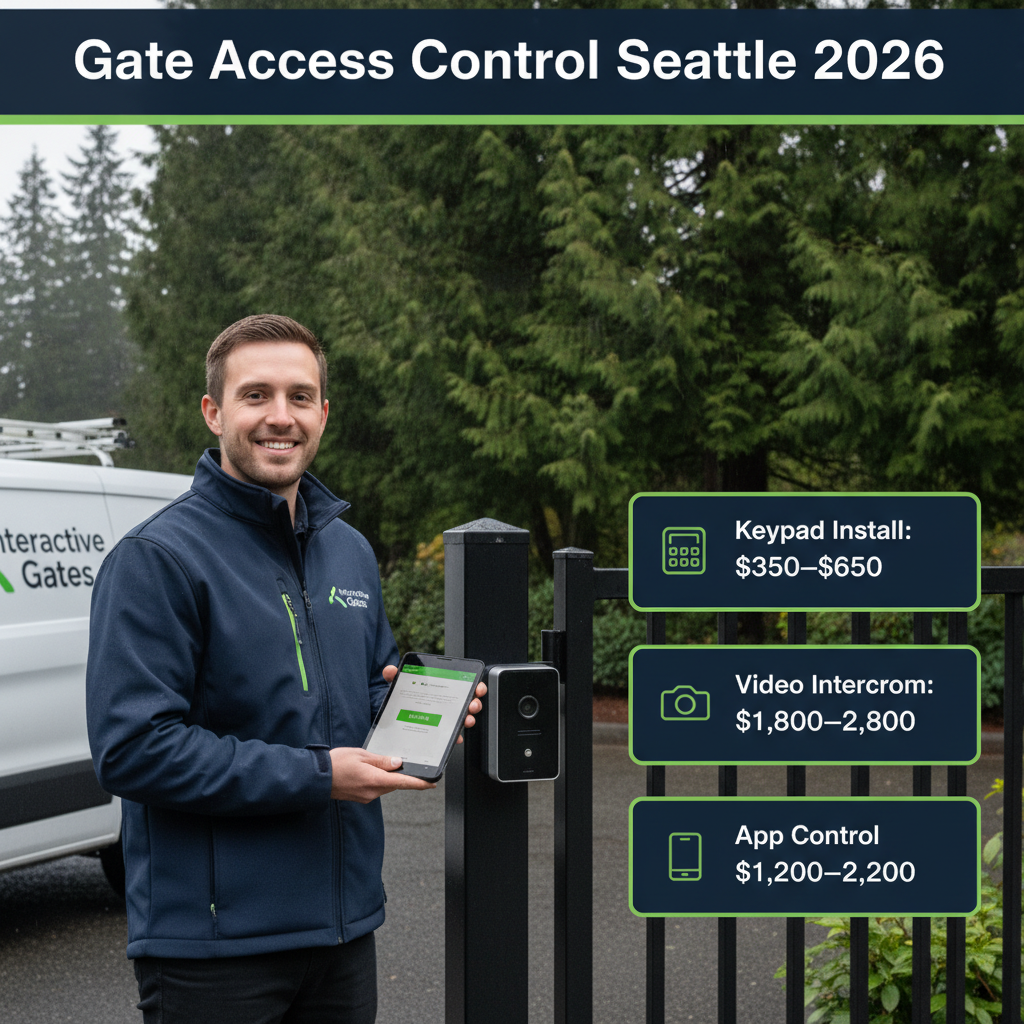
- Keypad entry systems start at $350–$650 installed for a basic single-unit; full app-controlled smart access runs $1,200–$3,500+ depending on brand and features.
- Video intercoms add $800–$2,500 to a gate project but are increasingly expected in Bellevue, Mercer Island, and Medina neighborhoods.
- LiftMaster MyQ, DoorKing, and 2N are the three most-installed access brands in the Seattle metro in 2026, each suited to different property types.
- Cell-based systems (no Wi-Fi needed) are the smart choice for rural Snohomish County and Gig Harbor properties where broadband is inconsistent.
- Seattle's wet climate demands IP65-rated or better keypads — unrated units fail within 12–18 months in the region's 38+ inches of annual rainfall.
- HOAs and multi-tenant properties save 15–30% on long-term access costs by choosing cloud-managed systems over traditional key-fob setups.
- Permit requirements vary by city — Bellevue and Kirkland require low-voltage electrical permits for hardwired access systems; Seattle proper reviews case-by-case.
- Most access control installs take one day; cloud programming and credential setup adds 1–3 days of remote configuration time.
What's the Best Gate Access Control System for a Seattle Home in 2026?
You've already decided you want an automatic gate — or maybe you have one and the clunky keypad from 2018 has finally given up. Now you're staring at a wall of options: keypads, intercoms, smartphone apps, license plate readers, key fobs, Bluetooth, and systems that promise to do everything short of making coffee. What actually works in Seattle? What's overkill? And what will quietly fail the moment November rain arrives? This guide cuts through the noise with real prices, real brand comparisons, and honest local context for homeowners and property managers across the Seattle metro — from Seattle proper and Bellevue to Gig Harbor and Snohomish.
How Much Does Gate Access Control Cost in Seattle in 2026?
Access control is the most variable line item in any gate project. A homeowner in Tacoma with a single-family driveway gate has completely different needs — and a completely different budget — than an HOA board in Lynnwood managing a 200-unit community. Here's how the costs actually break down in 2026 for the Seattle market:
- Basic keypad only (surface-mount, wired): $350–$650 installed. Brands like Linear and Liftmaster's budget tier live here. Fine for a single-family home where you only need a 4-digit code.
- Keypad with multiple access codes + key fobs: $600–$1,100 installed. Most residential installs with 2–8 users land here. DoorKing 1506 and LiftMaster KPWR is a common combo in Auburn and Lakewood.
- Smartphone-app-controlled system (cloud-based): $1,200–$2,200 installed. Includes a cellular or Wi-Fi controller, app setup, and typically 1–3 users configured. LiftMaster MyQ Commercial and Remo+ are popular in this tier.
- Video intercom with remote unlock: $1,800–$3,500 installed. Two-way video, mobile app unlock, guest PIN generation. 2N Helios IP and DoorKing 1837 are the two systems our crews install most in Bellevue and Mercer Island.
- License plate recognition (LPR) systems: $3,500–$8,000+ installed. Almost exclusively commercial or high-end residential. Genetec and Avigilon are common in this tier. Overkill for most single-family homes; appropriate for gated communities with 50+ units.
- Full commercial cloud-access suite (HOA/multi-tenant): $5,000–$20,000+ depending on gate count, intercom stations, and number of credentials managed. Annual SaaS licensing runs $300–$1,200/year on top of hardware.
Pro Tip: Always budget 15–20% above the hardware quote for conduit, junction boxes, and the low-voltage wiring run from your gate operator to the access device. On long driveways (100 ft+) in Snohomish or Gig Harbor, wire runs alone can add $400–$900 to the project.
Keypad vs. Intercom vs. App Control: Which Is Right for Your Seattle Property?
The honest answer is that most Seattle homeowners use a combination of two access methods — a keypad for daily entry and an app or intercom for visitor management. Here's how to think about each:
Keypads
Keypads are the workhorse of residential gate access. A quality weatherproof keypad like the DoorKing 1506 or LiftMaster KPWR handles 10–100 user codes, runs on 12–24V DC from your gate operator, and requires almost no maintenance beyond an annual wipe-down. In Seattle's climate, look for units with a sealed membrane keypad and an IP65 or IP66 weathering rating — rubber gasket keypads from no-name brands routinely fail by year two in our wet winters. Expected lifespan for a quality keypad: 8–12 years with proper sealing.
Intercoms
If you receive frequent deliveries, have household staff, or simply want to see who's at your gate before buzzing them in, a video intercom is worth every dollar. The 2N Helios IP Verso is the gold standard in 2026 — it runs over your home network, streams HD video to your smartphone, and lets you unlock the gate remotely from anywhere in the world. Installation including network configuration runs $1,800–$2,800 for a single-family install. For a slightly more budget-conscious option, the DoorKing 1837 cellular intercom skips the home Wi-Fi dependency entirely, dialing your cell phone when someone presses the call button — ideal for properties in Gig Harbor or rural Snohomish where home internet can be spotty.
Smartphone App Control
App-based access has matured significantly by 2026. LiftMaster's MyQ platform now integrates with Google Home and Amazon Alexa, logs every open/close event with a timestamp, and lets you grant temporary access codes to guests that expire automatically. The FAAC RP 432 EFC controller paired with the FAAC app is another strong option, especially when FAAC is already the gate operator brand. The main limitation: if your home internet goes down, so does app control. For properties in neighborhoods with reliable fiber (most of Seattle proper, Bellevue, Redmond), this is rarely a problem. For properties further out, pair app control with a keypad backup.
What Access Control Systems Work Best in Seattle's Wet Climate?
This is the question Seattle installers get asked more than almost any other, and it's the right one. The Pacific Northwest's climate is genuinely hard on electronics — not because of extreme cold (Seattle rarely freezes hard), but because of persistent moisture, condensation cycles, and the corrosive effect of years of rain on terminals and contacts.
- Minimum IP rating for any exterior-mounted device: IP65. This means fully dust-tight and protected against water jets from any direction. IP66 is better. IP67 (submersion-rated) is overkill for a driveway gate but doesn't hurt.
- Aluminum or stainless-steel housings outlast painted zinc or plastic housings. Look for this spec on intercoms and keypads mounted in exposed locations.
- Conformal-coated circuit boards resist moisture penetration inside the unit. 2N Helios and DoorKing both use conformal coating on their main PCBs as of 2026.
- Solar-powered wireless keypads are popular for remote installs, but Seattle's overcast winters (average 2.3 hours of sun per day December–February) often leave solar panels undercharged. If you go solar, size the panel at least 20W and add a backup battery with at least 7 days of reserve.
- Heated keypad enclosures (a small resistive heater inside the housing) are worth the $60–$120 add-on cost for properties in Snohomish or elevated Auburn lots that see frost.
Pro Tip: Even IP65-rated units benefit from a small overhang or rain canopy above the keypad. A simple powder-coated steel canopy welded to your gate post costs $80–$200 and can double the lifespan of the electronics beneath it.
HOA and Multi-Tenant Access Control in the Seattle Metro: What's Different?
Managing access for an HOA gate in Lynnwood, Auburn, or Tacoma is a fundamentally different challenge than managing a single-family driveway. You have dozens or hundreds of residents, frequent unit turnover, delivery services, emergency vehicle access, and a board that doesn't want to field calls every time someone forgets their code.
Cloud-managed systems are the right answer for communities with 20+ units. The two platforms our crews deploy most often in the Seattle HOA market in 2026 are DoorKing's myDKS cloud platform and LiftMaster's MyQ Community. Both allow the property manager to add, remove, or modify credentials remotely from a web browser, generate audit logs showing who entered at what time, and integrate with resident apps for mobile unlock. DoorKing myDKS supports up to 10,000 users per system — more than enough for even large Tacoma or Lakewood communities. Monthly SaaS licensing for myDKS runs $25–$80/month depending on user count. MyQ Community pricing is typically bundled with hardware purchase but carries an annual renewal fee of $150–$400.
Emergency vehicle access is a local code concern as well. King County and Pierce County both require that gated community entrances include a Knox Box or KNOX key switch so fire and EMS can enter without delay. Budget $350–$600 for Knox Box hardware and installation — it's not optional and inspectors do check.
Do I Need a Permit for Gate Access Control in Seattle?
For most standalone wireless or solar keypads, no permit is required. But once you're running hardwired low-voltage circuits from a panel or adding a video intercom with PoE (Power over Ethernet) infrastructure, the rules change:
- Seattle proper: Low-voltage permits are reviewed on a case-by-case basis. Most residential access control installs under $5,000 in scope do not require a separate permit if they're part of a permitted gate installation. Check with the Seattle Department of Construction and Inspections (SDCI) for your specific address.
- Bellevue and Kirkland: Both cities require a low-voltage electrical permit for any hardwired access control system. Budget 2–4 weeks for permit approval and $120–$250 in permit fees.
- Unincorporated King County: Generally follows the state electrical code; low-voltage exemptions apply for circuits under 50V, which covers most gate access systems.
In One Minute: Seattle Gate Access Control in 2026
Here's the short version: a quality weatherproof keypad ($350–$650 installed) handles daily entry for most single-family homes. Add a video intercom ($1,800–$2,800) if you have frequent guests or deliveries. Go app-controlled (LiftMaster MyQ or FAAC) for remote management and access logs. For HOAs and multi-tenant properties, invest in cloud-managed platforms like DoorKing myDKS or LiftMaster MyQ Community — the admin time saved pays for the system within two years. Always specify IP65 or better ratings, and budget for a rain canopy over any keypad. Check permit requirements in Bellevue and Kirkland before your installer starts running wire.
Frequently Asked Questions: Gate Access Control in Seattle
What is the most reliable gate keypad brand for Seattle's rainy climate?
DoorKing and LiftMaster are the two most consistently reliable keypad brands in the Seattle market as of 2026. Both offer sealed membrane keypads with IP65 or better ratings, conformal-coated circuit boards, and backed warranty service. The DoorKing 1506 and LiftMaster KPWR are the most commonly specified models for single-family residential installs in wet Pacific Northwest conditions. Avoid budget no-name units from online marketplaces — most carry no meaningful IP rating and fail within 12–18 months of exposure to Seattle rainfall.
Can I control my Seattle driveway gate with my smartphone?
Yes. LiftMaster's MyQ platform and the FAAC app are both fully functional smartphone control systems available in 2026. You can open, close, and monitor your gate remotely, receive open/close notifications, set scheduled access times, and grant temporary guest codes that expire automatically. The main requirement is a reliable home internet connection or a cellular-based controller. For properties with inconsistent broadband, DoorKing's cellular intercom system dials your phone directly and requires no home Wi-Fi at all.
How long does a gate access control system last in Seattle?
Quality hardwired keypads last 8–12 years in Seattle's climate when properly sealed and maintained. Video intercoms from brands like 2N and DoorKing typically last 7–10 years before hardware replacement is warranted. Cloud-platform software is updated continuously, so the software side doesn't age out the way old firmware did. Key fob transmitters last 5–8 years with normal use; the batteries inside them need replacement every 1–3 years. Annual inspection of all terminals, gaskets, and connections significantly extends system lifespan.
What access control system do HOAs in the Seattle area use?
The most widely deployed HOA access platforms in the Seattle metro in 2026 are DoorKing's myDKS cloud system and LiftMaster MyQ Community. Both allow remote credential management, audit logging, and resident mobile apps. Larger communities (100+ units) increasingly use enterprise platforms like Brivo or Openpath, which integrate with property management software and support more granular permission structures. Smaller HOAs (under 50 units) often find a DoorKing 1812 or 1816 keypad system — without cloud management — sufficient, at significantly lower upfront cost.
Does my Seattle gate access system need to allow emergency vehicle access?
Yes. King County and Pierce County both require gated community entrances to provide emergency vehicle access, typically via a Knox Box or KNOX key switch mounted at or near the gate. Single-family residential gates are not required to have Knox Boxes, but if you live in a private road community with a shared gate, the community gate must comply. Knox Box hardware and installation typically runs $350–$600. Your gate installer should coordinate Knox Box mounting with your local fire marshal's office — requirements vary slightly between jurisdictions like Seattle, Bellevue, and Tacoma.
How much does it cost to upgrade an old gate keypad to a smart system in Seattle?
Upgrading from a legacy keypad to a modern app-controlled or cloud-managed system typically costs $800–$2,500 depending on what infrastructure is already in place. If your gate operator is a recent LiftMaster or FAAC model, a smart controller can often be added without replacing the operator. If the gate operator is more than 10 years old, it may make more sense to replace operator and access control together. An interactive consultation with a local installer — like the team at Interactive Gates — can help you determine which upgrade path makes sense for your specific setup and budget.
Ready to Choose the Right Access System for Your Seattle Gate?
Every property is different — lot size, household traffic, internet reliability, HOA requirements, and your own comfort with technology all shape the right answer. If you want to explore what a gate and access control system might look like for your specific property, the Interactive Gates design visualizer is a great place to start. You can also browse completed local projects and customer reviews from Seattle-area homeowners, or reach out directly for a no-pressure site assessment. The right system is the one that still works flawlessly on a wet November morning in year eight — and we can help you find it.


