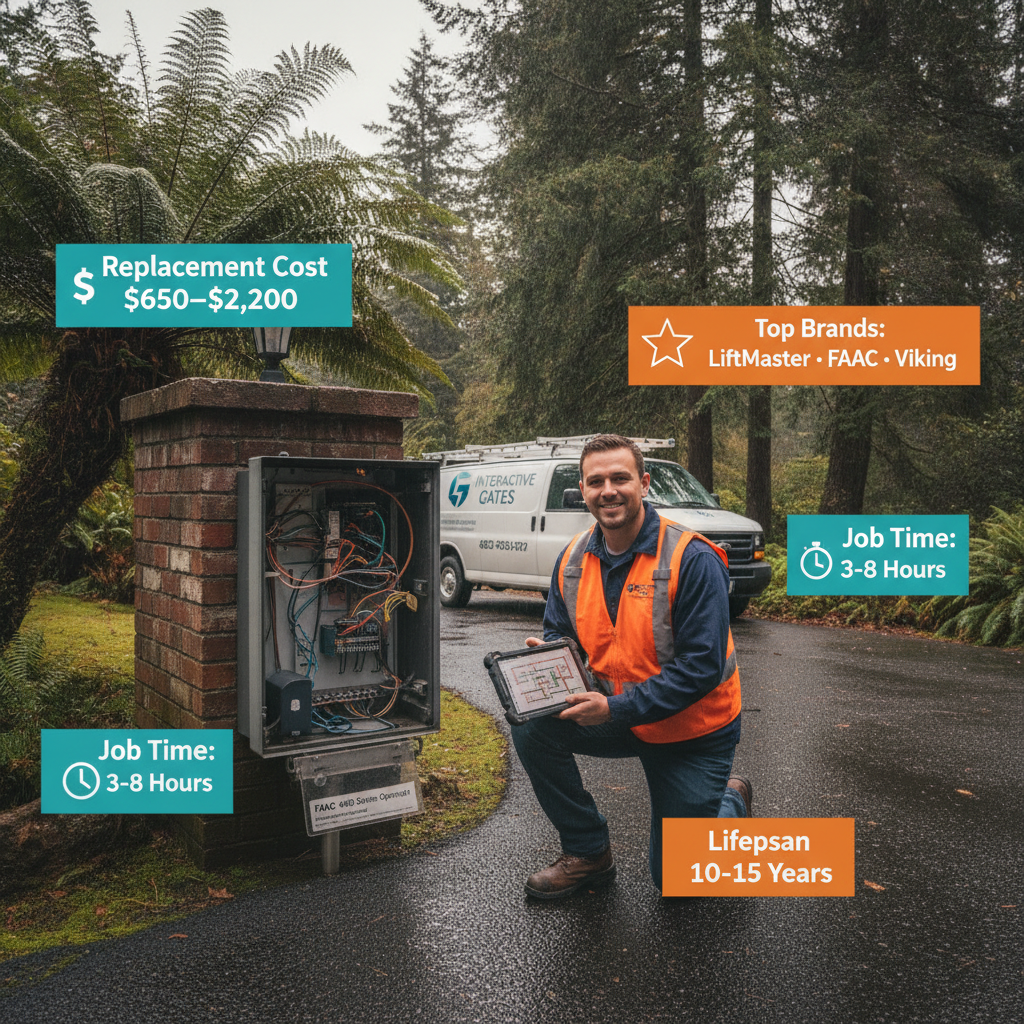
- LiftMaster remains the top-selling residential gate operator brand in the Seattle metro, powering roughly 40% of new residential installs in 2026.
- FAAC operators typically cost $800–$1,400 more than comparable LiftMaster units but deliver superior performance in Puget Sound's wet, salt-air climate.
- Viking Access operators carry a 3-year parts warranty and are the dominant choice for HOAs and commercial properties in Bellevue and Kirkland.
- Elite (formerly Linear) swing-gate operators start around $650 installed, making them the budget entry point for residential driveways under 16 feet wide.
- Cycle counts matter in Seattle: a busy household with 20+ open/close cycles per day needs a commercial-duty operator rated for at least 500,000 cycles.
- Solar-ready operators are now code-preferred in several King County jurisdictions for detached structures with no existing conduit run.
- Corrosion-resistant aluminum or powder-coated steel enclosures are non-negotiable given Seattle's 150+ rainy days per year.
- Lead times for premium FAAC and BFT units run 3–6 weeks in 2026 — plan ahead if you're targeting a spring install.
Which Automatic Gate Brand Is Best for Seattle in 2026?
You've decided on an automatic gate for your Seattle home, Eastside property, or HOA community — now comes the harder question: LiftMaster or FAAC? Viking or Elite? Does it even matter which operator brand goes on your gate, or is one motor basically the same as another? Seattle homeowners and property managers ask these questions constantly, and the answers depend heavily on your driveway volume, gate weight, exposure to the elements, and budget. This guide breaks it all down so you can make a confident, informed decision before the installer ever shows up.
Why Does Brand Choice Matter More in Seattle Than in Drier Climates?
Most automatic gate operators are engineered and tested in sunny, dry conditions. The Puget Sound region is a different animal. Seattle averages roughly 152 rainy days per year, relative humidity hovers in the 70–80% range through fall and winter, and salt air pushes inland from the Sound — especially in waterfront neighborhoods like Magnolia, West Seattle, and along the Gig Harbor peninsula. That moisture gets into motor housings, corrodes circuit boards, and degrades rubber seals faster than manufacturers' specs predict under ideal lab conditions.
The brands that perform best here share a few traits: sealed or semi-sealed motor housings, conformal-coated circuit boards (which resist moisture intrusion), stainless-steel hardware, and aluminum or UV-stabilized polycarbonate enclosures. That's not marketing copy — it's what separates a 5-year operator from a 15-year operator when installed within a mile of Elliott Bay or under the perpetual drip of a Douglas fir canopy in Snohomish County.
LiftMaster: Seattle's Most Installed Residential Gate Operator
LiftMaster (a Chamberlain Group brand) dominates the Seattle residential market for straightforward reasons: wide availability, extensive dealer support, competitive pricing, and a deep ecosystem of accessories. For a standard residential swing gate up to 16 feet and 400 lbs, the LiftMaster LA400 or LA412 dual-swing kit runs $1,800–$2,600 installed in the Seattle metro as of early 2026, depending on conduit runs and control board upgrades.
The LA series uses a built-in battery backup, which matters enormously in a region where winter power outages are routine — the 2024–25 winter saw several multi-day outages across King and Snohomish counties. The myQ integration allows remote monitoring and control from a smartphone, and it connects cleanly with Ring, Alarm.com, and other smart-home platforms popular in the tech-heavy Bellevue and Seattle neighborhoods.
Limitations: the LA series enclosures, while weather-resistant, are plastic-bodied. In exposed waterfront locations or heavily shaded lots with chronic moisture pooling, the internals need annual maintenance checks to prevent premature board failure. Cycle rating for the LA400 is approximately 200,000 cycles — plenty for a typical household doing 8–12 cycles per day, which works out to roughly 45–68 years of use at that rate. But if your property has a gate shared by 10 or more units, you need to look upstream.
FAAC: The Premium Choice for Wet, High-Traffic Seattle Properties
FAAC is an Italian manufacturer that has been engineering gate operators for European climates — rainy, cold, and demanding — for over 50 years. Their operators are standard-issue on upscale residential projects in Lake Oswego-equivalent neighborhoods in Seattle like Medina, Hunts Point, and Mercer Island, as well as on commercial campuses throughout the Eastside.
The FAAC 391 and 402 series swing operators are oil-hydraulic: the motor sits in a sealed oil bath, which means moisture simply cannot reach the working components. These units are rated for gates up to 800 lbs per leaf and carry cycle counts exceeding 500,000 — effectively unlimited for residential use. Installed cost for a dual-swing FAAC 402 setup in Seattle runs $3,200–$5,500 depending on gate size, control card selection (FAAC's E124 board supports up to 31 remote codes, Bluetooth, and GSM integration), and site prep. Lead times as of Q1 2026 are running 4–6 weeks for some SKUs; order early if you want a May or June install.
For slide gates, the FAAC 844 ER is a rack-and-pinion unit built for gates up to 880 lbs and 65 feet wide — commonly specified for commercial entries in SoDo, Georgetown, and industrial corridors near Tacoma. Installed cost: $4,000–$7,000 depending on gate weight and control-card configuration.
Pro Tip: If your property is within half a mile of Puget Sound or Lake Washington waterfront, FAAC's oil-bath hydraulic units aren't an upsell — they're the right tool. Expect to pay $1,000–$1,800 more than a comparable LiftMaster setup, but plan on 15–20 years of service with annual fluid checks rather than 8–12 years with a standard electromechanical operator.
Viking Access: The HOA and Commercial Standard for the Eastside
Viking Access (a US-based brand owned by Nice Group) occupies the sweet spot between LiftMaster's consumer-friendly ecosystem and FAAC's premium-hydraulic engineering. Viking's V2000 and V2500 swing operators and their SW-2000 and SW-4000 slide gate operators are workhorses built for high-cycle environments — the SW-4000 is rated at continuous duty, meaning it can run all day without thermal cutout.
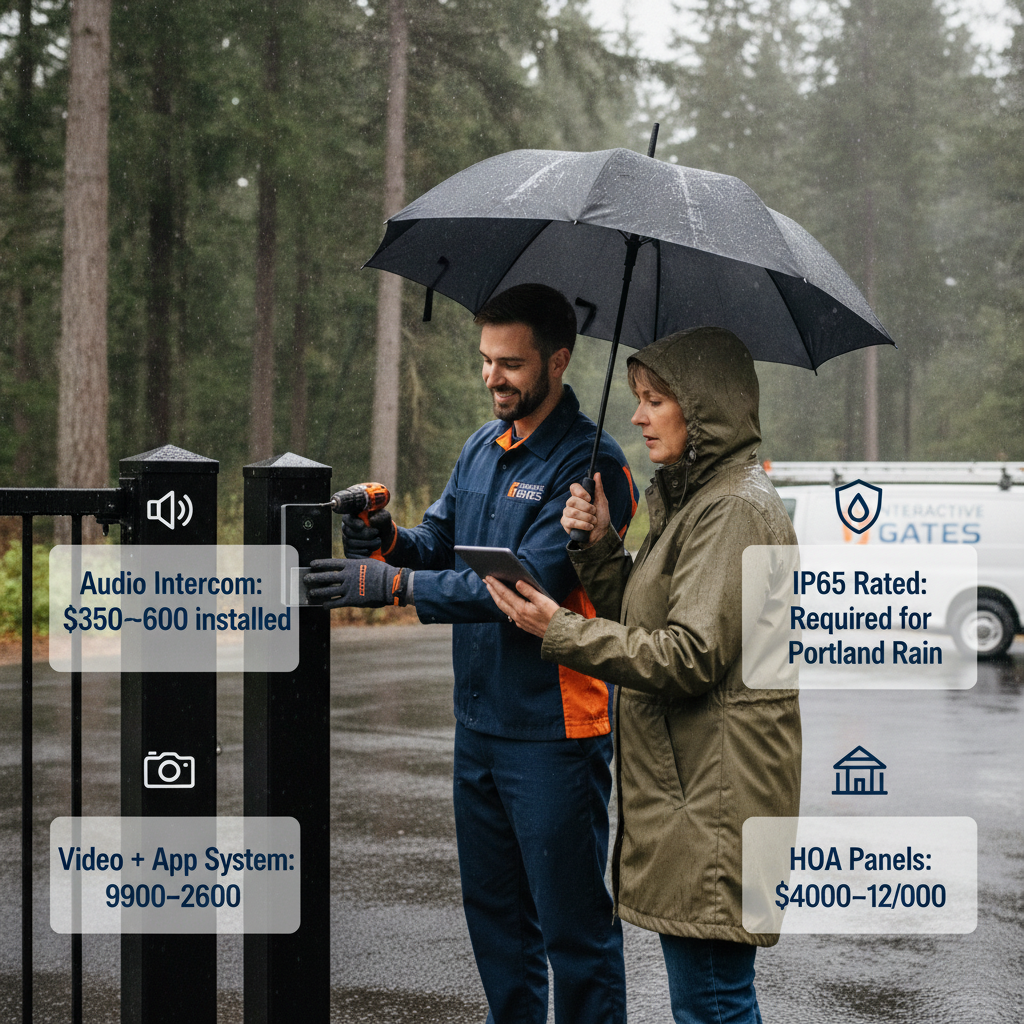
HOAs in Bellevue, Kirkland, and Redmond frequently spec Viking for gated community entrances because the operators integrate cleanly with telephone-entry systems (Viking's own VK-Series intercoms, plus Liftmaster CAPXL and DoorKing), support up to 1,000 access codes natively, and carry a 3-year parts warranty — the longest standard warranty of any brand in this comparison. Installed cost for a Viking SW-2000 slide gate setup: $2,800–$4,200. For the heavy-duty SW-4000: $4,500–$6,500. Residential Viking installs for single-family homes are less common but perfectly appropriate for large estates in Sammamish or Snohomish with multiple daily vehicle movements.
Elite (Linear): The Budget-Friendly Entry Point
Elite (rebranded from Linear, now under Nortek) is the value-tier option that still comes from a reputable manufacturer with decades of gate-operator history. The Elite EL25 and ES101 swing and slide operators are popular for single-family driveways with standard swing gates under 14 feet and 300 lbs. Installed pricing in Seattle runs $1,400–$2,100 — roughly 20–30% less than a comparable LiftMaster setup.
The trade-off is cycle rating (approximately 150,000 cycles) and a more basic enclosure that benefits from regular sealing and maintenance in Seattle's climate. For a household doing 6–8 cycles per day in a covered or partially sheltered gate column, Elite operators can deliver solid 10–12 year lifespans. They're less appropriate for exposed waterfront locations or high-traffic properties.
BFT and Nice: Honorable Mentions Worth Knowing
Two additional brands appear frequently in Seattle installs, especially among specialty dealers. BFT (Italian, like FAAC) offers the Mizar and Phobos series — hydraulic swing operators with similar weather resilience to FAAC, priced comparably at $3,000–$5,000 installed. Nice (parent company of Viking) has expanded its North American residential line with the RoboSlide and Run series, adding color options and compact profiles popular on contemporary architectural gates in Capitol Hill and South Lake Union townhome projects.
Pro Tip: Brand matters, but installer competence matters just as much. A perfectly spec'd FAAC operator installed with poor conduit sealing or an incorrect control-board configuration will fail prematurely in Seattle's climate. Always ask your installer to show you examples of past Seattle-area installs and check their reviews before signing anything. See what our customers say at our reviews page.
Which Brand Should You Choose? A Side-by-Side Summary
- Budget residential (swing gate, light use): Elite EL25 — $1,400–$2,100 installed
- Mid-range residential (swing or slide, moderate use): LiftMaster LA400/LA412 or CSW24V — $1,800–$3,200 installed
- Premium residential or waterfront (swing gate, heavy use): FAAC 391/402 — $3,200–$5,500 installed
- HOA or commercial slide gate: Viking SW-2000 or SW-4000 — $2,800–$6,500 installed
- High-end commercial or industrial slide gate: FAAC 844 ER or Viking SW-4000 — $4,000–$7,500 installed
You can also browse real installed examples from our Seattle and Eastside projects in our project portfolio before deciding on a style and operator pairing.
What About Solar-Powered Gate Operators in Seattle?
Given Seattle's reputation for grey skies, homeowners are often surprised to learn that solar-powered gate operators work reliably here. Modern solar gate kits — LiftMaster's SOLKSDU solar kit, FAAC's S418 solar package, and third-party kits paired with Elite or Viking operators — use panels sized for Pacific Northwest irradiance (typically 20–30 watts), paired with sealed AGM or lithium batteries rated for 3–5 days of autonomy. They're most practical for detached gates where trenching a conduit run would cost $800–$2,000+ in rocky or established-landscaping situations common in older Bellevue and Gig Harbor properties.
King County's updated 2026 permitting guidance notes solar operators as a preferred approach for accessory structures on parcels over one acre where no existing electrical service runs to the gate column. Confirm requirements with your specific jurisdiction — Tacoma, Everett, and Seattle proper each have slightly different submittal processes. Learn more about properties we serve across the region on our Seattle service page and our Gig Harbor service page.
In One Minute: Best Gate Brands for Seattle 2026
LiftMaster leads in volume and value for standard Seattle homes. FAAC wins on durability and weather resistance for waterfront and premium properties. Viking is the go-to for HOAs and high-cycle commercial entries. Elite is the honest budget choice for light residential use. BFT and Nice fill specialty niches. Whatever brand you choose, prioritize corrosion-resistant enclosures, conformal-coated boards, and an installer who knows Puget Sound conditions. Operator cost is typically $650–$7,500 of your total gate system investment — don't cheap out on it. Ready to explore gate designs for your property? Try our interactive gate designer to see styles and configurations before you commit.
Frequently Asked Questions About Automatic Gate Brands in Seattle
Is LiftMaster good enough for a Seattle waterfront property?
LiftMaster's electromechanical operators are reliable for most Seattle residential applications, but on exposed waterfront sites — within a quarter to half mile of Puget Sound, Lake Washington, or Lake Union — the moisture and salt air accelerate housing and board corrosion. For those locations, a hydraulic operator like FAAC's 391 or 402 series is a better long-term investment, even at the $1,000–$1,800 price premium.
How many cycles per day does a typical Seattle home gate do?
A two-adult household with one or two vehicles averages 6–12 open/close cycles per day. A household with multiple drivers, frequent delivery vehicles, or a shared-access driveway can easily hit 20–30+ cycles. Matching your expected daily cycle count to the operator's rated cycle life is one of the most important — and most frequently overlooked — spec decisions in gate selection.
Do I need a permit to install an automatic gate in Seattle?
In most cases, yes. Seattle and surrounding King County jurisdictions require a permit for automatic gate installations that involve electrical work or structural gate-post footings. Permit costs and submittal requirements vary: Seattle proper, Bellevue, Everett, and Tacoma each have their own processes. Your installer should pull the permit on your behalf — if they offer to skip it, that's a red flag. Check our Bellevue service page and Tacoma service page for jurisdiction-specific context.
What warranty should I expect on a gate operator in 2026?
Warranties vary significantly by brand: Elite operators typically carry a 1-year parts warranty; LiftMaster offers 1–3 years depending on model; Viking Access provides 3 years on parts; FAAC and BFT typically offer 2 years on parts with extended options. Labor warranty is separate and depends on your installer — a reputable company will provide at least 1 year on installation workmanship.
How long does installation take once I've chosen a brand?
A standard residential single-gate installation typically takes 4–8 hours on-site. A dual-swing or slide-gate system with conduit trenching, concrete column work, and intercom integration can run 2–3 days. Factor in lead time for equipment: LiftMaster and Elite units are generally in local distributor stock; FAAC, BFT, and some Viking configurations may have 3–6 week lead times as of early 2026 due to ongoing supply-chain constraints on European-manufactured components.
Can I get a quote before deciding on a brand?
Absolutely — and you should compare at least two quotes that each specify the brand and model number of the operator, not just a generic line item. A reputable installer will be transparent about what's going inside your column. You can start the conversation and request a site assessment through our contact page, or explore residential gate options at our residential gate services page.
Ready to Choose the Right Gate System for Your Seattle Property?
The best gate brand isn't the most expensive one on the market — it's the one properly matched to your gate's weight, your daily cycle volume, your site's exposure, and your budget. Whether you're a homeowner in Magnolia, a property manager in Bellevue, or an HOA board in Gig Harbor, getting that match right from the start means fewer service calls, longer operator life, and a gate that actually works on the dark, rainy Tuesday morning when you need it most. When you're ready to talk specifics, our team is here to help — no pressure, just honest advice from people who install gates in this climate every day.