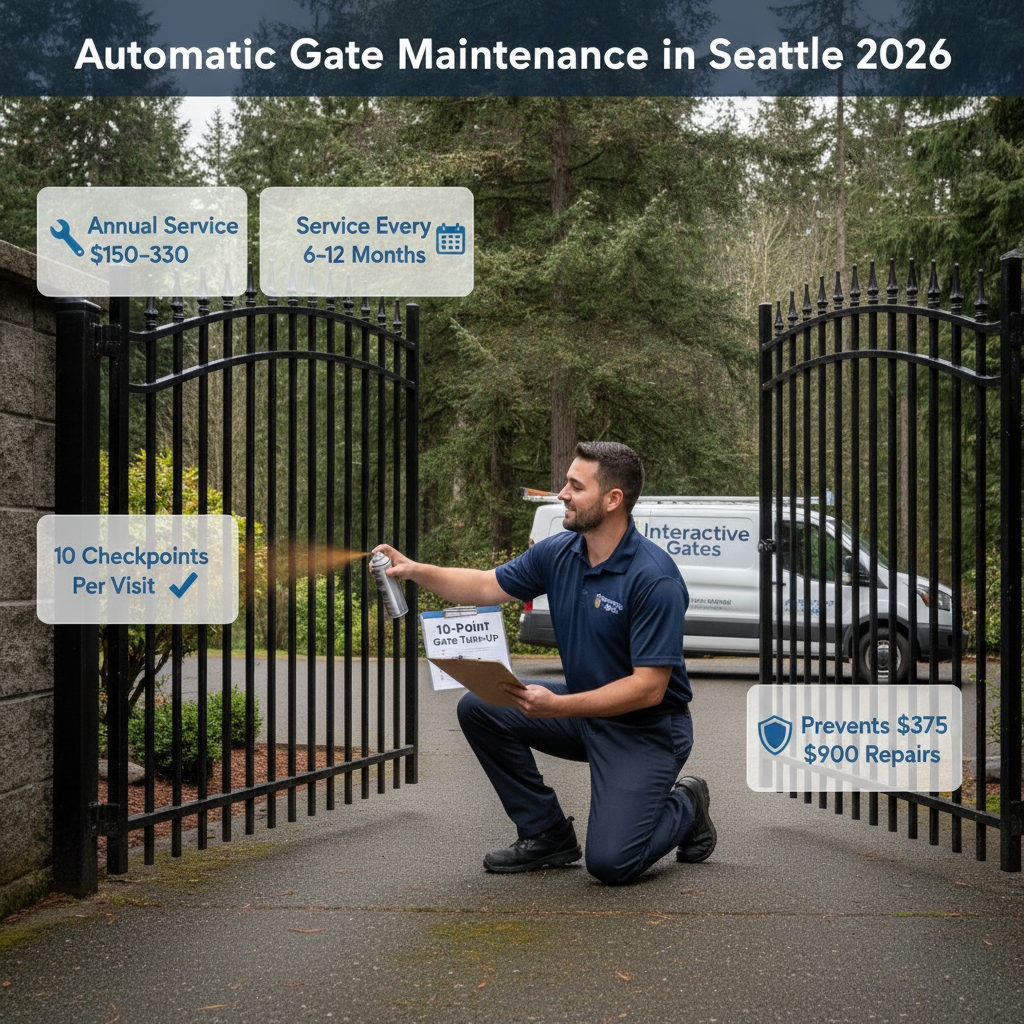
- Rain, salt air, and freeze-thaw cycles make Seattle gates work up to 40% harder than gates in dry climates, accelerating wear on hinges, chains, and circuit boards.
- Most operators should be serviced every 6–12 months — or every 10,000 cycles, whichever comes first.
- Skipping lubrication alone can cut a gate motor's lifespan from 15 years down to 7–9 years in the Pacific Northwest climate.
- A full 10-point professional tune-up typically takes 60–90 minutes and covers operator, hinges, limit switches, safety edges, and access-control hardware.
- LiftMaster, FAAC, and Viking all recommend Seattle-specific maintenance intervals in their 2026 service manuals due to the region's above-average rainfall and corrosion risk.
- Most gate failures in Seattle neighborhoods like Mercer Island, Gig Harbor, and Bellevue trace back to deferred maintenance, not product defects.
Is Your Seattle Gate Making That Grinding Noise Again?
If you've Googled 'why is my electric gate so slow in winter' or 'how often should I service my automatic gate in Seattle,' you're in the right place. Seattle's combination of 140+ annual rain days, coastal salt air in neighborhoods like West Seattle and Gig Harbor, and the occasional hard freeze in Snohomish or Auburn creates a uniquely demanding environment for automatic gate hardware. This guide walks through exactly what maintenance tasks matter, how often to do them, what each one costs in 2026, and how to tell when a tune-up has tipped into a full repair. Residents throughout Seattle, Bellevue, and Gig Harbor deal with these exact issues every rainy season.
Why Does Seattle's Climate Make Gate Maintenance Non-Negotiable?
The Pacific Northwest's weather isn't just inconvenient — it's mechanically destructive in very specific ways. Here's what's actually happening to your gate hardware between service visits:
- Constant moisture infiltration: Seattle averages 38 inches of rain per year, but the real damage comes from the 6–8 months of persistent drizzle and fog that keeps surfaces perpetually damp. Water migrates into gear housings, corrodes rack-and-pinion drives, and causes hinge pins to seize.
- Salt air corrosion: Properties within 2 miles of Puget Sound — including large swaths of West Seattle, Edmonds, Gig Harbor, and Tacoma — face accelerated metal oxidation. Stainless-steel hardware rated for inland use can show surface rust within 18 months in these zones.
- Freeze-thaw cycling: While Seattle rarely sees sustained hard freezes, Auburn, Snohomish, and Lynnwood can hit 25–28°F on winter nights. Water that's infiltrated hinge joints or conduit connections expands, loosening fasteners and cracking grease seals.
- Organic debris: Douglas fir needles, maple seeds, and leaf matter pack into slide gate tracks and around swing gate hinges throughout fall and winter, jamming limit switches and forcing operators to draw excess current.
The net effect: a gate that might need servicing once every 14–18 months in Phoenix needs attention every 6–10 months in the greater Seattle area.
What Does a Professional Gate Tune-Up Actually Include?
Not all maintenance visits are equal. A thorough professional service call in 2026 should cover at least ten distinct checkpoints. Here's what Interactive Gates & Security technicians inspect and adjust on a standard Seattle tune-up:
- Operator inspection: Check motor brush wear, capacitor health, and control board for moisture intrusion or burn marks. For LiftMaster CSW200 and FAAC 844 operators, this includes a firmware version check — both brands pushed updates in early 2026 affecting cold-weather torque curves.
- Limit switch calibration: Open and close limits drift over time. A gate that over-travels by even 2 inches puts stress on the motor and can damage the stop post. Recalibration takes about 10 minutes but prevents major mechanical failures.
- Lubrication: Hinges, pivot points, rack drives, and roller chains all need the correct lubricant — not WD-40 (a degreaser, not a lubricant), but a marine-grade silicone spray for hinge pins and a lithium-grease stick for rack drives. In Seattle's wet climate, petroleum-based greases attract grit and form an abrasive paste; silicone stays clean.
- Safety edge and photocell testing: Per UL 325 requirements, all automatic gates must have functional entrapment-protection devices. Technicians should test both the leading-edge safety strip and the photo-eye beam with an obstruction pass, verifying auto-reverse in under 2 seconds.
- Track and hardware inspection: Slide gates need track cleared of debris and roller condition checked. Swing gates need hinge bolts torque-checked — loose anchor bolts are the #1 cause of gate sag in Seattle's clay soils, which shift significantly during the wet season.
- Access control hardware: Keypads, card readers, and intercom stations need weatherproofing inspected. Silicone seals around keypad faceplates dry out and crack within 2–3 years in UV-exposed locations.
- Battery backup test: Seattle sees grid outages during windstorms (especially November through March). A backup battery that tests at full voltage but has degraded internal capacity will fail to cycle the gate more than 2–3 times during an outage. Load-testing takes 5 minutes and can save a very inconvenient evening.
- Gate structure check: Look for frame welds showing stress cracks, pickets loosening in their frames, and any signs of vehicle strike damage to posts or hinges.
Pro Tip: Ask your service tech to document the torque settings and limit-switch positions in a service report. If you ever need emergency repair from a different company, those baseline numbers cut diagnostic time and save troubleshooting labor.
How Often Should You Service Your Seattle Gate in 2026?
Maintenance frequency depends on gate type, usage volume, and location. Here are the current 2026 guidelines used by technicians serving the greater Seattle metro:
- Low-use residential gate (under 20 cycles/day, inland locations like Bellevue or Auburn): Full professional service once per year, plus a DIY lubrication pass every spring after the rainy season ends.
- Moderate-use residential gate (20–50 cycles/day, or any property within 2 miles of saltwater): Professional service every 6–8 months. This applies to a significant portion of properties in Tacoma, Gig Harbor, and West Seattle.
- High-use residential or light commercial gate (50–150 cycles/day): Every 4–6 months. At this usage rate, a Viking SL-3000 slide operator will accumulate 10,000 cycles in roughly 5–6 months — the manufacturer's recommended service interval.
- HOA or commercial gate (150+ cycles/day): Quarterly inspection minimum, with monthly visual checks by on-site staff. See our HOA and commercial gate page for dedicated maintenance contract options.
What Does Gate Maintenance Cost in Seattle in 2026?
Prices below reflect current Seattle-metro labor rates and parts costs as of mid-2026:
Pro Tip: Schedule your annual or semi-annual service for September or March — just before the main rainy season ramps up, and again just after it ends. September appointments book out 2–3 weeks in Everett, Lynnwood, and Bellevue, so don't wait until the first big October storm to call.
Interactive Gates & Security prices (late 2026): a tune-up is $225 per gate. Common parts: backup battery $375, safety edge $450, control board from $525. A repair visit is $400, with an itemized written quote before any further work.
What Can You Do Yourself Between Professional Visits?
There's meaningful DIY maintenance that saves money and extends hardware life between professional visits. Here's what's safe and genuinely effective for a homeowner to do:
- Track cleaning (slide gates): Use a stiff brush to clear debris from the ground track every 4–6 weeks during fall. A clogged track forces the drive motor to work against resistance, shortening its lifespan measurably.
- Hinge lubrication (swing gates): Apply a marine-grade silicone spray to all exposed hinge pins every 3 months. Takes 5 minutes. This single habit extends hinge life by 3–5 years in Seattle's climate.
- Photocell lens wipe: Clean the photo-eye lenses with a microfiber cloth monthly. Spider webs and water spots on lenses are the most common cause of phantom reversals and 'gate won't close' calls.
- Visual inspection after storms: After any windstorm, walk the gate perimeter and check for debris jammed in the mechanism, and verify the gate fully opens and closes without hesitation before relying on it.
What NOT to do yourself: don't adjust limit switches without knowing the correct stop positions, don't attempt to re-tension a hydraulic swing arm (FAAC or BFT units), and don't disassemble the operator housing unless you're comfortable with 24V DC wiring. Mistakes on the control board can trigger UL 325 safety faults that require a full re-commissioning by a licensed technician.
How Do You Know When Maintenance Has Crossed Into Repair?
Some symptoms during a tune-up signal that you're past routine maintenance and into repair territory:
- A battery that won't hold a charge: a replacement backup battery is $375.
- A safety edge that's torn or not responding: a new safety edge is $450.
- Erratic behavior, error codes or a dead control board: a replacement board starts at $525.
- Grinding, stalling or a motor that hums but won't move: we diagnose it on a $400 repair visit and give you an itemized written quote before any further work.
In One Minute: Seattle Gate Maintenance Recap
Seattle gates need servicing every 6–12 months — more often near the Sound or in high-use applications. An Interactive Gates & Security tune-up is $225 and covers the operator, hinges, safety devices, access control and battery backup. The right lubricant is marine-grade silicone or lithium grease, not WD-40. Between visits, clean the track or hinges monthly and wipe the photocell lenses. A yearly $225 tune-up almost always pays for itself by preventing a single unplanned repair. The most common failure points in Seattle — seized hinges, gear wear, and loose anchor bolts — are all preventable with consistent service. View past projects and gate styles in our portfolio, or design your own gate at our gate designer tool.
Frequently Asked Questions: Gate Maintenance in Seattle
How much does annual gate maintenance cost in Seattle in 2026?
An Interactive Gates & Security tune-up is $225 for a residential gate, and most homes need one a year. Gates that cycle heavily, sit near salt water or serve an HOA benefit from more frequent visits. Common parts found during a tune-up: backup battery $375, safety edge $450, control board from $525.
How often should I have my automatic gate serviced in Seattle?
For most residential gates in inland Seattle suburbs like Bellevue or Auburn, once per year is the minimum. Properties near saltwater (Gig Harbor, West Seattle, Tacoma waterfront) should schedule service every 6–8 months due to accelerated corrosion. High-use gates processing 50 or more cycles per day need service every 4–6 months regardless of location.
What lubricant should I use on my gate in Seattle's wet climate?
Use a marine-grade silicone spray for hinge pins, pivot points, and any exposed metal-on-metal contact. Use a lithium-grease stick or marine-grade lithium spray for rack-and-pinion drives and roller chains. Avoid WD-40 — it's a water displacer and degreaser, not a lubricant, and it actually strips protective grease from gears. Petroleum-based greases should also be avoided in Seattle because they attract the grit and organic debris that's constantly present in this climate, forming an abrasive compound that accelerates wear.
Can I do my own gate maintenance, or do I need a professional?
Homeowners can safely handle track cleaning, hinge lubrication, photocell lens cleaning, and visual post-storm inspections. Battery indicator monitoring is also a simple DIY habit. However, limit-switch calibration, hydraulic arm adjustments (on FAAC or BFT operators), control board diagnostics, and UL 325 safety-device compliance testing should be left to a licensed gate technician. Incorrectly adjusted limit switches can cause gate damage or create an entrapment hazard.
What are the most common gate problems in Seattle that maintenance prevents?
The top four preventable failures in the Seattle area are: (1) seized hinge pins from moisture and lack of lubrication, (2) loose anchor bolts from clay-soil movement during the wet season, (3) rack-and-pinion gear wear from debris-contaminated grease, and (4) degraded backup batteries that fail during winter power outages. All four are caught and addressed during a routine tune-up before they become costly repairs.
Does my gate need maintenance if it seems to be working fine?
Yes. Many of the most common failure modes — capacitor degradation, hinge-bolt loosening, and battery capacity loss — don't produce obvious symptoms until the component fails completely. A gate that appears to work fine may have a backup battery that will only cycle the gate twice during a power outage, or hinge bolts that are 70% of the way to shearing. Preventive service catches these issues on the technician's checklist, not at 10pm during a November windstorm.
Ready to Schedule Your Seattle Gate Service?
Whether you have a swing gate on a Bellevue hillside or a slide gate at a Snohomish acreage property, consistent maintenance is the single highest-ROI thing you can do to protect your gate investment. If you'd like to get on the schedule, see recent local work, or ask about a maintenance contract, the contact page is the easiest place to start. You can also explore residential gate options if you're thinking about an upgrade while a technician is already on-site. No pressure — just straight answers from people who work on Seattle gates every day.
FAQs
Interactive Gates & Security
Gates, fencing, metal work and access control since 2004
Washington · Seattle–Tacoma
(425) 900-6083Contact@interactivegates.com- Bellevue 12721 NE Bel Red Rd Ste 230, Bellevue, WA 98005Directions
- Lynnwood 16825 48th Ave W Ste 341, Lynnwood, WA 98037Directions
- Auburn 1608 2nd St NE, Auburn, WA 98002Directions
- Tacoma 5401 S Tacoma Way, Tacoma, WA 98409Directions
Oregon · Portland–Vancouver
(971) 351-9750Portland@interactivegates.com- Portland 555 SE Martin Luther King Jr Blvd Ste 2038, Portland, OR 97214Directions
- Lake Oswego 4800 Meadows Rd, Lake Oswego, OR 97035Directions
- Vancouver 1220 Main St #425, Vancouver, WA 98660Directions
Southern California · LA–Orange County
(657) 312-3376LosAngeles@interactivegates.com- Los Angeles 10880 Wilshire Blvd Suite 1101, Los Angeles, CA 90024Directions
- Rolling Hills Estates 609 Deep Valley Dr Suite 200, Rolling Hills Estates, CA 90274Directions
- Orange 1100 W Town and Country Rd Suite 1250, Orange, CA 92868Directions
- Dana Point 34231 Camino Capistrano, Dana Point, CA 92624Directions
Services
Residential gatesCommercial & HOA gatesGate repairGate openersFencingMetal workSmart securityWhy us
Since 2004 · 800+ gates installed10-year warranty on gates we buildLiftMaster Verified DealerBBB AccreditedFinancing through SynchronyAbout Interactive Gates & Security. Interactive Gates & Security is a family-owned gate, fence and access-control company serving homeowners, HOAs and businesses since 2004. We design, weld and install automatic driveway gates, commercial and HOA gates, fences, railings and custom metal work in our own metal shop, and we install and repair gate openers, keypads, intercoms and cameras of any brand. 800+ gates installed, 2,000+ customers, a 10-year warranty on gates we build, financing through Synchrony, and an itemized written quote before any work.
© 2026 Interactive Gates & Security · Washington, Oregon and Southern California. Interactive Gates & Security is a registered trade name of Blue Lake Construction LLC. Washington Contractor Registration #BLUELLC760C3.