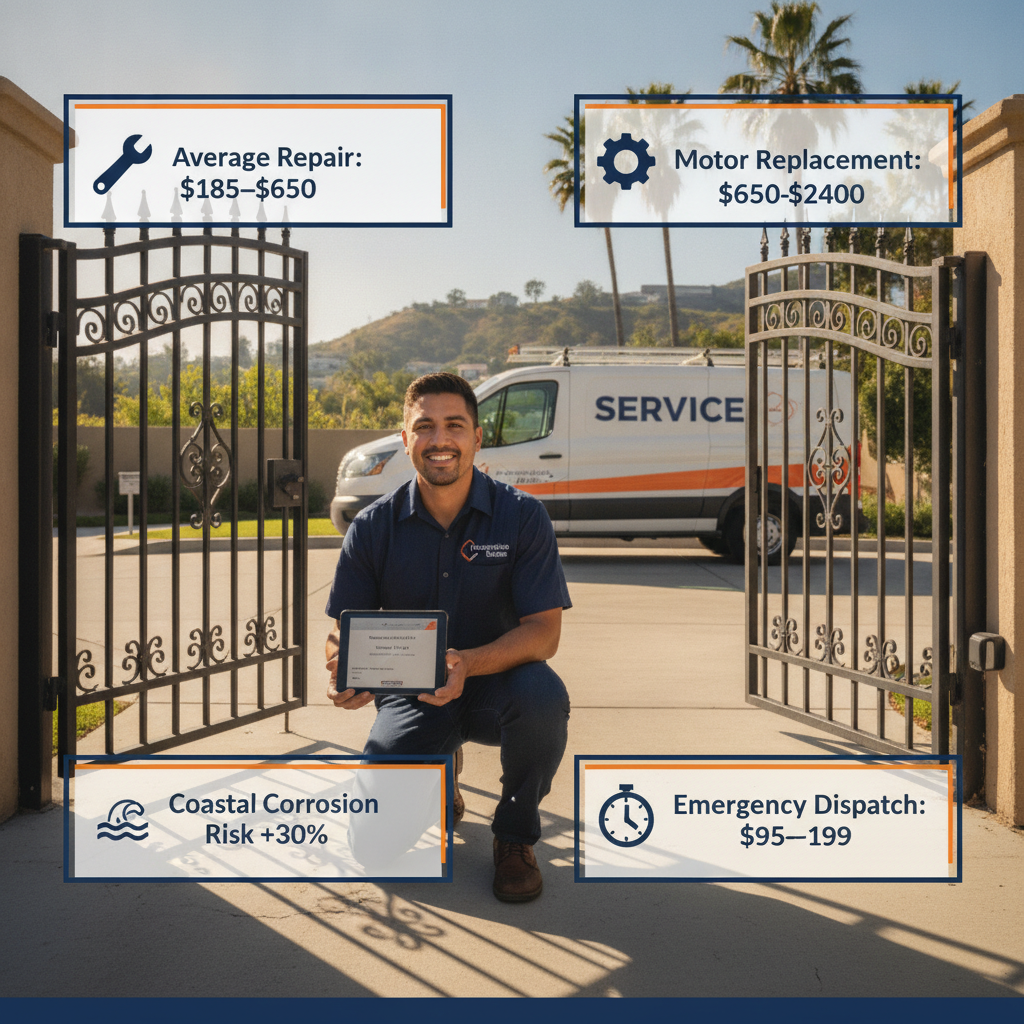
- Average gate repair in Los Angeles runs $185–$650 for most common issues in 2026.
- Motor/operator replacement costs $650–$2,400 depending on brand and gate weight class.
- Intercom and access-control repairs average $250–$900, with video upgrade add-ons pushing higher.
- Salt-air corrosion near the coast (Laguna Beach, San Clemente) accelerates hardware wear by 30–40% versus inland areas.
- Most gate technicians charge $95–$165 per hour for labor in the LA metro, with a typical service call lasting 1–2 hours.
- Preventive tune-ups cost $149–$249 and can extend operator life by 3–5 years versus reactive-only repairs.
- LiftMaster, FAAC, and Viking parts are generally stocked locally, cutting repair wait times to 1–3 business days in most LA neighborhoods.
- Permit requirements vary by city — Los Angeles proper, Rolling Hills, and Orange each have different thresholds for gate work that triggers a building permit.
Why Is My Automatic Gate Not Working — and What Will It Cost to Fix in LA?
Your electric gate grinds to a halt on a Tuesday morning. The intercom is dead. The motor hums but nothing moves. Or maybe the gate swings fine but won't latch. If you live anywhere from Rolling Hills to Orange to Laguna Beach and you are Googling 'gate repair near me' or 'how much does gate repair cost in Los Angeles,' you already know the frustration. This guide breaks down every common failure type, what parts cost in 2026, what labor runs in the LA market, and how your neighborhood's microclimate affects the repair bill.
What Is the Average Cost to Repair an Automatic Gate in Los Angeles in 2026?
For a typical residential swing or slide gate in the greater Los Angeles area, most repair visits land between $185 and $650 all-in — parts plus labor for a standard single-issue call. Complex repairs involving motor replacement, circuit board failure, or full access-control rewiring push into the $800–$2,800 range. Here is how the numbers break down by problem type:
- Gate off track (slide gate): $185–$420. Includes re-racking or replacing a damaged rack section and re-aligning the trolley wheels.
- Broken or bent hinge (swing gate): $200–$550. Mild-steel hinges cost $35–$90 each; stainless or powder-coated hardware runs $80–$180 per hinge.
- Damaged or worn limit switches: $150–$310. Quick swap, usually under an hour of labor.
- Safety loop detector replacement: $220–$480 installed. Loop wire, detector board, and labor for saw-cutting a new loop into asphalt or concrete.
- Gate arm or post repair (after vehicle strike): $350–$1,200 depending on structural damage.
- Control board replacement: $400–$950 parts and labor. LiftMaster control boards run $180–$380; FAAC boards $220–$420; Viking boards $190–$360.
- Full operator/motor replacement: $650–$2,400 installed. See the detailed breakdown below.
How Much Does Gate Motor Replacement Cost in Los Angeles?
When a motor is burned out or beyond economic repair, replacement is the call. In the LA metro in 2026, operator replacement costs depend heavily on gate type, weight, and the brand you choose:
- LiftMaster LA400 (residential swing, up to 300 lb gate): $680–$950 installed. The LA400 is one of the most common residential operators in Southern California and parts are widely stocked at local distributors in Commerce and Chatsworth.
- LiftMaster SL3000 (slide gate, residential/light commercial): $950–$1,450 installed. Handles gates up to 40 feet and 1,500 lbs.
- FAAC 400 series (swing, residential): $820–$1,150 installed. Italian-engineered, popular in higher-end communities like Rolling Hills and Laguna Beach for its quiet hydraulic operation.
- Viking Access G100 (slide gate): $1,100–$1,600 installed. Heavy-duty brushless motor; a favorite for HOA entry points in Orange and Anaheim Hills.
- Elite SL-1500B (slide, heavy-duty commercial): $1,400–$2,400 installed. Appropriate for high-cycle commercial sites doing 100+ cycles per day.
Labor for motor swap alone is typically $250–$480 in LA, covering removal of the old unit, mounting the new one, programming, and cycle testing. Expect the total job to take 2–4 hours on site.
Pro Tip: If your operator is 10+ years old and the control board has already been replaced once, full motor replacement is almost always more economical than a second board swap. A new operator resets your maintenance clock and typically carries a 1–3 year parts-and-labor warranty.
How Does the LA Coastal Climate Affect Gate Repair Costs?
This is the part most generic guides skip entirely. The Los Angeles metro spans dramatically different microclimates, and where your gate lives matters enormously for what breaks — and how fast.
- Coastal zones (Laguna Beach, San Clemente, parts of Los Angeles near the water): Salt-laden marine air accelerates oxidation on exposed steel hardware. Hinges, fasteners, and rack teeth can corrode to the point of binding in as little as 3–5 years without annual lubrication and zinc-rich primer touch-ups. Expect to budget 15–30% more per repair visit for hardware replacement versus inland properties.
- Inland valley heat (Orange, Anaheim Hills, East LA): Summer temperatures regularly hitting 100°F+ stress hydraulic fluid in FAAC and similar hydraulic operators. Fluid changes every 2–3 years ($95–$145) prevent the most common inland failure — sluggish or jerky movement in hot months.
- Fire-prone foothill zones (Rolling Hills, Palos Verdes): Ash and particulate from seasonal fires clog sensor eyes and limit-switch grooves. After any significant fire event nearby, a $149 tune-up that includes sensor cleaning and forced-limit recalibration is cheap insurance against a nuisance service call.
- Urban density zones (central Los Angeles): High vehicle volumes at driveway gates push cycle counts to 30–60 per day versus a typical residential 10–15. A gate doing 50 cycles daily will hit 18,000 cycles per year — the rated service life of a mid-grade operator in roughly 3–4 years instead of 7–10.
What Do Access Control and Intercom Repairs Cost in LA in 2026?
Modern gate systems are as much electronics as mechanics. Intercom, keypad, and app-based access failures are a growing share of LA repair calls — especially as older telephone-entry systems age out and owners want smartphone integration.
- Telephone entry system repair (Doorking, Linear, Liftmaster): $175–$420. Often a failed power supply, corroded terminal block, or outdated programming.
- Telephone entry system replacement with video intercom: $850–$2,200 installed. Units like the LiftMaster CAPXLV or DoorKing 1837 with camera run $480–$1,100 in parts alone.
- Keypad replacement (surface-mount, weatherproof): $180–$350 installed. Budget for a Keypad-only swap; wiring typically reuses existing conduit.
- Loop detector board replacement: $220–$480. Loop detectors fail from power surges, which are more common in older LA neighborhoods with aging utility infrastructure.
- Wireless receiver or remote pairing issue: $95–$175 (usually a 1-hour diagnostic and programming call).
- Full access-control upgrade (new controller, readers, fob system): $1,200–$4,500+ for commercial or HOA entry points. See our commercial gate and HOA page for community-specific pricing.
Do You Need a Permit to Repair a Gate in Los Angeles?
Minor repairs — replacing a motor, swapping a hinge, or reprogramming an intercom — generally do not require a permit in most LA-area jurisdictions. However, structural work that changes the gate's footprint, height, or electrical service can trigger a permit requirement. Key local rules in 2026:
- City of Los Angeles: New gate installation or any work that modifies load-bearing posts typically requires a building permit. Operator swap-in-kind usually does not. Always confirm with LADBS (LA Department of Building and Safety) for your specific parcel.
- Rolling Hills: The Rolling Hills Community Association has additional design-review requirements for any visible exterior change, including gate panel replacement. Budget an extra 3–6 weeks for HOA approval if you are changing gate style or material.
- Orange: Minor repairs are permit-exempt; new gate construction or electrical panel work requires a City of Orange permit, which runs $150–$400 in fees.
- San Clemente and Laguna Beach: Both cities flag coastal-zone properties for additional review under California Coastal Act rules if the work is within the coastal development permit area. Your installer should verify the parcel's coastal status before quoting structural work.
Pro Tip: Always ask your gate repair company whether the scope of work requires a permit pull. A reputable installer will check proactively. If a company says 'we never pull permits for gate work' as a blanket policy, that is a red flag — especially for any job involving new electrical connections or post-setting in concrete.
How Much Does an Emergency Gate Repair Cost in Los Angeles?
Gate stuck open at midnight? Vehicle trapped inside a parking structure? Emergency after-hours service in the LA metro carries a premium. In 2026, most companies charge:
- After-hours dispatch fee: $95–$195 on top of standard labor rates.
- Weekend/holiday rates: 1.25x–1.5x the standard hourly labor rate, so $120–$250 per hour versus the standard $95–$165.
- Emergency same-day motor replacement: Add $200–$400 to standard installed prices for expedited parts sourcing if the unit is not already on the truck.
The fastest way to avoid an emergency call is a twice-yearly tune-up. Most LA-area gate companies offer maintenance plans at $249–$449 per year covering two visits, lubrication, safety testing, and cycle count checks.
In One Minute: LA Gate Repair Cost Summary for 2026
Standard repairs run $185–$650. Motor replacement lands at $650–$2,400 depending on brand and gate type. Coastal neighborhoods pay a 15–30% premium due to salt-air hardware wear. Labor is $95–$165/hour, with most visits lasting 1–2 hours. Access-control and intercom work adds $175–$2,200+ depending on whether it is a fix or a full upgrade. Permits are rarely needed for like-for-like repairs but matter for structural or electrical changes, and the rules differ across LA, Rolling Hills, Orange, San Clemente, and Laguna Beach. Annual maintenance plans at $249–$449/year are the single best investment to keep repair bills low over a gate's 10–20 year life. Browse real completed projects in Southern California on our project portfolio or check what other LA homeowners say on our reviews page.
Frequently Asked Questions About Gate Repair in Los Angeles
How long does a typical gate repair take in the LA area?
Most single-issue repairs — a broken hinge, failed limit switch, or off-track slide gate — are completed in 1–2 hours on site. Motor replacements run 2–4 hours. Complex access-control or intercom upgrades may require a second visit if special-order parts are needed, adding 2–5 business days to the timeline. Parts availability is generally good in the LA metro because major distributors serving LiftMaster, FAAC, Viking, and Elite dealers are located in Commerce, Chatsworth, and Anaheim.
Is it cheaper to repair or replace an old automatic gate operator?
If the operator is under 8 years old and this is the first major failure, repair is almost always the better value. If the unit is 10–15 years old, has had multiple board or motor repairs, or is a discontinued model with hard-to-source parts, replacement at $650–$2,400 installed typically costs less over a 5-year horizon than repeated repair bills that add up to $400–$800 per incident. Ask your technician for the model's manufacture date — it is stamped on the motor housing or operator ID plate.
Why does my gate work fine in the morning but slow down in the afternoon?
This is classic heat-related hydraulic sluggishness, most common in inland LA communities like Orange and Anaheim Hills during summer. As ambient temperature climbs above 90°F, hydraulic fluid in operators like the FAAC 400 series thins and loses pressure. A fluid flush and refill with high-temp hydraulic oil ($95–$145) usually resolves it. If the problem persists, the pump seal may be worn, pushing the repair into the $300–$600 range.
What causes a gate to reverse before it fully closes?
The most common culprits are a dirty or misaligned photo-eye safety sensor, a failing loop detector, or an obstruction-force limit set too sensitively in the operator's programming. In coastal areas like Laguna Beach and San Clemente, salt film builds up on photo-eye lenses and triggers false obstruction readings. Cleaning the sensor lenses and recalibrating force limits is a $95–$175 diagnostic call in most cases.
Can I get a residential gate repaired and a new design installed at the same location in LA?
Yes — and many homeowners combine a motor replacement with a panel refresh or full gate replacement when the existing panels are corroded or damaged beyond cosmetic repair. If you want to explore what a new gate could look like before committing, try the Interactive Gates design visualizer to preview styles and materials. For a full residential gate project, visit our residential gate services page or contact our LA team for a site estimate.
Are gate repair costs higher in gated communities like Rolling Hills versus standard LA neighborhoods?
Somewhat, yes — for two reasons. First, Rolling Hills and similar master-planned communities often have heavier-duty commercial-grade operators at entry points, and commercial operator parts cost more. Second, HOA design-review requirements can add time and occasionally require specific hardware finishes (powder-coated black, for example) that cost more than standard galvanized options. Expect a 10–20% premium on materials in HOA-governed communities. For community-level gate service, see our HOA and commercial gate page or visit the Rolling Hills service area page.
Ready to Get Your Gate Diagnosed?
Whether you are dealing with a gate that grinds, stutters, or simply will not budge, the best next step is an on-site diagnostic — not a phone guess. Our team serves homeowners and property managers across Los Angeles, Laguna Beach, San Clemente, Orange, and Rolling Hills. A diagnostic visit is a low-cost way to get a clear repair-vs-replace recommendation with real numbers, no pressure. Reach out to schedule a visit and get your gate running right before the next heat wave or coastal fog season takes another toll on your hardware.