- HOA gate system projects in Portland typically run $18,000–$85,000+ depending on gate type, entry count, and access technology.
- Slide gates handle Portland's sloped terrain far better than swing gates — hillside communities in Lake Oswego and West Hills almost always need slide or vertical pivot.
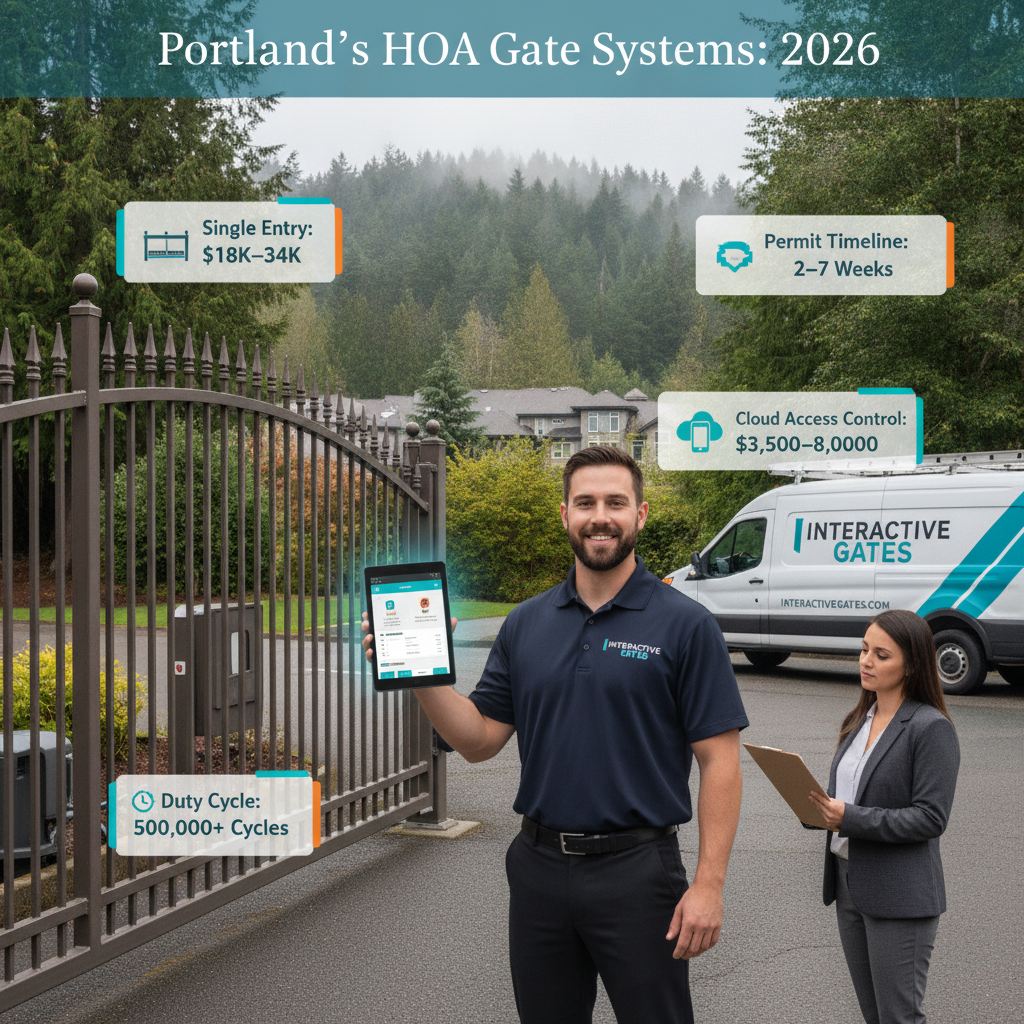
- LiftMaster and FAAC are the top commercial operators for Portland HOAs, rated for 500,000+ duty cycles and wet-climate resilience.
- Telephone entry systems start around $1,200–$2,500 per unit; cloud-managed systems like DoorKing or Aiphone GT Series add remote admin capabilities HOA boards love.
- Oregon's wet season (Oct–Apr) accelerates corrosion on untreated hardware — specify hot-dip galvanized or powder-coat Grade A finish on any ironwork.
- Permit timelines in Portland metro average 3–6 weeks for residential community gates; Beaverton and Hillsboro can move faster at 2–4 weeks.
- Annual maintenance contracts run $600–$1,800/year for a two-entry HOA gate system in the Portland market.
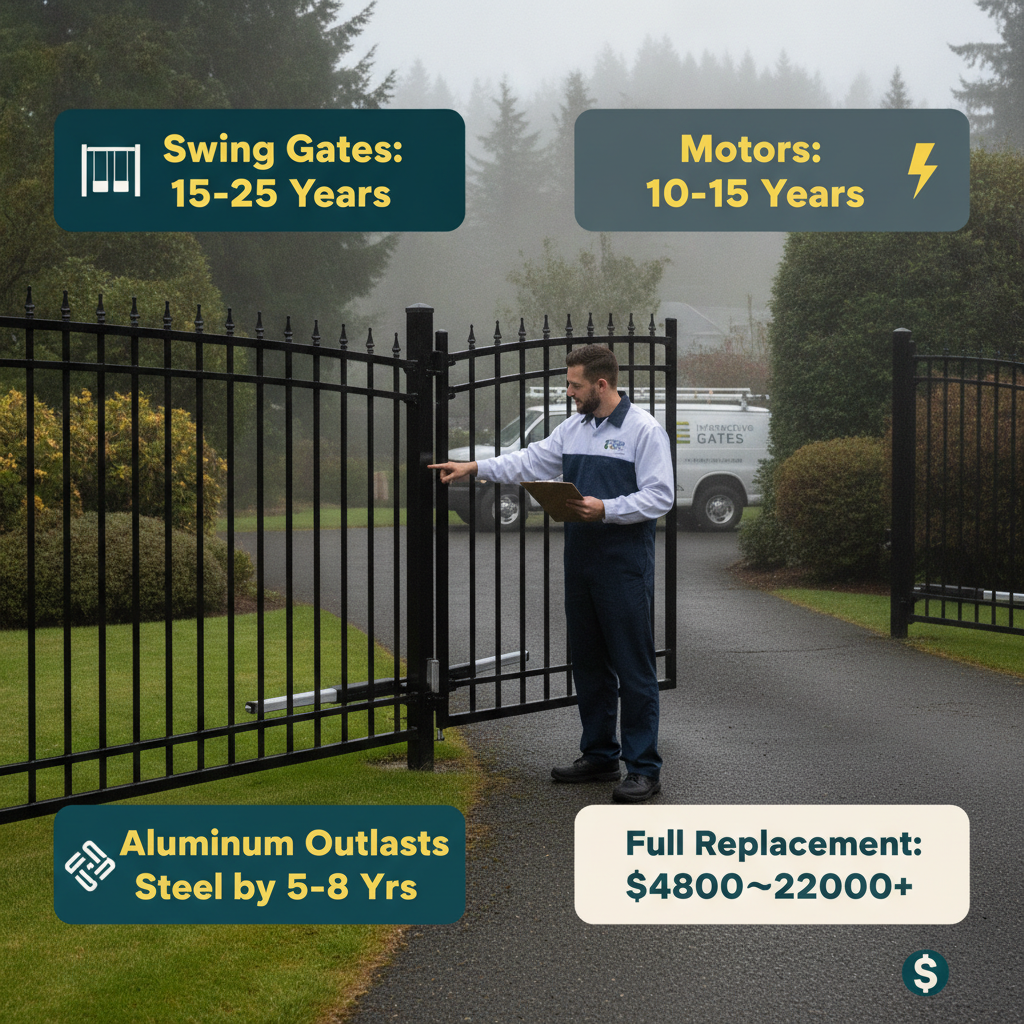
- Most well-maintained HOA gate systems last 15–25 years on the mechanical side, with electronics refreshed every 8–12 years.
What Does an HOA Gate System Actually Cost in Portland in 2026?
If you're on a Portland-area HOA board and you've Googled 'HOA gate installation cost Portland' or 'how much does a community gate system cost,' you already know the answers online are frustratingly vague. This post gives you the real numbers — broken down by gate type, access control tier, and the specific terrain and climate challenges that affect communities from Lake Oswego to Hillsboro to Gresham.
Let's start with what drives cost, then build toward a full picture of what your community actually needs.
What Are the Main Cost Components of an HOA Gate System in Portland?
A complete HOA gate installation has four cost buckets: the gate itself (fabrication and materials), the operator (the motor and drive system), the access control hardware (how residents and guests get in), and installation labor plus any civil work like concrete pads, conduit trenching, and electrical service.
Here's a realistic 2026 breakdown for a typical Portland-area gated community with one vehicle entry, one pedestrian gate, and a two-lane exit:
- Single slide gate, 16 ft, ornamental steel: $4,500–$9,500 fabricated and primed
- Commercial slide gate operator (LiftMaster CSW24V or FAAC 844 ER): $2,200–$4,800 installed
- Telephone entry / keypad system (DoorKing 1837 or 1916): $1,800–$3,500 installed
- Loop detectors (entry + exit): $400–$900 per lane
- Concrete pad, conduit, and electrical rough-in: $2,500–$6,000 depending on run distance
- Pedestrian gate with keypad or fob reader: $2,000–$5,500
- Exit lane arm or secondary slide gate: $1,500–$4,500
Total for a basic single-entry HOA setup: $18,000–$34,000. A dual-entry community (main entrance plus secondary exit-only) with cloud-managed access control runs $35,000–$65,000. High-security communities in areas like Lake Oswego or West Portland Hills with video intercoms, license plate recognition, and backup power can reach $75,000–$110,000+.
What Gate Type Is Right for Portland HOA Terrain?
Portland's topography is not flat. Anyone who has driven through the West Hills, Dunthorpe, or the neighborhoods above Beaverton knows that level driveways are the exception, not the rule. Gate type selection is not just an aesthetic choice — it's an engineering decision.
Slide gates are the default recommendation for any entry with more than a 2% grade on either side of the opening. A swing gate needs 12–20 feet of level swing clearance per leaf; on a slope, that's either impossible or requires expensive ground-grading. Slide gates run parallel to the fence line and sidestep the problem entirely. They're also faster (3–6 second open time on a 16-ft gate vs. 8–14 seconds for swing) and easier to harden against vehicle impact.
Dual swing gates work well on flat entries — think newer subdivisions in Hillsboro or parts of Beaverton where the land was graded before development. They look more traditional, which some HOAs prefer aesthetically. Operators like the LiftMaster LA500 or FAAC 844 ER handle these reliably in rainy conditions.
Vertical pivot (vertical lift) gates are increasingly popular for communities with very tight right-of-way constraints — when you can't slide left or right and can't swing open. They lift straight up. They cost more ($8,000–$16,000 for the gate alone) but solve geometry problems nothing else can.
Barrier arms are not a security solution for residential HOAs — they're a traffic management tool. If a determined driver wants through, a barrier arm won't stop them. Use them for parking management or secondary interior lanes, not primary community entry.
Which Access Control System Is Best for a Portland HOA in 2026?
Access control is where HOA boards feel the most confusion — and where choosing wrong creates the most ongoing headaches. Here's how to think about the tiers:
Tier 1 — Basic keypad entry ($800–$1,500 installed): A single-code keypad like the Linear AK-11 or LiftMaster KPW250. Fine for very small communities (under 20 units) with low turnover. The problem is code sharing — once the code is out, it's out. When a resident moves, you change the code for everyone.
Tier 2 — Telephone entry system ($1,800–$4,000 installed): Systems like the DoorKing 1837, 1916, or the Aiphone JP series. Residents get a directory listing; guests call from the panel and the resident buzzes them in from any phone. These are the workhorse of Portland HOA gates. The DoorKing 1916 supports up to 3,000 directory entries and has been the standard in communities from Oregon City to Gresham for years.
Tier 3 — Cloud-managed access ($3,500–$8,000 installed, plus $60–$180/month SaaS): Platforms like DoorKing DKS Access Plus, Brivo, or Verkada allow HOA managers to add, delete, and audit residents remotely from a web dashboard. When someone sells their home, their credential is deleted in 30 seconds — no rekeying, no site visit. For communities with professional management companies, this tier pays for itself in labor savings within two years.
Tier 4 — Video intercom + license plate recognition ($8,000–$20,000+ installed): Systems like the Avigilon LPR camera paired with a Verkada intercom, or the Aiphone GT Series video intercom. Delivery drivers, contractors, and guests are visually verified before the gate opens. For higher-end communities in Lake Oswego or along the west hills, this is increasingly the expectation rather than the upgrade.
Pro Tip: Whatever tier you choose, make sure the system stores an audit log of every entry event. Oregon's landlord-tenant and HOA governance frameworks increasingly require documentation of access in disputes. DoorKing's DKS Access Plus and Brivo both export time-stamped logs on demand.
What Portland-Specific Climate Factors Affect HOA Gate Hardware?
Portland averages 36–43 inches of rainfall per year, mostly concentrated between October and April. That's not extreme by Pacific Northwest standards, but it's sustained — and sustained moisture is the enemy of gate hardware that wasn't spec'd for it.
Key things your installer should be doing for any Portland community gate:
- Gate frame: Specify ASTM A500 Grade C steel tubing (or better) with hot-dip galvanized finish before powder coating. Standard powder coat alone on bare steel will start showing rust at welds within 3–5 years in Portland's climate.
- Operator housing: The LiftMaster CSW24V has a NEMA 3R-rated housing as standard. FAAC's 844 ER series is IP55-rated. Both are appropriate. Avoid operators with unsealed control boards mounted in open junction boxes.
- Gate bottom clearance: Portland also gets ice events (Dec–Feb) roughly 8–12 times per year where ice accumulates on driveways. Slide gate bottom brackets and guide wheels need 1.5–2 inch ground clearance minimum to avoid binding on ice.
- Operator heater kits: For any gate operator in a community above 500 ft elevation (parts of West Hills, Skyline, and communities near Lake Oswego's upper streets), budget $150–$300 for an internal heater kit. Cold-soaked hydraulic fluid in FAAC operators and cold circuit boards in LiftMaster units are the #1 cause of winter service calls.
Pro Tip: Specify a stainless-steel hinge set on any swing gate in a Portland community — standard zinc-plated hinges will seize within two winters. The upcharge is $80–$150 per gate. It's worth every dollar.
How Long Does an HOA Gate System Permit Take in Portland Metro?
Permit timelines are one of the most common sources of project delays. Here's what to expect in 2026 across the Portland metro:
- Portland city proper: 4–7 weeks for a residential community gate permit. The Bureau of Development Services (BDS) reviews for right-of-way impacts, setback compliance, and electrical. Pre-application conferences can save time if your entry is near a public ROW.
- Beaverton: 2–4 weeks. Washington County's permit portal is more efficient than Multnomah County's, and Beaverton's community development office has streamlined gate permits significantly in 2025–2026.
- Hillsboro: 2–4 weeks. Similar to Beaverton — Washington County jurisdiction.
- Lake Oswego: 3–5 weeks. Lake Oswego has its own city permit department and is generally well-organized, but HOA projects sometimes require a neighborhood compatibility review if the gate is visible from a public street.
- Gresham: 3–5 weeks. Multnomah County jurisdiction outside Portland city limits — similar timeline.
- Oregon City: 3–6 weeks. Clackamas County reviews can run slower when volume is high.
Plan for permits to add 3–7 weeks to your project timeline. A reputable installer will pull permits on your behalf and manage the inspection schedule — if a contractor offers to 'skip the permit to save time,' walk away.
What Should an HOA Board's Gate RFP Include in 2026?
If your board is going out for bids, here's the minimum specification list to include so you're comparing apples to apples:
- Gate type (slide / swing / vertical pivot) and opening width in feet
- Steel gauge and finish specification (e.g., 2x2 11-gauge tube, hot-dip galvanized + powder coat)
- Operator brand and model number (not just 'commercial operator')
- Duty cycle rating (insist on 500,000+ cycle minimum for HOA use)
- Access control system brand and model, including software/app details
- Number of resident credentials included in base price
- Loop detector brand and installation method
- Warranty terms: gate structure, operator, access control separately
- Permit pull and inspection included (yes/no)
- Annual maintenance contract pricing
View completed community projects in our portfolio to get a sense of finishes and configurations that work well for Portland HOAs, and check out our reviews from property managers and HOA boards across the metro.
In One Minute: HOA Gate Systems in Portland 2026
A basic single-entry HOA gate in Portland runs $18,000–$34,000. Dual-entry with cloud access control is $35,000–$65,000. High-security video intercom setups reach $75,000–$110,000+. Slide gates are the right call for Portland's sloped terrain; swing gates work on flat entries in Hillsboro and Beaverton. Specify hot-dip galvanized steel and NEMA-rated operators for the rainy season. Permit timelines run 2–7 weeks depending on jurisdiction. Annual maintenance contracts cost $600–$1,800 for a two-entry system. Cloud-managed access platforms like DoorKing DKS Access Plus or Brivo pay for themselves in two years for professionally managed communities. Want to explore gate designs for your community? Try our gate designer tool or request an HOA consultation.
Frequently Asked Questions: HOA Gates in Portland
How much does an HOA gate system cost in Portland in 2026?
A single-entry HOA gate system in Portland ranges from $18,000 to $34,000 for a standard slide gate with telephone entry and loop detectors. Dual-entry communities with cloud-managed access control typically run $35,000–$65,000. High-security configurations with video intercom and license plate recognition can reach $75,000–$110,000 or more depending on the community's size and complexity.
What type of gate works best for Portland HOAs on sloped terrain?
Slide gates are the standard recommendation for Portland HOA entries with any noticeable grade. Swing gates require level clearance for the arc of the leaf — on a slope, that's often impractical or requires expensive ground modification. Vertical pivot gates solve tight right-of-way constraints but cost more. Slide gates are also faster and easier to reinforce for vehicle impact deterrence.
Which access control system is best for a Portland community gate?
For communities with fewer than 50 units and stable residency, a DoorKing 1837 or 1916 telephone entry system is reliable and cost-effective at $1,800–$4,000 installed. For professionally managed HOAs with higher turnover, cloud-managed platforms like DoorKing DKS Access Plus or Brivo ($3,500–$8,000 installed plus a monthly subscription) are worth the investment — remote credential management alone saves significant labor cost over time.
How long does it take to permit an HOA gate in Portland?
Permit timelines in the Portland metro range from 2–4 weeks in Beaverton and Hillsboro (Washington County) to 4–7 weeks in Portland proper (Multnomah County/BDS). Lake Oswego and Oregon City typically fall in the 3–5 week range. Always factor permit time into your project schedule — a reputable installer will pull permits on your behalf.
How often does an HOA gate system need maintenance in Portland?
Most commercial HOA gate operators in Portland should be serviced twice per year: once in the fall before the rainy season (October) to lubricate the drive chain, check board seals, and test safety loops, and once in spring (April–May) after winter stress. Annual maintenance contracts for a two-entry system run $600–$1,800 depending on system complexity. Skipping maintenance is the leading cause of early operator failure in Portland's wet climate.
Can I see examples of HOA gate projects Interactive Gates has done near Portland?
Yes — you can browse completed community and commercial gate projects in our project portfolio. If you're ready to discuss your community's specific needs, you can also connect with our team through our HOA and commercial gate page or reach out directly via our contact page.
Ready to Plan Your Community Gate Project?
The best HOA gate projects start with a clear-eyed look at your community's specific terrain, traffic volume, resident mix, and long-term management model. If you're a board member or property manager in the Portland area — from Portland proper to Salem — we're happy to walk through the options with you, pull example specs, and help you write an RFP that actually gets you comparable bids. No pressure, no upsell — just practical guidance from a team that has installed and maintained community gates across the Pacific Northwest for years.