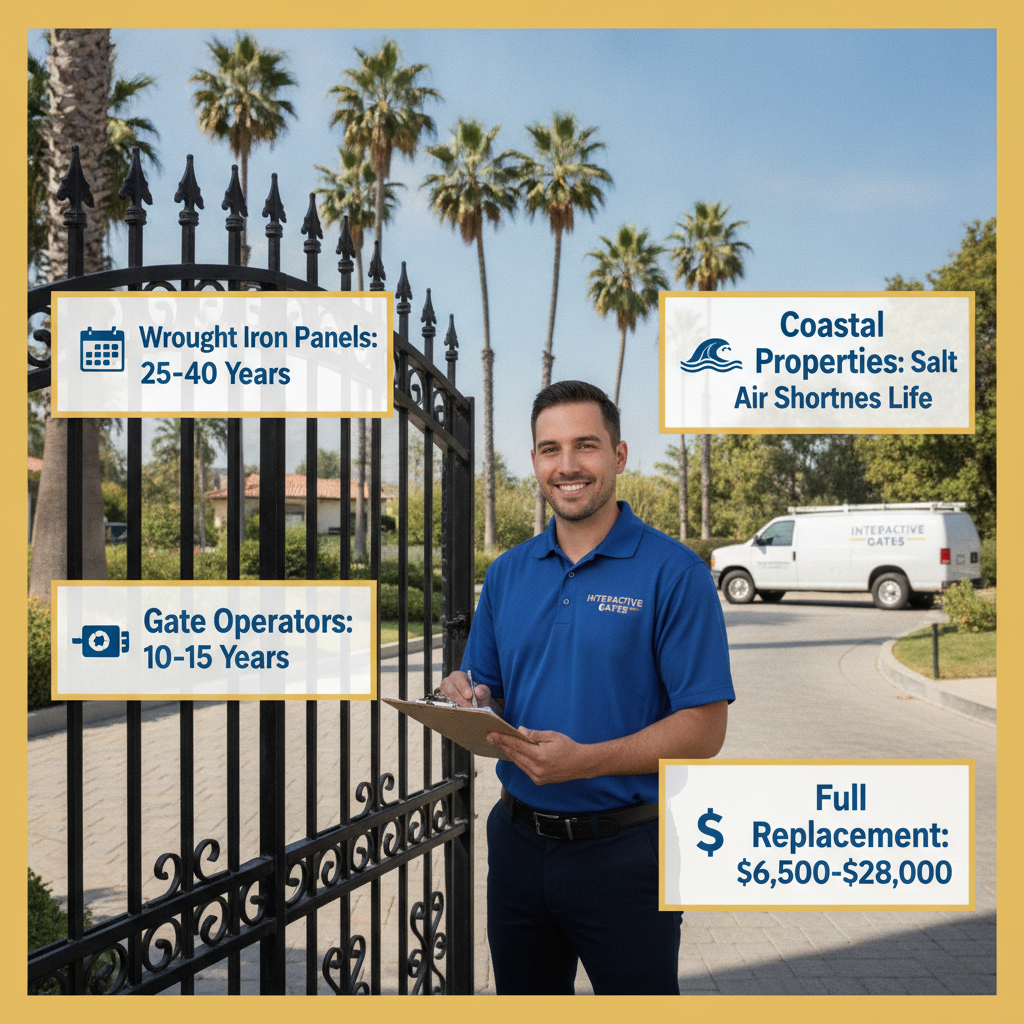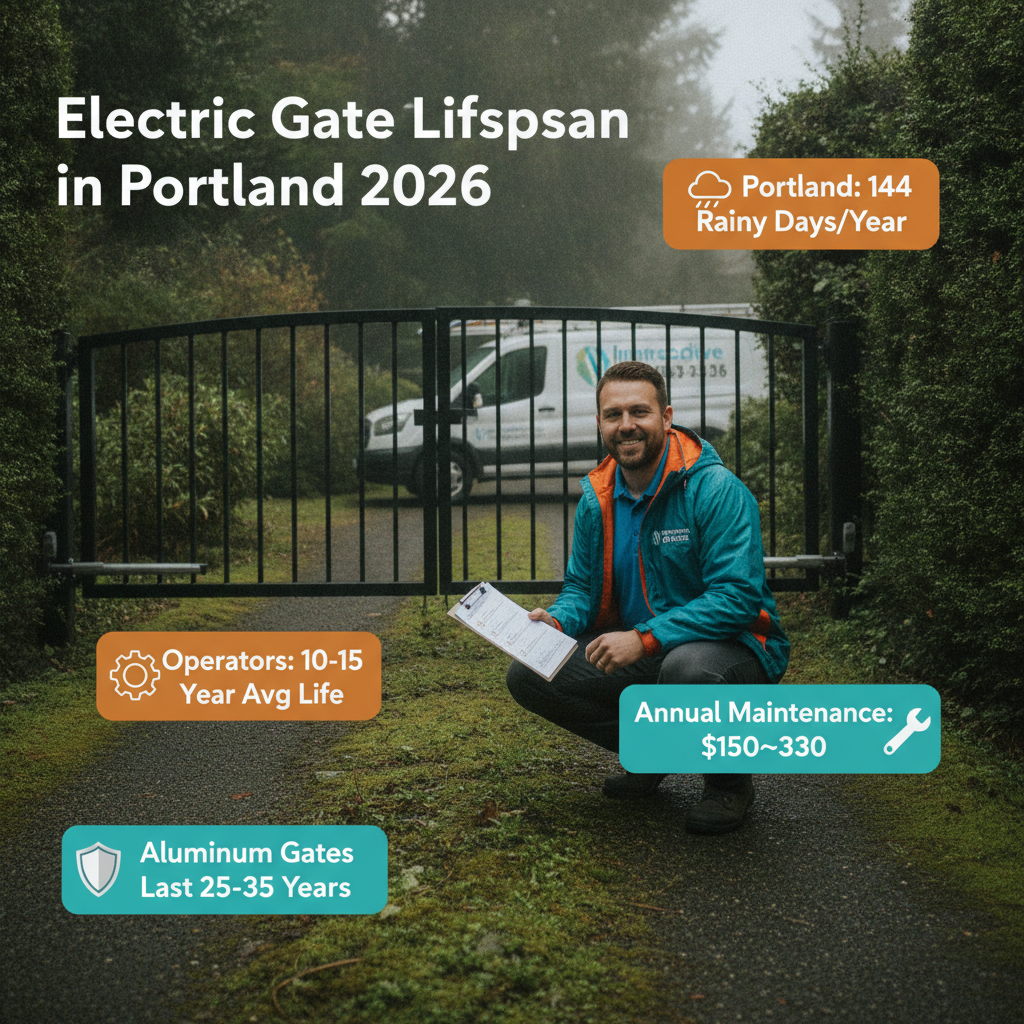
- Most automatic gates in Portland last 15–25 years on the gate structure itself, but motors average 10–15 years depending on cycle volume and rainfall exposure.
- Swing gate operators in Portland's wet climate often need bearing and seal replacements every 5–7 years due to persistent moisture infiltration.
- Slide gate motors rated for 500,000+ cycles (like FAAC 844 or Viking 9000) outlast budget operators by 8–12 years in high-traffic driveways.
- Rust and galvanic corrosion are the #1 lifespan killers in Portland — powder-coated steel gates near the Columbia River corridor or Coast Range foothills degrade 30–40% faster without annual re-sealing.
- HOAs and commercial properties in Lake Oswego and Beaverton typically replace gate operators every 8–12 years at a cost of $1,200–$4,500 installed.
- Aluminum and stainless steel gates outlast mild-steel gates by 10+ years in Portland's 144+ rainy days per year environment.
- Annual professional maintenance ($150–$350) can add 4–6 years to a gate system's useful life and prevent $800–$2,500 emergency repair calls.
- UL 325 safety reverse sensors degrade faster in Portland's temperature swings (20°F winters to 100°F summers) and should be tested every 6 months.
How Long Do Electric Gates Actually Last in Portland?
If you're a Portland homeowner Googling 'how long does an automatic gate last,' 'when should I replace my gate motor,' or 'why is my electric gate rusting already,' you're asking exactly the right questions — and the answers depend heavily on where in the Portland metro you live and what type of gate you have. Portland's climate is not forgiving to metal hardware. Between the relentless fall and winter rain, freeze-thaw cycles in Gresham and the east hills, and the occasional 100°F summer heat dome, your gate system takes punishment from every direction. This guide breaks down realistic lifespans by gate type, flags the warning signs that replacement is near, and gives you real numbers so you can plan your budget before a breakdown catches you off guard.
What Is the Average Lifespan of an Electric Gate in Portland?
The gate itself — the physical panel, whether steel, aluminum, or wood-frame — and the operator (the motor that moves it) age at completely different rates. Understanding both is key to knowing what you're actually replacing.
Gate structure lifespans in Portland:
- Powder-coated mild steel: 15–20 years with maintenance; 8–12 years without annual resealing near moisture-heavy zones like Sauvie Island or the Columbia Slough corridor.
- Aluminum: 25–35 years. Aluminum doesn't rust, making it the top structural choice for Portland's wet environment. Brands like Specrail and Jerith produce aluminum gates that routinely hit 30 years.
- Wrought iron: 20–30 years with proper galvanizing and paint maintenance; prone to pitting and scaling near the West Hills where fog lingers.
- Wood frame with metal hardware: 10–18 years. Wood swells and contracts dramatically in Portland's humidity range (40–90% relative humidity seasonally), accelerating hardware stress.
- Stainless steel or galvanized steel: 30–40+ years. Premium choice for Lake Oswego waterfront estates and commercial entrances in Hillsboro's tech corridor.
Gate operator (motor) lifespans in Portland:
- Budget/builder-grade operators (Ghost Controls, basic Mighty Mule): 5–8 years, 50,000–100,000 cycles.
- Mid-tier residential (LiftMaster LA400, Viking VS1): 10–15 years, 150,000–300,000 cycles.
- Commercial-grade (FAAC 844, Viking 9000, Elite SL-1000): 15–25 years, 500,000–1,000,000 cycles.
For a typical residential driveway with 8–12 gate cycles per day, a mid-tier operator handles roughly 3,000–4,400 cycles per year — meaning a 150,000-cycle rated motor lasts about 34–50 years in pure cycle math. But Portland's moisture intrusion, condensation inside control boards, and UV degradation on circuit components cut that real-world number down significantly.
How Does Portland's Climate Specifically Shorten Gate Lifespan?
Portland averages 144 rainy days per year and sits at roughly 37 inches of annual rainfall. That's not the wettest city in America, but the consistency of moisture — combined with temperature swings — creates four specific threats to gate longevity:
1. Control board corrosion: Condensation inside operator housings corrodes circuit boards. LiftMaster and FAAC both use sealed enclosures, but budget brands often don't. A corroded control board costs $280–$650 to replace and is almost always avoidable with a weatherproof housing upgrade ($80–$150 installed).
2. Bearing and bushing rust: Swing gate pivot bearings in open-frame operators — common on articulated arm models — collect standing water. Without annual lubrication (use a lithium-based grease rated for wet environments, not WD-40), bearings seize in 3–5 years.
3. Ground heave affecting slide gate tracks: Gresham, Oregon City, and the east Portland foothills experience frost depth of 12–18 inches in hard winters. Concrete pads shift, V-groove tracks misalign, and the motor strains to move the gate — burning out brushes 2–3 years early.
4. UV and heat stress on wiring: Portland's 100°F+ heat dome summers (increasingly common post-2021) crack insulation on low-voltage wiring and degrade photo-eye sensor lenses. Infrared sensors should be replaced or resealed every 5–7 years regardless of apparent function.
Pro Tip: If your gate operator sits in a low spot or near a downspout, add a $40–$80 drip cap and redirect drainage away from the motor housing. This single step can add 3–5 years to operator life in Portland's rainy climate.
What Are the Warning Signs My Portland Gate Is Near End of Life?
Portland homeowners often call us after their gate has already failed — a much more expensive scenario than planned replacement. Watch for these signals at least 6–18 months before the system dies completely:
- Grinding or groaning on open/close: Worn drive gears or seized bearings. Repair window: 3–6 months before full failure.
- Intermittent operation in rain: Moisture in the control board or corroded wiring connections. Often misdiagnosed as a remote issue.
- Gate drifts or doesn't hold position: In swing gates, this usually means a hydraulic ram seal failure (FAAC and CAME hydraulic operators are common in Portland installs from 2005–2015). Ram replacement runs $350–$700 per arm.
- Slow cycle times increasing by 20%+: Motor brushes wearing down or gearbox lubrication failure. A motor that took 8 seconds to open now takes 12 seconds — that's a warning.
- Visible surface rust bleeding through powder coat: Once rust reaches the weld points, structural integrity is compromised. Surface rust on flat panels is cosmetic; rust at hinges and frames is structural.
- Frequent tripped reset buttons: The motor is overloading. In a properly tuned gate, this should never happen.
- Access control display errors or keypad failure: Older DoorKing, Aiphone, or Linear systems from 2008–2015 are reaching end of firmware support — parts availability is shrinking.
How Much Does It Cost to Replace a Gate Operator in Portland in 2026?
Replacement costs in Portland break down into operator cost plus labor, and the range is wide depending on gate type and operator tier:
- Budget residential swing operator replacement (single gate, Ghost Controls or basic Mighty Mule): $600–$1,000 installed.
- Mid-tier residential swing operator (LiftMaster LA400, Viking VS1, Elite SW): $1,200–$2,200 installed for a pair of arms.
- Commercial swing or slide replacement (FAAC 844, Viking 9000, LiftMaster CSW200): $2,500–$4,500 installed depending on gate weight and run frequency.
- Complete gate panel + operator replacement (new steel or aluminum panel plus mid-tier motor): $4,500–$12,000+ depending on gate size, material, and design complexity.
- Access control upgrade at time of replacement (new keypad, intercom, or LPR camera): Add $800–$3,500 depending on system.
Labor in Portland runs $95–$145 per hour for certified gate technicians. Most residential operator swaps take 3–5 hours; complex commercial jobs run 6–10 hours.
If you're curious what a new system might look like for your specific driveway style, the Interactive Gates design tool lets you visualize gate styles before committing to a quote. Portland homeowners in neighborhoods from Eastmoreland to Forest Heights use it to match gate designs to their home's architecture.
Which Gate Types Last Longest in Portland's Climate?
Slide gates vs. swing gates in Portland: Slide gates generally outlast swing gates in Portland for one key reason — they don't rely on pivot bearings exposed to rain. The rolling carriage sits on a track, which can be maintained and replaced modularly. However, track heave from frost is a real issue in outer east Portland. Swing gates are simpler mechanically but are more vulnerable to wind loading (Portland sees 40–60 mph gusts during Willamette Valley gap wind events each winter).
Vertical pivot and cantilever gates: Premium cantilever slide gates — which float above the ground without a bottom track — are gaining popularity in Salem and Hillsboro commercial parks because there's no ground-contact hardware to corrode or shift. They cost 20–35% more upfront but reduce long-term maintenance costs significantly.
Bi-fold and vertical lift gates: Less common in residential Portland, these are built for high-cycle commercial use (500+ cycles/day) and are designed to last 20–30 years in heavy-use environments. You'll find them at Oregon City industrial parks and Beaverton tech campuses.
To see examples of gate types and styles installed across the Portland metro, the Interactive Gates portfolio includes real local projects in Lake Oswego, Hillsboro, and Gresham.
What Maintenance Schedule Maximizes Gate Lifespan in Portland?
Every 6 months:
- Test auto-reverse safety sensors (required by UL 325) — place a 2x4 flat on the ground in the gate path and confirm reversal.
- Clean photo-eye lenses with isopropyl alcohol — Portland moss and condensation fog them quickly.
- Inspect hinge welds and mounting hardware for rust bleed-through.
Annually (ideally October before the rainy season):
- Lubricate all pivot points, hinges, and drive gears with a lithium-based or marine-grade grease.
- Check control board terminals for corrosion — use contact cleaner spray ($8) and reseat all wire connectors.
- Test battery backup (if installed) — most sealed lead-acid backup batteries need replacement every 3–4 years.
- Inspect weatherstripping on operator housing; replace if cracked.
Every 3–5 years:
- Professional alignment check on slide gate tracks or swing arm calibration.
- Re-apply or touch up powder coat on gate panels — especially at weld points and bottom rails that contact water splash.
- Replace safety sensor emitters and receivers if response time has slowed.
A professional annual maintenance visit in Portland costs $150–$350 and typically includes all of the above plus a written condition report. Contact Interactive Gates to schedule a maintenance visit before the fall rains arrive.
Pro Tip: October is Portland's best month for gate maintenance — dry enough to work comfortably, but before the 5-month rainy stretch from November through March that causes the most stress on hardware and electronics.
Is It Worth Repairing or Replacing an Old Portland Gate?
The 50% rule is a reliable benchmark: if repair costs exceed 50% of replacement cost, replace the operator. Here's how that plays out in real Portland scenarios:
- LiftMaster LA400 operator, 12 years old, needs new control board ($450) and drive gear ($280) — total $730 repair vs. $1,400–$1,800 replacement: Repair is worth it if the motor brushes are still good and no other issues exist.
- FAAC 402 hydraulic swing operator, 18 years old, leaking ram and corroded board — total repair $900–$1,200 vs. $1,800–$2,500 replacement: Replacement is the smarter call — too many worn components to justify the repair cost.
- Gate panel with rust at hinge welds and weld cracks — repair estimate $600–$900 vs. new aluminum gate $2,800–$5,000: Weld repairs are valid for 3–5 more years; aluminum replacement is a 25-year decision. Depends on budget and long-term plans.
For HOA communities in Beaverton or Lake Oswego managing high-cycle entrance gates, see our HOA and commercial gate services page for guidance on lifecycle planning and bulk service agreements.
In One Minute: Portland Gate Lifespan Summary
Gate panels last 15–35 years depending on material — aluminum wins in Portland's wet climate. Gate operators (motors) last 10–15 years for mid-tier residential, 15–25 years for commercial-grade. Portland's 144 rainy days, freeze-thaw cycles in Gresham and Oregon City, and increasing summer heat events are the three biggest lifespan reducers. Annual maintenance ($150–$350) is the highest-ROI investment you can make. When repair costs hit 50% of replacement cost, replace. Budget $1,200–$4,500 to swap a residential operator installed; $4,500–$12,000+ for a full panel-plus-operator replacement. Plan replacements proactively — emergency replacement costs 20–35% more than scheduled replacement. Aluminum gates with commercial-grade operators are the best long-term value for Portland's climate.
Frequently Asked Questions: Electric Gate Lifespan in Portland
How long does a LiftMaster gate motor last in Portland?
A LiftMaster residential swing gate operator like the LA400 or LA500 typically lasts 10–15 years in Portland with annual maintenance. The main vulnerability is control board corrosion from condensation — a sealed or weatherproofed housing can extend that to 15–18 years. LiftMaster's commercial line (CSW200, RSW12V) is rated for 500,000+ cycles and realistically lasts 18–25 years in high-traffic Portland driveways.
Does rain in Portland really shorten gate life that much?
Yes — meaningfully so. Portland's persistent moisture (not just rain volume, but humidity and condensation cycling) degrades circuit board contacts, accelerates bearing rust, and causes wood components to swell and bind. Powder-coated steel gates in Portland's wettest zones (Sauvie Island, the Columbia Gorge corridor) show measurable rust at weld points within 5–7 years without resealing, compared to 12–15 years in drier climates. Aluminum gates and sealed hydraulic operators are the most climate-resilient choices.
When should I replace my gate opener vs. repair it?
Use the 50% rule: if the repair quote exceeds half the cost of a new installed operator, replace it. Also consider age — operators over 15 years old are often better candidates for replacement even on smaller repairs, because multiple components are near end of life simultaneously. If your gate is 12+ years old and facing a $600+ repair, get a replacement quote before committing to the fix.
What is the best gate material for Portland's wet climate?
Aluminum is the top choice for Portland residential gates. It doesn't rust, handles humidity and temperature swings well, and a quality aluminum gate from brands like Specrail or Jerith can last 30–35 years with minimal maintenance. For a higher-end look with maximum longevity, galvanized steel with a powder-coat finish is the second-best option. Avoid untreated mild steel or wood-frame gates if your property is in a high-moisture zone.
How often should I have my Portland gate professionally serviced?
Once a year is the minimum recommended service interval, ideally in September or October before Portland's rainy season begins. High-cycle gates (HOA entrances, commercial properties with 30+ cycles per day) should be serviced every 6 months. A professional service visit in Portland costs $150–$350 and should include lubrication, sensor testing, control board inspection, alignment check, and a written condition report.
Do Portland gate companies offer maintenance plans?
Yes — many Portland gate installation companies, including Interactive Gates, offer annual or semi-annual maintenance agreements that lock in a service rate and prioritize your property for scheduling during busy repair seasons. These plans typically run $250–$600 per year depending on gate type and cycle volume. For residential homeowners in areas like Lake Oswego or Hillsboro, an annual plan is usually the most cost-effective coverage. See our Lake Oswego service area page or our Hillsboro coverage area to confirm we serve your neighborhood.
Ready to Assess Your Portland Gate's Remaining Life?
Whether your gate is showing early warning signs, coming up on its 10-year mark, or you're simply planning ahead for a replacement, the best first step is a professional eyes-on inspection. A certified technician can give you a realistic remaining-life estimate, flag the components most likely to fail first, and help you plan a budget — whether that's $300 in maintenance or a full system replacement. Visit the Interactive Gates residential gate page to learn about replacement options, or reach out to schedule an inspection at a time that works for you. No pressure — just honest answers about what your system actually needs.