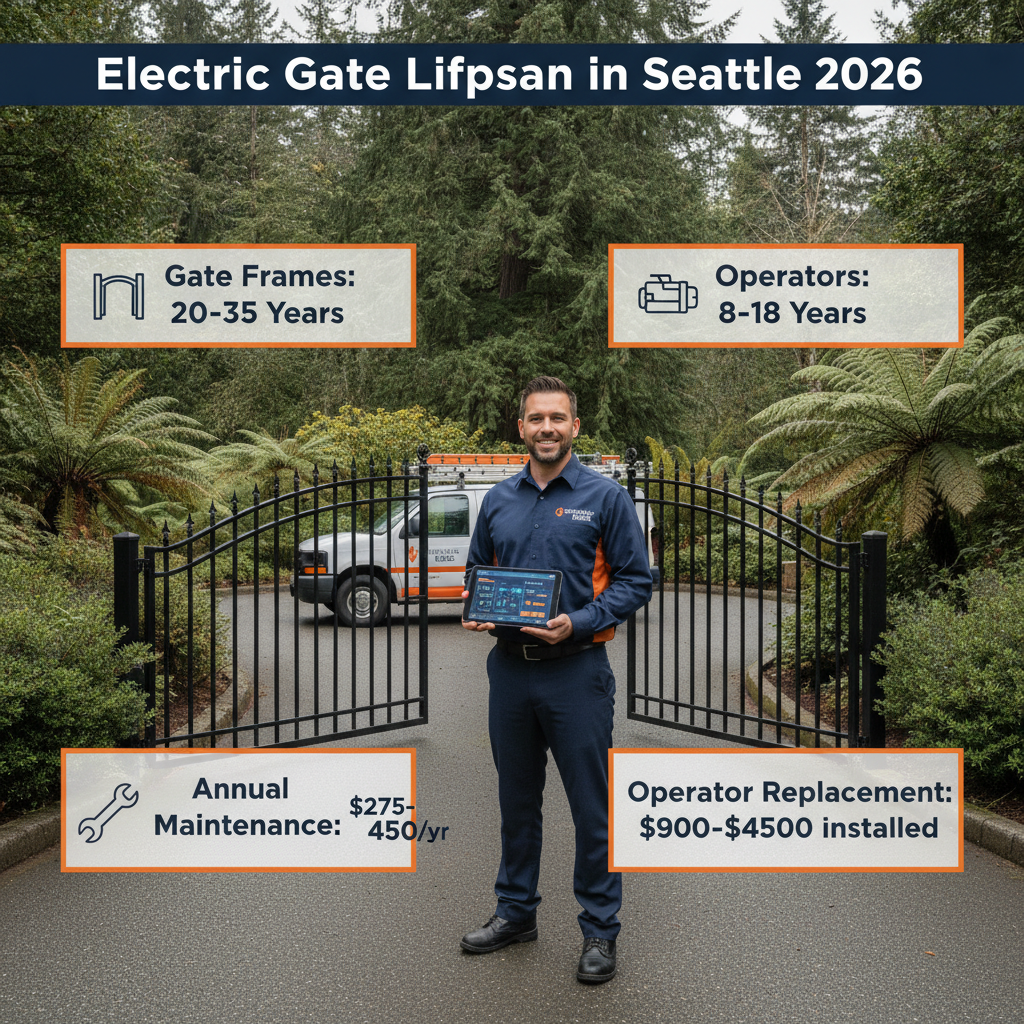
- Most electric gate systems in Seattle last 15–25 years on the structural frame, but operators typically need replacement every 8–15 years.
- Seattle's marine climate accelerates corrosion — untreated steel gates can show surface rust within 3–5 years without annual sealing or powder coating.
- Swing gates average 10–20 years of reliable automated operation; slide gates on track systems often outlast them by 3–5 years due to lower stress on hardware.
- Gate operator replacement in 2026 costs $900–$2,800 installed depending on brand (LiftMaster, FAAC, Viking, Elite) and gate weight.
- Safety sensor replacements run $150–$400, and ignoring failed sensors voids most manufacturer warranties after 90 days.
- Annual preventive maintenance contracts in the Seattle area average $275–$450/year and can double an operator's lifespan.
- Most HOA and commercial gates in Bellevue, Kirkland, and Redmond see operators hit 500,000–1,000,000 cycles before failure — roughly 8–12 years at a busy entrance.
- Control board failures spike in Seattle's wet winters; replacing a board runs $350–$750 and is the #1 reason gates stop working mid-season.
Is My Electric Gate Getting Old, or Is Something Just Broken?
Homeowners across Seattle, Bellevue, and Tacoma type these exact questions into Google every week: How long should an electric gate last? Is my gate operator dying or just needs a tune-up? When should I replace vs. repair my gate in Seattle? These are the right questions — and the answers depend heavily on what kind of gate you have, how heavily it cycles, and what Seattle's notoriously damp climate has done to your hardware over the years. This guide breaks it all down with real numbers so you can make an informed decision instead of guessing.
How Long Do Electric Gate Frames Last in Seattle's Climate?
The structural frame of an electric gate — the actual metal you see — can outlast the automated components by a decade or more, but only if it's properly finished and maintained. Here's what to expect by material in the Pacific Northwest:
- Powder-coated steel: 20–30 years before significant structural degradation, assuming re-coating every 7–10 years. Surface blistering can begin around year 5–8 in high-moisture zip codes like Gig Harbor, Everett, or Lynnwood without touch-up treatment.
- Galvanized steel: 25–35 years structural lifespan. More corrosion-resistant than painted steel but heavier — important for operator sizing.
- Aluminum: 30–40+ years. Doesn't rust, lighter load on the operator, and excellent for Seattle's salt-air influence near Puget Sound. Preferred in areas like Gig Harbor and parts of Tacoma.
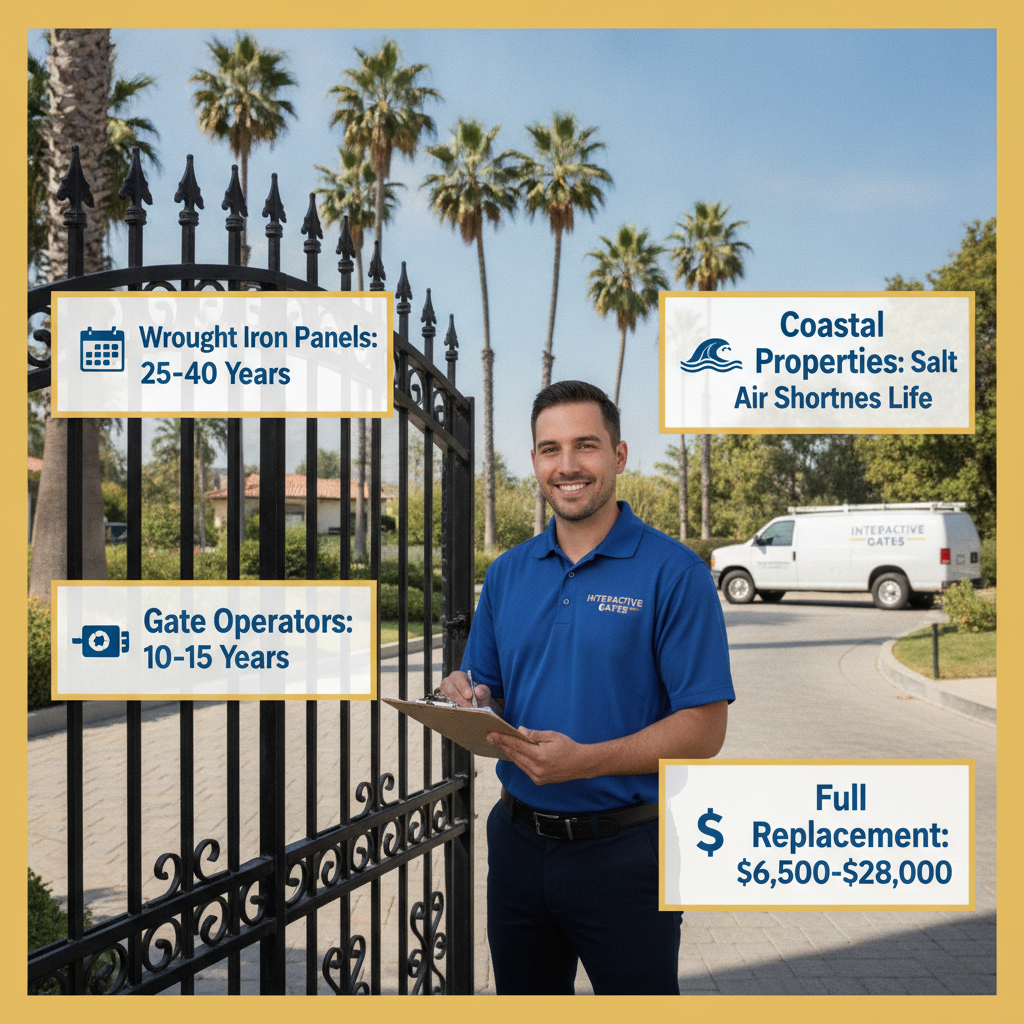
- Wrought iron: Can last 50+ years structurally but demands the most maintenance. Needs rust treatment, priming, and painting on a strict 3–5 year cycle. Looks stunning in neighborhoods like Bellevue's Bridle Trails or Seattle's Madrona, but budget for upkeep.
- Wood (cedar or redwood): 10–20 years maximum in Seattle's wet environment, even with staining. Cedar holds up better than most woods, but automated wood gates are increasingly rare because the weight variability from moisture absorption hammers operators hard.
Pro Tip: If your gate frame is aluminum or galvanized steel and was installed after 2010, there's a strong chance the frame still has 15+ years of life left even if the operator is failing. In that case, a targeted operator swap — not a full gate replacement — is almost always the smarter financial move. See real examples in our project portfolio.
How Long Do Gate Operators Actually Last in Seattle?
The operator (the motor/drive unit that actually opens and closes your gate) is the component that determines your gate's functional lifespan. Frames outlast operators. Here's the real-world data from installations across the Seattle metro:
- Residential swing gate operators (low-cycle, 1–20 opens/day): 12–18 years. LiftMaster's CSW24V and FAAC's 402 series regularly hit the top of this range. Viking's SW Series is comparable.
- Residential slide gate operators (1–30 opens/day): 14–20 years. Slide gates put less rotational stress on the operator than swing gates and tend to age more gracefully in wet climates.
- Commercial swing gate operators (50–200+ cycles/day): 8–12 years. In high-traffic applications like apartment entrances in Auburn, Lakewood, or Everett, budget for a replacement operator around year 8–10.
- Commercial slide gate operators (50–300+ cycles/day): 10–14 years at a quality installation. FAAC's 844 ER and Viking's 25XL are workhorses in this category and commonly specified for Seattle-area HOA projects.
- Barrier arm operators (parking facilities, commercial lots): 5–10 years depending on cycle count. Some high-volume parking entrances in downtown Bellevue or Redmond hit 1,000+ cycles per day, meaning a mid-tier operator can wear out in under 5 years.
Cycle count matters more than calendar time. A residential gate that opens twice per day ages very differently than a condo entrance gate that opens 200 times per day. Always ask your installer what the cycle rating is on any operator they quote — entry-level residential operators are typically rated for 150,000–300,000 cycles while commercial-grade units like the FAAC 620 or LiftMaster LA500 are rated to 500,000–1,000,000 cycles.
What Does Seattle's Climate Do to Gate Hardware Faster Than Other Cities?
Seattle averages 38 inches of rain per year, with Gray November-to-March stretches where humidity stays above 75% for weeks at a time. That sustained moisture environment creates predictable problems for gate systems:
- Control board corrosion: The #1 accelerated failure mode in Seattle. Circuit boards inside gate operator enclosures absorb humidity through inadequate seals. Boards from brands without IP-rated enclosures (many budget brands) fail 30–40% faster in the Pacific Northwest than in dry climates. A board replacement runs $350–$750 in 2026.
- Gate track and wheel corrosion (slide gates): Steel V-groove tracks can rust and pit, causing jerky movement and accelerated wheel wear. Re-tracking a slide gate costs $400–$900 depending on track length. Stainless-steel track upgrades add $200–$500 but are worth it for gates in Gig Harbor or near water.
- Hinge corrosion on swing gates: Surface hinges on swing gates in high-moisture zones like Snohomish County can seize within 5–8 years without lubrication. Seized hinges put extreme back-pressure on operators, shortening motor life by 2–4 years. Hinge replacement: $200–$600 per pair installed.
- Safety edge and loop detector damage: Underground loop detectors (the vehicle sensors buried in your driveway) can fail when water infiltrates conduit joins. Loop detector failure in Seattle typically manifests in late November after the first heavy rain cycle. Loop replacement: $350–$650.
- Keypad and intercom face corrosion: Entry keypads and video intercoms on exterior pedestals degrade faster here than in LA or Phoenix. Budget for intercom replacement every 8–12 years for exterior-mounted systems.
Neighborhoods with the highest corrosion rates we see in service calls: Gig Harbor waterfront properties, West Seattle (fog influence), Everett near the waterfront, and any property adjacent to Puget Sound inlets in Tacoma and Lakewood.
How Much Does It Cost to Replace a Gate Operator in Seattle in 2026?
If your operator is at or past its expected lifespan and repairs are stacking up, here's what a full operator replacement costs in the Seattle metro right now:
- Residential swing gate operator (single gate): $900–$1,600 installed. LiftMaster CSW24V installed typically runs $1,100–$1,400. FAAC 402 kits land in a similar range.
- Residential swing gate operator (dual gate): $1,600–$2,800 installed for both arms.
- Residential slide gate operator: $1,100–$1,900 installed. Viking 25 or LiftMaster SL595 are common specs.
- Commercial swing gate operator: $1,800–$3,500 installed. FAAC 620 or Viking SW-VL are typical recommendations for HOA and multi-family entrances.
- Commercial slide gate operator (heavy duty): $2,200–$4,500 installed. Heavy commercial slide operators like FAAC 844 ER or LiftMaster LA500 sit at the top of this range.
Labor in the Seattle market runs $95–$145/hour in 2026. Most operator swaps take 3–6 hours for a residential job, 5–9 hours for commercial. Always get a written quote that separates parts from labor — some contractors bury low-grade parts in a flat-fee quote.
Explore your residential gate options or our commercial and HOA gate systems to understand what new equipment looks like before calling for a quote.
Pro Tip: If you're replacing an operator on a gate that's already 15+ years old, ask your installer to inspect the posts, hinges, and wiring at the same time. The incremental labor cost to address a corroded post or cracked conduit during an operator replacement is far lower than returning for a second service call six months later. Our Seattle service team performs full-system assessments at no extra charge when bundled with operator work.
Repair vs. Replace: How to Decide in 2026
Use this framework to make the call:
- Repair if: The operator is under 8 years old, the repair is a single component (board, sensor, battery backup), and the repair cost is less than 35% of a new operator installed.
- Replace if: The operator is 12+ years old, you've had two or more service calls in 18 months, the motor itself is seizing or burning, or repair quotes exceed 50% of replacement cost.
- Replace everything if: The frame shows structural rust or weld cracking, posts are heaving or leaning (common in Snohomish County's clay soils), or your current system predates modern UL 325 safety compliance (pre-2008 systems often lack required entrapment protection).
For a visual sense of what a freshly upgraded system looks like, the Interactive Gates gate designer tool lets you configure styles and finishes before committing to anything.
In One Minute: Electric Gate Lifespan in Seattle
Steel and aluminum gate frames last 20–35+ years in Seattle's climate if properly finished. Gate operators — the motors — last 8–18 years depending on cycle count and maintenance. Seattle's marine environment accelerates control board corrosion, track rust, and hinge seizure faster than drier climates. Annual maintenance contracts ($275–$450/year) are the single highest-ROI investment for extending operator life. Operator replacement in 2026 runs $900–$4,500 installed depending on type and brand. Use the 35/50 rule to decide repair vs. replace. Structural steel frames should be inspected for weld integrity and post alignment every 5 years in the Pacific Northwest.
Frequently Asked Questions: Electric Gate Lifespan in Seattle
How long does a typical residential electric gate last in Seattle?
The gate frame itself — if steel or aluminum — typically lasts 20–35 years with proper coating maintenance. The automated operator, however, usually needs replacement every 8–18 years depending on how frequently the gate cycles and how well it has been maintained. In Seattle's humid climate, plan for an operator refresh around the 10–12 year mark for average residential use.
What is the most common reason electric gates fail in the Seattle area?
Control board failure from moisture infiltration is the single most common failure mode we see across Seattle, Bellevue, Everett, and Tacoma. Seattle's sustained winter humidity gets into operator enclosures — especially on older units without sealed IP-rated housings — and corrodes circuit boards. This is followed closely by hinge seizure and track corrosion on aging swing and slide gate systems.
Does the type of gate (swing vs. slide) affect how long it lasts?
Yes. Slide gate operators typically outlast swing gate operators by 2–5 years in comparable installations because they experience less mechanical stress during each cycle. Swing gates put rotational torque on the arm and pivot hardware with every open-and-close cycle, which adds wear faster. That said, slide gates require more track and wheel maintenance, especially in Seattle's wet, debris-heavy environment.
How many cycles does a gate operator last before it needs replacing?
Residential-grade operators are typically rated for 150,000–300,000 cycles. Commercial-grade operators from brands like FAAC, Viking, and LiftMaster's commercial line are rated 500,000–1,000,000 cycles. A residential gate opening 10 times per day hits 300,000 cycles in roughly 82 years — so for most homes, time and moisture do more damage than cycle count. For busy commercial entrances in Auburn, Lakewood, or Redmond, cycle count becomes the governing factor.
Is it worth replacing just the operator on an older gate, or should I replace everything?
In most cases, replacing only the operator is the right move if the frame and posts are structurally sound — and in Seattle, a well-constructed aluminum or galvanized steel frame from the 2000s is often in perfectly fine shape even when the motor is tired. The economics favor operator-only replacement if the frame has no weld cracking, the posts are plumb, and the gate panels don't show through-rust. A technician can assess this in about 20 minutes on a service visit.
What maintenance does an electric gate need in Seattle's climate to reach maximum lifespan?
Annual preventive maintenance is the minimum for Seattle conditions. A typical service visit includes: lubricating hinges and tracks with marine-grade grease, testing and adjusting limit switches, inspecting the control board enclosure seal, testing all safety sensors, checking battery backup health, and inspecting the frame and weld points for corrosion. Annual contracts in the Seattle area run $275–$450 in 2026 and consistently extend operator lifespan by 3–5 years compared to run-to-failure approaches. Read verified customer experiences on our reviews page.
Ready to Assess Your Gate's Remaining Life?
If your gate is showing any of the warning signs above — slow movement, error codes, rust streaking, or a history of repair calls — a professional assessment is the logical next step. An honest evaluation will tell you whether you're looking at a targeted repair, a single-component swap, or a full operator replacement. No pressure, no upsell. Just a clear picture of what your system needs and what it will cost. Reach out to our Seattle team through the contact page, or explore what a new system could look like for your property using the gate designer. We serve homeowners, property managers, and HOA boards across Seattle, Bellevue, Tacoma, Everett, and the broader Puget Sound region.