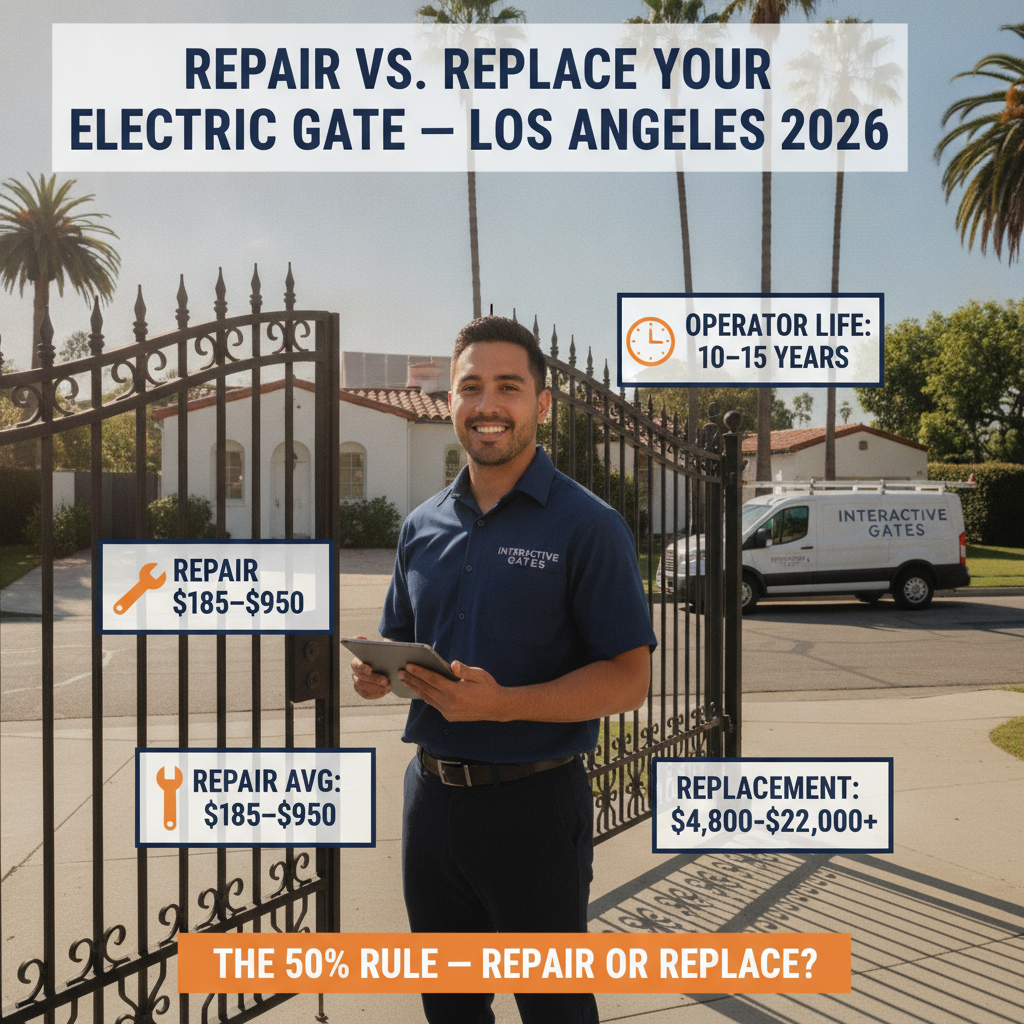
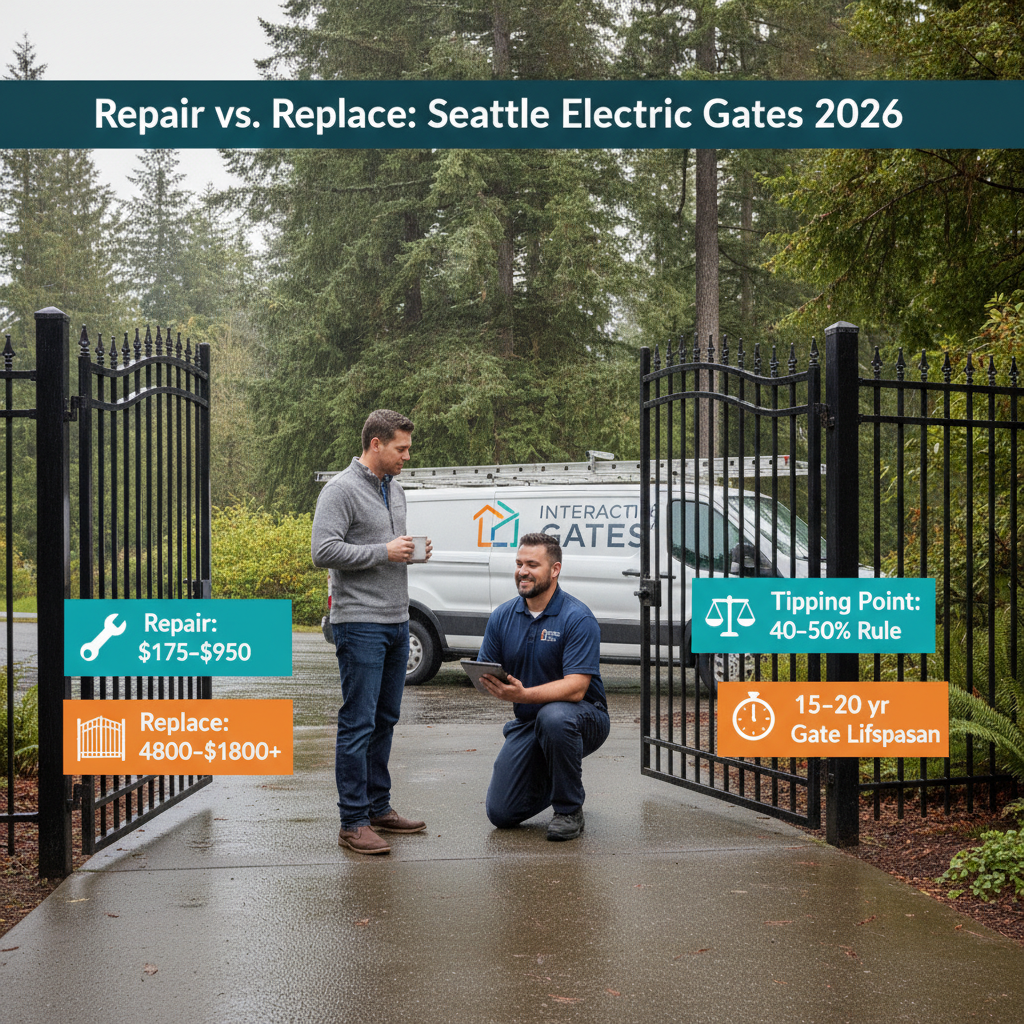
- Most automatic gates in LA last 15–25 years on the structure, but operators typically need replacement at 10–15 years.
- Coastal salt air (Laguna Beach, San Clemente) accelerates corrosion and can cut steel gate lifespan by 30–40% without proper coating.
- Cycle counts matter more than age — a residential operator rated for 500,000 cycles lasts far longer in a 2-car household than a busy HOA driveway.
- Annual maintenance costs $150–$350 in the LA metro, covering lubrication, sensor testing, and operator inspection.
- LiftMaster and FAAC operators are the most common brands installed locally, with expected service lives of 10–18 years under normal residential use.
- Replacing an aging operator runs $800–$2,200 installed in 2026, depending on gate weight, brand, and access-control upgrades.
- Hillside properties in Rolling Hills and Palos Verdes face extra stress on gate hardware from grade changes, requiring more frequent arm and hinge inspections.
- Rust staining or slow operation are the two clearest signs your gate is approaching end-of-life and needs professional evaluation.
How Long Does an Automatic Gate Last in Los Angeles?
How long will my automatic gate last? When should I replace my gate operator? What's causing my gate to slow down? These are the real questions LA homeowners type into Google — and the answers depend heavily on where you live in Southern California, how much your gate moves every day, and whether it has ever seen a maintenance visit.
The short answer: expect 15–25 years from the gate structure itself (the steel, aluminum, or iron panels and frame) and 10–15 years from the electromechanical operator that actually swings or slides it. But those numbers swing dramatically based on your zip code, your gate's daily cycle count, and the maintenance it receives. If you live near the coast in Laguna Beach or San Clemente, you're playing by different rules than someone in the dry inland valleys of Orange County.
What Actually Wears Out First — the Gate or the Operator?
Most homeowners assume the heavy steel or iron gate panel will fail first. In practice, the opposite is almost always true. The gate operator (the motor-and-arm unit) is the first component to need replacement. Here's why: an operator contains circuit boards, capacitors, limit switches, gears, and wiring harnesses — all of which degrade with heat, moisture, and repetitive mechanical stress.
In Los Angeles, summer temperatures regularly push past 95°F in the San Fernando Valley, Inland Empire fringe, and communities like Orange. Heat is an operator's worst enemy. Every degree above 80°F inside an operator housing shortens capacitor life. Combine that with fine dust from the Santa Ana wind events that hit every fall and you have an abrasive, thermally stressful environment for electronics.
The gate structure itself — assuming it was powder-coated or properly primed before installation — can outlast two or three operators. A well-welded iron driveway gate installed in 2006 in Rolling Hills with intact powder coat can still look great in 2026. The LiftMaster LA400 or FAAC 400 that was bolted to it in 2006, however, is almost certainly overdue for replacement or already replaced.
How Do Cycle Counts Determine Gate Operator Lifespan?
Every manufacturer rates their operators in cycles. One cycle = one full open and one full close. A residential-grade operator like a LiftMaster LA412 is rated at approximately 500,000 cycles. A commercial-duty unit like the FAAC 844 ER pushes toward 2,000,000+ cycles. That gap matters enormously for HOA front gates and apartment complexes.
Run the math for a typical single-family home: if two adults leave and return twice daily plus deliveries, that's roughly 8–12 cycles per day, or 3,000–4,400 cycles per year. At that pace a 500,000-cycle operator theoretically lasts 115–165 years mechanically — but heat, UV, and component aging intervene first, capping real-world life at 12–18 years regardless.
Now consider an HOA community gate in Orange serving 80 households. With 200–400 cycles per day, that same 500,000-cycle unit hits its rated limit in just 3.5–7 years. That's why commercial and HOA properties need operators rated for at least 1,500,000+ cycles, and why their maintenance contracts look very different from a residential plan.
Pro Tip: Ask your installer for the manufacturer's cycle rating on any operator they propose. For HOA or commercial gates in the LA metro, insist on FAAC, DoorKing, or LiftMaster Commercial series units — not the residential SKUs that look similar but carry a fraction of the duty rating.
How Does LA's Coastal Climate Affect Gate Lifespan?
Southern California's climate diversity is extreme within just 30 miles. A gate in Laguna Beach faces salt-laden marine air year-round. Sodium chloride accelerates oxidation in mild steel at a rate roughly 2–5× faster than inland environments. If a gate was installed without marine-grade powder coat or a sacrificial zinc primer layer, you can expect surface rust within 3–5 years and structural corrosion within 8–12 years.
Coastal best practices in 2026 include: specifying 316-grade stainless steel hardware at all hinge and latch points (not the cheaper 304 grade), choosing aluminum or hot-dip galvanized steel panels rather than mild steel, and applying a two-part epoxy primer beneath powder coat. These upgrades add $400–$1,200 to initial installation cost but easily add 10+ years to gate life in salt-air zones.
Inland communities like those in the foothills above Los Angeles face a different threat: wildfire ash and fine particulate. Ash is mildly alkaline and retains moisture against metal surfaces, accelerating rust in micro-pockets on any gate with scratched or chipped coating. After every significant fire event, coastal and inland gates alike benefit from a rinse and inspection.
Hillside terrain adds mechanical stress. Properties in Rolling Hills often have sloped driveways where a swing gate must travel an arc across uneven grade. This puts asymmetric load on the operator arm and can wear pivot points 30–50% faster than a level installation. Slide gates are often the better engineering choice on steep grades for exactly this reason.
What Are the Signs My LA Gate Is Reaching End-of-Life?
Watch for these warning signs, roughly ordered from early to late stage:
- Slow or hesitant movement — The operator struggles to start or finishes the arc slowly. Often a capacitor or gear issue, repairable at $150–$400, but signals the operator is aging.
- Grinding or squealing sounds — Dry or worn gears, bearings, or rollers (on slide gates). Budget $100–$300 for lubrication and hardware service; persistent noise after service means component replacement.
- Gate reverses without obstruction — The logic board's obstacle sensors are mis-calibrating, often due to UV-degraded sensor lenses or a failing circuit board.
- Surface rust or paint bubbling — First sign of corrosion beneath the coating. If caught early, wire-brush, prime, and repaint. If rust has penetrated the tube wall, structural replacement is needed.
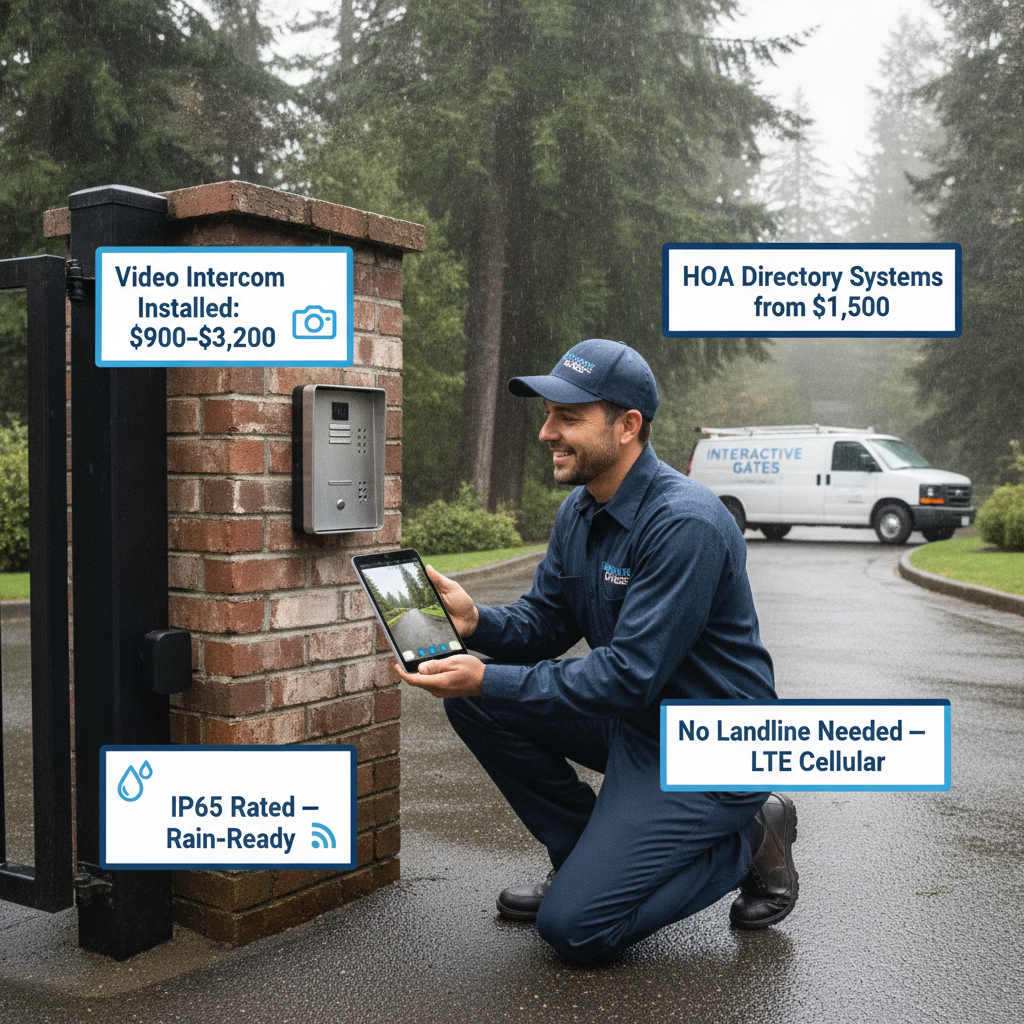
- Keypad or intercom failures — Access control components (keypads, intercoms, card readers) often fail before the gate itself. These are modular and replaceable independently at $200–$800 installed.
- Repeated tripped breakers or GFCI resets — A sign the operator motor is drawing excessive current, indicating a worn motor winding or seized mechanical component.
What Does Gate Maintenance Cost in Los Angeles in 2026?
A professional annual maintenance visit in the LA metro runs $150–$350 for residential gates and $300–$650 for commercial or HOA gates, depending on gate complexity, access control components, and travel distance. That visit should include: lubrication of all pivot points, hinge pins, and (for slide gates) the rack and pinion; safety-sensor alignment and testing; limit-switch adjustment; battery backup test; and a visual inspection of all wiring and control board connections.
Skipping annual maintenance is the single fastest way to shorten operator life. A $200 maintenance visit that catches a $15 worn idler roller prevents a $1,800 operator replacement when that roller seizes and burns out the motor. The math is straightforward.
Many LA installers, including our team, offer maintenance agreements that lock in pricing and add priority scheduling — worthwhile if your gate is a primary security perimeter for your home or business. Check our reviews to see how local customers describe the maintenance experience.
Pro Tip: Schedule gate maintenance in October or November — after the worst of summer heat and before winter rains expose any drainage or corrosion issues. The dry Santa Ana season in fall is also ideal for thorough visual inspections because dust and debris are most visible on gate tracks and hinge points.
How Much Does It Cost to Replace a Gate Operator in LA in 2026?
Operator replacement — not the gate itself, just the motor-and-arm or motor-and-chain unit — runs $800–$2,200 installed across the LA metro in 2026. The range reflects: operator brand and model (residential vs. commercial duty), gate weight (a heavy ornamental iron gate needs a higher-torque unit than a lightweight aluminum panel), and whether you're upgrading access control at the same time.
Common 2026 replacement scenarios and approximate installed costs:
- LiftMaster LA400 residential swing operator replacement: $950–$1,350
- FAAC 400 residential swing operator replacement: $1,050–$1,500
- LiftMaster CSW200 slide operator replacement (residential): $1,100–$1,600
- Commercial/HOA slide operator (FAAC 844 or DoorKing series): $1,800–$3,500+
- Operator replacement + new keypad/intercom upgrade: Add $300–$900 to above
If the gate structure itself needs replacement or major repair (broken welds, severe corrosion, bent frame), costs scale significantly. A full residential gate-and-operator replacement in LA typically runs $4,500–$14,000+ depending on gate size, material, and access-control complexity. See our residential gate services page for a full breakdown, or explore your options visually with our gate designer tool.
HOA and Commercial Gate Lifespan: Different Rules
HOA community gates in Southern California operate under California Vehicle Code sections governing community access — and under CC&Rs that typically assign maintenance responsibility to the HOA board. The lifespan calculus is different from residential: high cycle counts, liability exposure for gate failures, and ADA compliance requirements (for pedestrian gates) all shorten effective replacement intervals.
Best practice for LA-area HOAs in 2026: schedule professional inspection every 6 months (not annually), budget for operator replacement every 7–10 years on primary entry gates, and maintain a reserve fund line item of at least $3,000–$6,000 per gate for planned replacement. Our HOA and commercial gate page covers this in more detail, including operator brands rated for high-cycle duty.
In One Minute: Automatic Gate Lifespan in LA
Gate panels (steel, aluminum, iron) last 15–25 years with proper coating. Gate operators last 10–15 years residentially, 7–10 years at HOA/commercial cycle rates. Coastal communities lose 30–40% of steel lifespan without marine-grade protection. Annual maintenance costs $150–$350 and pays for itself many times over. Operator replacement runs $800–$2,200 installed in 2026. Watch for slow movement, grinding sounds, and surface rust as the earliest warning signs. For a detailed look at what local customers' installations look like, browse our project portfolio.
Frequently Asked Questions: Automatic Gate Lifespan in Los Angeles
How long do automatic gate operators last in Southern California?
Under normal residential use (8–15 cycles per day), most quality operators — LiftMaster, FAAC, or Viking — last 10–15 years in the LA metro. Heat, dust from Santa Ana winds, and coastal salt air are the primary accelerants of wear. Operators on high-cycle HOA or commercial gates may need replacement in 7–10 years. Annual maintenance extends life at either end of that range.
Is it better to repair or replace an old gate operator in LA?
A general rule of thumb: if the repair cost exceeds 50% of a new operator's installed price, replacement makes more financial sense. In 2026, a new residential operator installed runs $800–$2,200; so if repair quotes exceed $900–$1,100, replacement is usually the better investment, especially since a new unit comes with a manufacturer warranty (typically 1–3 years parts, 1 year labor from most LA installers).
Do I need special coatings on my gate if I live near the coast in LA?
Yes. If you're within roughly 5 miles of the Pacific — communities like Laguna Beach, San Clemente, or coastal Los Angeles neighborhoods — you should specify marine-grade powder coat over a zinc or epoxy primer, 316 stainless hardware at all connection points, and aluminum or hot-dip galvanized steel panels rather than mild steel. These upgrades cost $400–$1,200 more upfront but extend gate life by a decade or more in salt-air environments.
How often should an HOA gate in Los Angeles be serviced?
HOA and community gates in Southern California should be professionally inspected and serviced every 6 months, not the annual schedule appropriate for residential gates. High cycle counts, liability exposure, and the complexity of access-control systems (card readers, intercoms, loop detectors) all justify the more frequent schedule. Many HOAs in LA build a semi-annual maintenance contract into their operating budget, typically at $300–$650 per visit depending on gate complexity.
What gate materials last longest in the Los Angeles climate?
Aluminum is the longest-lasting structural choice for coastal LA environments because it does not rust. Powder-coated ornamental iron or mild steel is the most popular choice inland and performs well for 20+ years with proper coating maintenance. Wrought iron requires the most maintenance but is highly repairable. Tubular steel with a quality two-stage powder coat finish is the most common and cost-effective choice across the LA metro in 2026.
When should I completely replace my gate versus just the operator?
Replace only the operator if the gate structure is structurally sound, the hinges and frame are not corroded through, and the panel aesthetics still meet your needs. Plan for full gate replacement if you see: welds cracking at stress points, corrosion that has penetrated the tube wall (not just surface rust), panel sections that are bent or misaligned, or if the gate style no longer meets current HOA architectural standards. A professional inspection can tell you which category you're in — contact us to schedule one in the LA area.
Ready for a Gate Health Check?
If your gate is slowing down, making new noises, or simply celebrating its 10th birthday, a professional inspection is the lowest-cost, highest-value step you can take before a small issue becomes an emergency. Our team serves communities across the LA metro — from coastal Orange County to hillside neighborhoods in Rolling Hills and the greater Los Angeles basin. Reach out through our contact page to schedule an assessment, or explore what a new gate could look like for your property using our free gate design visualizer. No pressure — just honest answers from people who work on these gates every day.