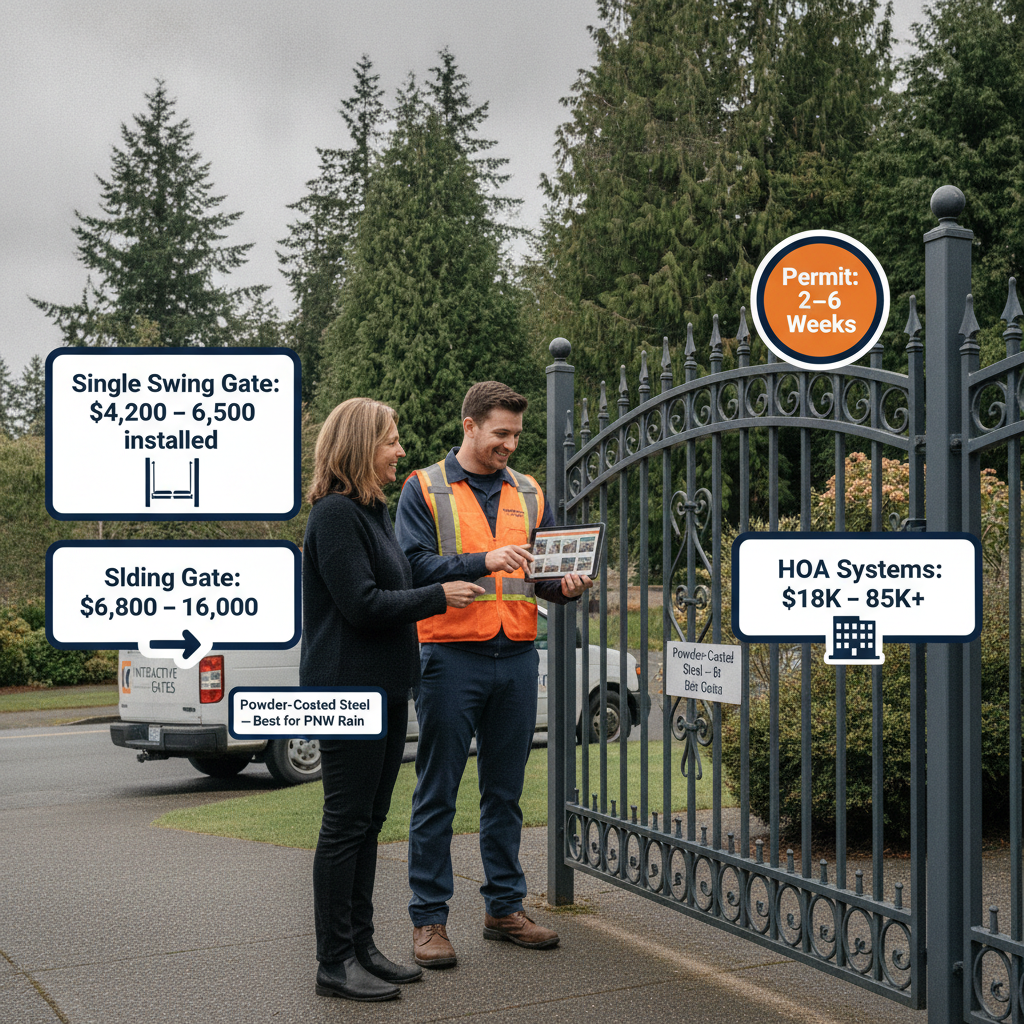
- Entry-level single swing gate packages start around $4,200–$6,500 installed in the greater Seattle area in 2026.
- Dual swing gate systems with access control typically run $7,500–$14,000 depending on width and automation brand.
- Sliding gates are often the smarter choice on Seattle's hilly lots — expect $6,800–$16,000 installed.
- HOA and commercial gate systems with keypads, intercoms, and loop detectors average $18,000–$45,000 in 2026.
- Permit timelines in King and Snohomish counties can add 2–6 weeks to your project schedule.
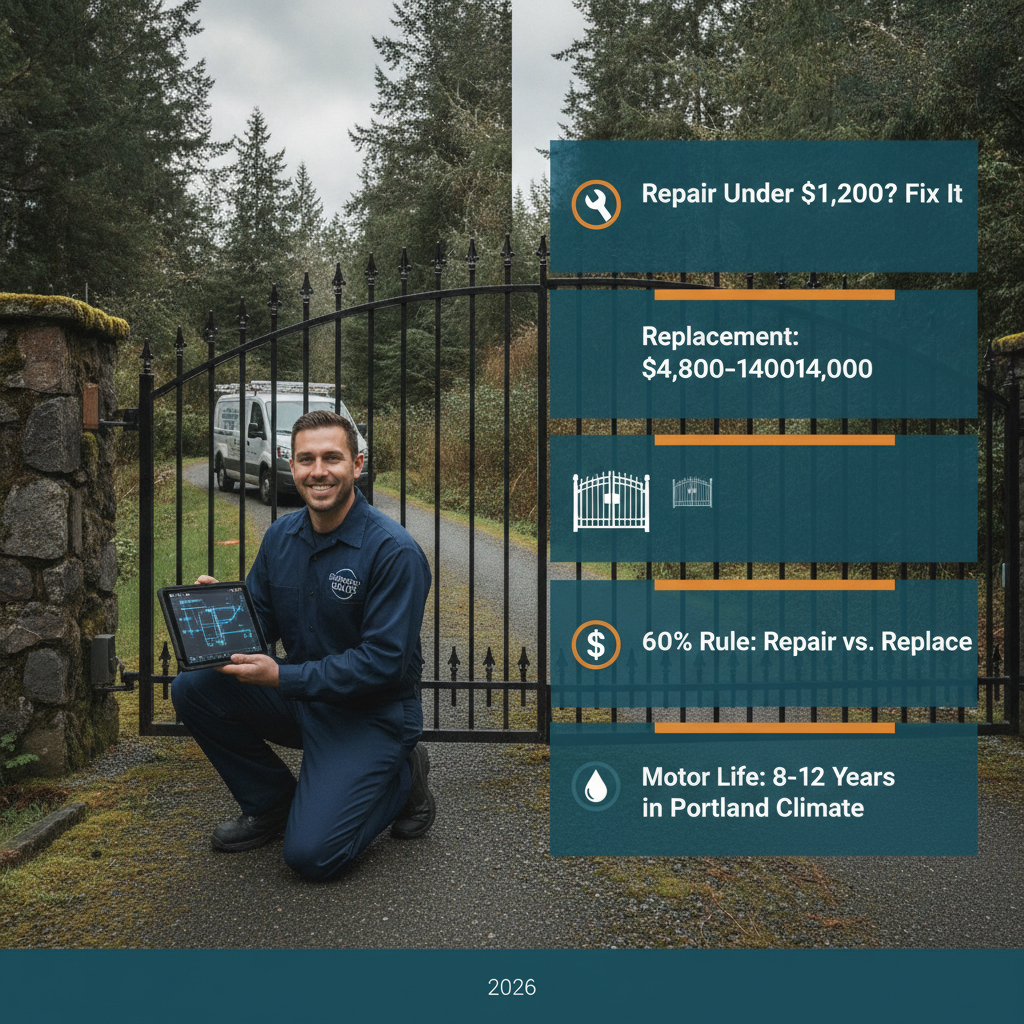
- Motor lifespan for a quality actuator (LiftMaster, Viking, FAAC) is typically 500,000–1,000,000 cycles under normal residential use.
- Seattle's wet climate makes stainless hardware, powder-coated steel, and aluminum the top material choices for longevity.
- Labor accounts for 35–55% of total project cost in the Seattle metro — shop local, licensed installers.
How Much Does an Electric Gate Cost in Seattle in 2026?
You've probably Googled something like 'electric gate installation cost Seattle' or 'how much does an automatic gate cost near me' and found frustratingly vague answers. We get it. The range online is absurdly wide — anywhere from $1,500 to $60,000 — and none of it feels grounded in real Pacific Northwest conditions. So let's fix that with actual 2026 numbers, broken down by gate type, neighborhood terrain, and the access-control features that matter most to Seattle-area homeowners, property managers, and HOA boards.
What Factors Drive Electric Gate Costs in the Seattle Area?
Before we break down prices by gate type, understand the five variables that move the needle most in this market:
- Terrain and slope: Neighborhoods like Capitol Hill, Laurelhurst, Madison Park, and most of Bellevue's east-facing hillsides require slope-compensation hardware or a sliding gate instead of a swing gate. That alone can add $1,200–$3,000 to a project.
- Driveway width: A standard single-car driveway is 10–12 feet. Double-wide driveways (18–24 feet) require larger leaf spans or a heavier sliding track — both push cost up.
- Material choice: Ornamental iron (tubular steel) is the most popular in Seattle suburbs. Aluminum is lighter and rust-proof. Wood is beautiful but demands annual sealing in our rainy climate. Prices below reflect powder-coated steel unless noted.
- Automation brand: Budget actuators (Mighty Mule, Ghost Controls) cost $250–$600 for the motor alone. Mid-tier residential motors (LiftMaster LA400, Viking X-Gate) run $900–$1,800. Commercial-grade (FAAC 740, BFT Icaro) are $2,000–$4,500 per operator.
- Access control add-ons: A simple keypad adds $150–$350. A video intercom (DoorBird, 2N, Aiphone) adds $600–$2,200. Vehicle loop detectors add $400–$900 per lane. License plate recognition (LPR) systems start at $3,500.
Pro Tip: In unincorporated King County and most of Snohomish County, a fence or gate over 6 feet requires a building permit. Budget $250–$600 for the permit fee alone, plus contractor time to prepare drawings — and plan for a 2–6 week review window before work can begin.
Single Swing Gate Installation Cost in Seattle 2026
A single swing gate — one leaf, swinging inward — is the classic driveway gate for smaller lots and narrower openings. It's the most affordable entry point for automation. Here's what real 2026 installed pricing looks like in the Seattle metro:
- Basic single swing (10 ft leaf, steel, keypad, LiftMaster LA400): $4,200–$6,500
- Mid-range single swing (12 ft leaf, ornamental iron, keypad + intercom, LiftMaster CSW200): $6,500–$9,200
- Premium single swing (14 ft leaf, custom forge-style iron, video intercom, underground operator): $10,000–$15,000
Underground operators like the FAAC 402 or BFT Kustos are increasingly popular in upscale neighborhoods like Medina, Mercer Island, and Hunts Point because they're invisible from the street. They cost $1,500–$3,000 more than a standard above-ground arm actuator but dramatically improve curb appeal and resist vandalism.
Dual Swing Gate Installation Cost in the Seattle Area
Dual swing gates — two leaves meeting in the center — are the go-to for wider driveways (16–24 feet) and properties that want a grand, symmetrical entrance. They require two operators, two sets of hardware, and precise installation to ensure both leaves close and latch at exactly the right position.
- Standard dual swing (16 ft total, steel, keypad, two LiftMaster LA400 operators): $7,500–$11,000
- Mid-range dual swing (20 ft total, ornamental iron, keypad + video intercom, two CSW200 operators): $11,000–$16,500
- High-end dual swing (24 ft total, custom ornamental iron, full access control suite, underground FAAC operators): $18,000–$28,000
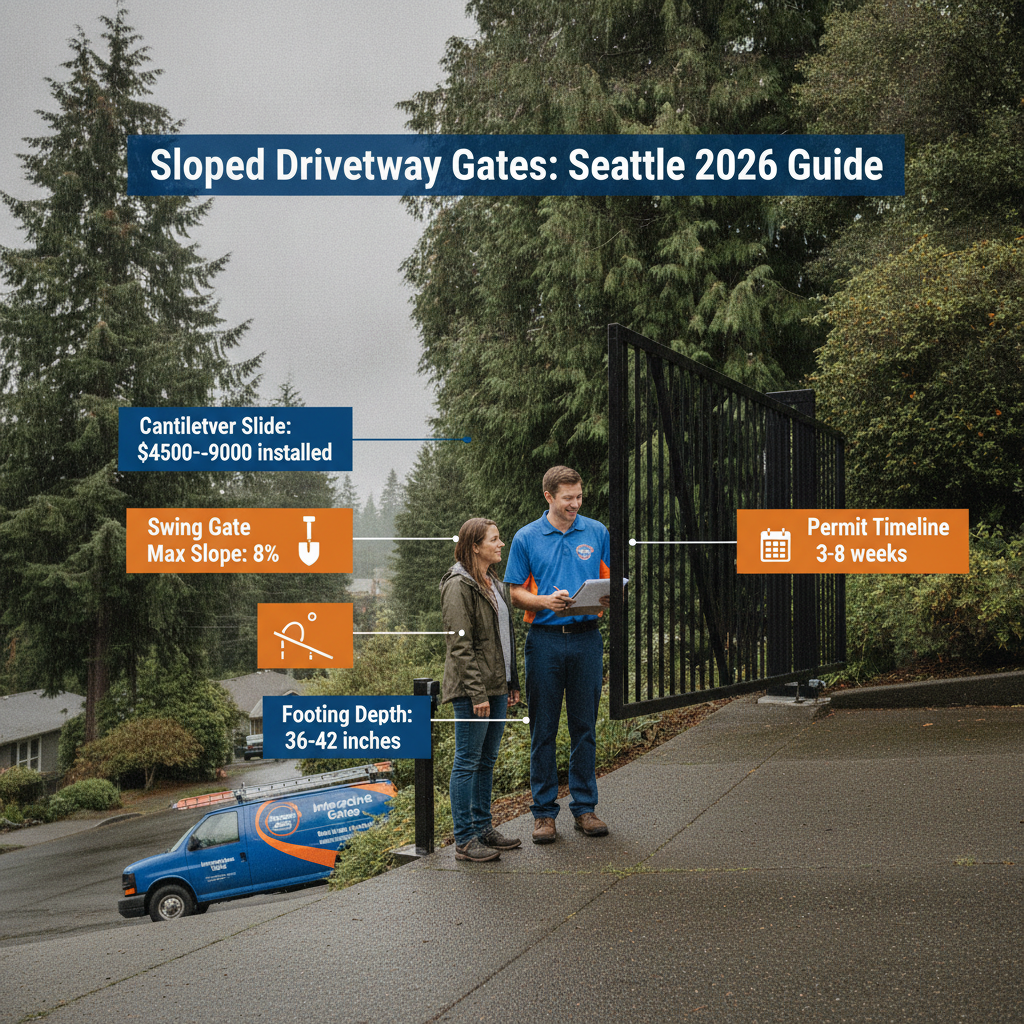
One thing Seattle installers see constantly: homeowners on sloped driveways in areas like Bellevue's Cougar Mountain or Redmond Ridge try to install dual swing gates and discover mid-project that the slope exceeds the operator's rated grade. Always get a site survey before committing to swing vs. sliding. See our Bellevue service area page for terrain-specific notes on the Eastside.
Sliding Gate Installation Cost in Seattle 2026
Sliding gates move parallel to the fence line on a track or cantilever system. They're the better mechanical choice whenever your driveway slopes more than 3–4 degrees, you have a long driveway where a swinging leaf would arc into a grade change, or you simply don't have the interior clearance for a swing arc. In hilly Seattle neighborhoods, sliding gates are the practical default.
- Standard slide gate (12 ft opening, steel, rack-and-pinion, LiftMaster SL595 operator, keypad): $6,800–$10,500
- Mid-range slide gate (16 ft opening, ornamental steel, LiftMaster SL3000 operator, keypad + intercom): $10,500–$16,000
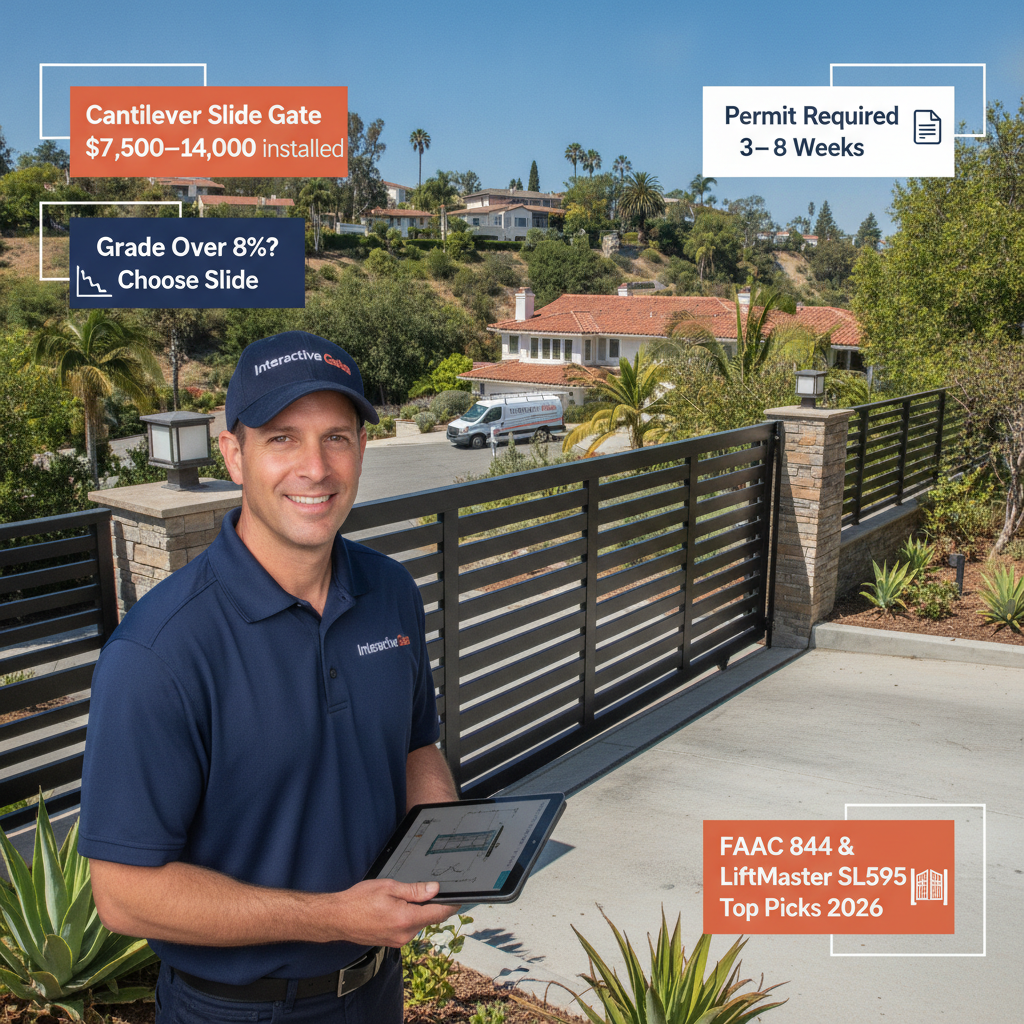
- Cantilever slide gate (20 ft opening, no track across driveway, heavy-duty commercial operator): $14,000–$24,000
Cantilever sliding gates are ideal for driveways where a ground track would collect debris or cause a trip hazard. They're also required at some gated community entrances in Gig Harbor and Snohomish County where the road grade makes a bottom track impractical. Learn more about our Gig Harbor installations.
Pro Tip: For high-cycle applications — think HOA entrances or multi-tenant properties with 50+ openings per day — spec a commercial-grade sliding operator like the FAAC 746 or Viking RS232. These are rated for 1,000,000+ cycles and cost $2,800–$5,500 for the operator alone, but they'll outlast a residential-grade motor by a decade or more in heavy use.
HOA and Commercial Gate System Costs in the Seattle Metro
Gated community entrances, apartment complexes, storage facilities, and commercial lots are a completely different project scope. Here's what HOA boards and property managers in the Puget Sound region should budget for a full system in 2026:
- Single-lane slide gate with keypad, loop detector, and intercom: $18,000–$28,000
- Dual-lane entry/exit system (two gates, two operators, two loop detectors, access management system): $32,000–$55,000
- Full LPR (license plate recognition) integrated system: $45,000–$85,000+
Access management platforms like PDKIO, Brivo, and OpenPath are now standard requests from HOA boards in communities like Snohomish's larger subdivisions and Tacoma's newer townhome developments. Cloud-based access control lets property managers grant, revoke, and audit access from a phone — no on-site visit required. See our HOA and commercial gate solutions page for a full breakdown of system options.
Does Gate Material Affect Price That Much in Seattle's Climate?
Yes — and Seattle's 38 inches of annual rainfall makes this decision more consequential than it would be in a drier climate. Here's how the major materials stack up in 2026:
- Powder-coated steel: Most popular, $55–$110/linear foot fabricated. Requires touchup every 5–8 years in the wet PNW climate to prevent rust at weld points.
- Aluminum: $70–$130/linear foot fabricated. Rust-proof, lighter (important for motor longevity), slightly less rigid. Great for coastal properties near the Sound.
- Wrought/ornamental iron: $90–$160/linear foot custom fabricated. Maximum curb appeal, maximum maintenance. Plan for professional repainting every 4–6 years.
- Cedar or Douglas fir wood: $45–$90/linear foot. Beautiful but needs annual sealing or staining in Seattle's climate. Automation adds significant complexity — wood gates warp and expand with moisture.
- Stainless steel (304 or 316 grade): $150–$280/linear foot. Nearly maintenance-free, ideal for waterfront properties on Lake Washington or Puget Sound. Premium cost, premium longevity.
How Long Does Electric Gate Installation Take in Seattle?
Timeline varies by project complexity, but here's a realistic breakdown for 2026:
- Site assessment and quote: 1–3 days from initial contact
- Permit application (if required): 2–6 weeks in King, Snohomish, and Pierce counties
- Gate fabrication (custom steel or iron): 3–6 weeks from deposit
- Installation day(s): 1 day for simple swing gate; 2–3 days for dual gates or full HOA systems
- Total project timeline: 5–10 weeks for permitted, custom projects; as few as 5–7 business days for pre-fabricated gate packages without permit requirements
Want to visualize what your gate might look like before committing? Use our gate designer tool to try different styles, materials, and configurations on a virtual driveway — it takes about 3 minutes and can save a lot of back-and-forth with your installer.
In One Minute: Seattle Electric Gate Cost Recap
Single swing gate installed: $4,200–$15,000. Dual swing installed: $7,500–$28,000. Sliding gate installed: $6,800–$24,000. HOA/commercial system: $18,000–$85,000+. Key cost drivers: terrain slope, driveway width, automation brand, and access-control features. Permit timeline: 2–6 weeks in King and Snohomish counties. Best materials for Seattle's climate: powder-coated steel, aluminum, or stainless. Motor life expectancy with quality brands: 500,000–1,000,000 cycles. Labor is 35–55% of total cost — always hire licensed, insured local installers. Explore our residential gate options or contact our Seattle team to schedule a free site assessment.
Frequently Asked Questions About Electric Gate Costs in Seattle
What is the cheapest electric gate system I can get installed in Seattle in 2026?
The most affordable complete installed system — gate, post, operator, and keypad — starts around $4,200 for a single swing gate with a mid-tier residential motor like the LiftMaster LA400 and a basic keypad. Budget-brand motors (Mighty Mule) can bring the operator cost down, but they're rated for significantly fewer cycles and shorter lifespans, making them better suited for very low-traffic rural driveways than Seattle suburban homes.
Do I need a permit for an electric gate in Seattle or Bellevue?
In most Seattle and Bellevue residential zones, a permit is required if the gate or fence structure exceeds 6 feet in height or if you're installing a new automated entry at a commercial property. Permit fees typically run $250–$600, and review times in King County averaged 3–5 weeks in early 2026. Your installer should handle permit preparation — if they don't offer this, that's a red flag.
How long do electric gate motors last in the Pacific Northwest climate?
A quality residential operator from LiftMaster, Viking, or FAAC is typically rated for 500,000 cycles and lasts 12–18 years under normal single-family home use (20–30 cycles per day). Seattle's rain and temperature variation don't dramatically shorten motor life if the unit is properly weatherproofed and the gate is correctly balanced — an out-of-balance gate is the number-one cause of premature motor failure in the PNW.
Is a sliding gate or swing gate better for a Seattle hillside driveway?
For most sloped driveways in Seattle, Bellevue, or the Eastside hills, a sliding gate is the mechanically safer and more reliable choice. Swing gates require the ground to be relatively flat across the arc of the leaf. On grades steeper than about 5–8 degrees, swing gates can drag, fail to latch, or put excessive stress on the operator arm. A cantilever sliding gate eliminates the ground-track issue entirely and works on virtually any grade.
What access control features are worth the upgrade cost in 2026?
Video intercoms (DoorBird, Aiphone GT series, 2N Helios) are the most frequently requested upgrade in Seattle's residential market right now, adding $600–$2,200 installed. For HOAs and multi-tenant properties, cloud-based access platforms like PDKIO or Brivo are worth every dollar — remote management, audit logs, and mobile credentials eliminate the physical-key headache. Vehicle loop detectors ($400–$900 per lane) are essential for any entrance with significant vehicle traffic.
Can I see examples of gates Interactive Gates has installed in the Seattle area?
Yes — our project portfolio includes photos of residential and commercial installations across the Puget Sound region, from single-family swing gates in Snohomish to dual sliding gates at HOA communities in Tacoma and Lakewood. You can also read reviews from local customers to get a sense of real project experiences. And if you want to experiment with styles yourself, try the interactive gate visualizer before your first consultation.
Ready to Get a Real Quote for Your Seattle Gate Project?
Pricing a gate project accurately requires eyes on your specific driveway — slope, width, soil type, panel-to-panel distance, and your access-control goals all matter. The numbers in this guide give you a solid baseline so you walk into any conversation knowing what's reasonable. When you're ready for a free, no-pressure site assessment from a licensed local team, our Seattle-area installers serve everything from Seattle proper to Everett, Auburn, and Tacoma. Reach out here and we'll get you scheduled — usually within a week.