- HOA gate projects in the Seattle metro typically run $18,000–$85,000 installed, depending on entry width, automation complexity, and access-control tier.
- Most Seattle-area HOAs need a dual-gate (entry + exit) system with vehicle loops, keypad, and intercom — a setup that adds $4,000–$9,000 over a single-gate install.
- LiftMaster RSW12V, FAAC B614, and Viking Model SL provides the best 2026 options for slide gates on hillside communities in Bellevue, Gig Harbor, and Snohomish County.
- Access-control hardware alone — keypads, intercoms, fob readers — adds $2,500–$14,000 to an HOA gate budget depending on unit count and cloud-management features.
- King County and Pierce County both require gate permits for HOA entry structures; plan 3–6 weeks for permit approval before installation can begin.
- Preventive maintenance contracts for Seattle HOAs average $900–$2,400/year, covering two service visits, lubrication, loop testing, and storm-season prep.
- Coastal salt air in Gig Harbor and South King County accelerates hardware corrosion — powder-coated aluminum or hot-dipped galvanized steel is recommended over bare wrought iron.
- Most HOA gate operators carry a 3-year parts warranty; commercial-grade operators like FAAC and Viking typically extend to 5 years when installed by a certified dealer.
What Does an HOA Gate System Actually Cost in the Seattle Area in 2026?
If your homeowners association is finally ready to add a gated entry — or replace the aging swinging arm that has been frustrating residents since 2019 — the first thing the board will ask is: how much does this really cost? And right behind that: what access-control system do we need for 80 homes? Can we manage it from an app? Do we need permits? This guide answers every one of those questions with real 2026 pricing and local Seattle-metro context, so your board can walk into a contractor conversation fully prepared.
For a broader look at residential gate options available to individual homeowners in the community, see our residential gate overview, or jump straight to our HOA and commercial gate page to see project examples built specifically for community entrances.
How Much Does an HOA Gate System Cost in Seattle in 2026?
HOA gate budgets span a wide range because the variables are genuinely large: single lane vs. dual lane, swing vs. slide, basic keypad vs. full video-intercom with cloud management. Here is how the numbers break down in the current Seattle-metro market.
Entry-level single-lane swing gate with keypad (communities under 30 homes): $18,000–$28,000 installed. This covers a 16-ft. powder-coated aluminum swing gate, one LiftMaster LA500 or equivalent operator, a standalone keypad, and basic vehicle-loop detection.
Mid-range dual-lane slide gate with intercom and fob reader (30–100 homes): $34,000–$55,000 installed. This is the most common configuration in Bellevue, Kirkland, and South Snohomish County subdivisions. It typically includes two FAAC 844 or Viking SL operators, a DoorKing 1812 or Aiphone IX-DVF-HID video intercom, dual loop detectors, and a 400-ft. ornamental steel or aluminum panel fence section flanking the gate.
Premium gated-community entrance (100+ homes, guard booth optional): $58,000–$85,000+. Projects at this tier include a canopy or guard-booth foundation, RFID reader integration, LPR (license-plate recognition) camera, cloud-based access management via systems like PTI Security or Openpath, and a backup generator hookup. Communities in Gig Harbor's Peninsula neighborhoods and parts of Auburn's master-planned subdivisions have seen installs in this range in 2025–2026.
Pro Tip: Always budget a 10–15% contingency on top of your gate line item. Seattle-area soil conditions — especially in hillside Bellevue or the glacial-till terrain of Snohomish County — can require additional concrete footing work that is difficult to quote until excavation begins.
Swing Gate vs. Slide Gate: Which Is Right for a Seattle HOA Entrance?
This is the single most consequential decision your board will make, and it is driven by your site geometry, not personal preference.
Swing gates need a clear swing arc — typically 1.5× the gate width — behind the gate panel. If your entry lane feeds directly into a roundabout or your entry has less than 18 feet of depth before a speed bump or curb, swing is off the table. Swing operators like the LiftMaster LA500 (residential) or FAAC 391 (commercial) are generally lower-cost — operators run $800–$1,800 per side — and parts are widely available at Seattle-area dealers.
Slide gates need a clear run of space parallel to the fence line — usually 1.1× the gate width, plus 3–4 ft. for the operator housing. Slide gates have no swing-arc problem, making them the default choice for most multi-family and HOA applications in urban Bellevue or denser Lynnwood subdivisions. Commercial slide operators like the FAAC B614 or Viking SL run $1,400–$3,200 per operator and are rated for 100–500 cycles/day — well above typical HOA usage.
Vertical pivot and bi-fold gates are niche solutions used when neither swing nor slide is geometrically possible. They are significantly more expensive ($6,000–$12,000 for the operator alone) and are not common in residential HOA settings.
What Access-Control System Does a Seattle HOA Need?
Access control is where HOA gate projects get complex — and where the wrong choice costs communities money year after year. Here is the 2026 landscape of options:
Basic keypad only ($400–$900 installed): Fine for a seasonal community or a second gate on a service road. For a main HOA entrance, this is almost always inadequate — PIN codes get shared, and there is no audit trail if something goes wrong.
Key-fob / clicker system ($1,200–$3,500 installed): The historical standard. Each resident gets one or two fobs. The problem in 2026: fobs cannot be remotely deactivated for sold homes without reprogramming the entire receiver, and there is no remote management. Many Seattle-area HOA boards are actively replacing fob-only systems with app-based solutions.
Video intercom with call-to-smartphone ($3,500–$8,000 installed): A DoorKing 1812, Aiphone IX-DVF, or ButterflyMX unit allows visitors to call a resident's cell phone, and the resident opens the gate remotely. This is the most-requested upgrade in 2025–2026 across Seattle's Eastside and South King County HOAs. Monthly cloud fees run $30–$80/month for the community account.
RFID / LPR hybrid ($7,000–$14,000 installed): Residents get an RFID windshield tag or a license-plate-recognized vehicle profile. The gate opens automatically as their car approaches. This tier also enables detailed entry/exit logs — valuable for HOA liability management. Openpath and Verkada are the leading platforms in this category for Pacific Northwest communities as of 2026.
For communities evaluating their full security posture — cameras, fencing, and intercom integration — our Bellevue service page and Seattle service page outline how these systems connect on a single project.
What Permits Does an HOA Gate Require in King County or Pierce County?
This is a step many HOA boards underestimate, and skipping it creates real liability. Here is what to expect in 2026:
King County / City of Seattle: Any gate structure attached to a permanent fence or post requires a building permit. The permit application must include a site plan showing the gate location relative to the property line and right-of-way, operator load calculations, and in some cases a traffic-impact note if the entry is on a collector street. Permit review currently takes 3–5 weeks for straightforward projects; allow 6 weeks for projects inside an incorporated city like Bellevue or Kirkland that has its own review queue.
Pierce County / Tacoma: Similar requirements, with an added fire-access review if the community has more than 30 units — the fire marshal needs to confirm the gate includes a Knox Box or a fire-department override keypad meeting NFPA 1 2024 standards. Tacoma Fire reviews run 2–4 weeks on top of the building-permit timeline.
Snohomish County / Lynnwood / Everett: Generally the most streamlined of the three: a straightforward HOA entry permit can be approved in as little as 2–3 weeks if the gate does not require right-of-way work.
Your contractor should pull the permit on your behalf — if they ask you to pull it yourself, that is a red flag. At Interactive Gates, we handle the permit application as part of every HOA project.
How Long Will an HOA Gate System Last in the Seattle Climate?
Seattle's climate is not the harshest gate environment in the country, but it is specific. The combination of 37–55 inches of annual rainfall, marine air that carries salt spray particularly in Gig Harbor and along Puget Sound, and freeze-thaw cycles in higher-elevation Snohomish County communities all affect hardware lifespan.
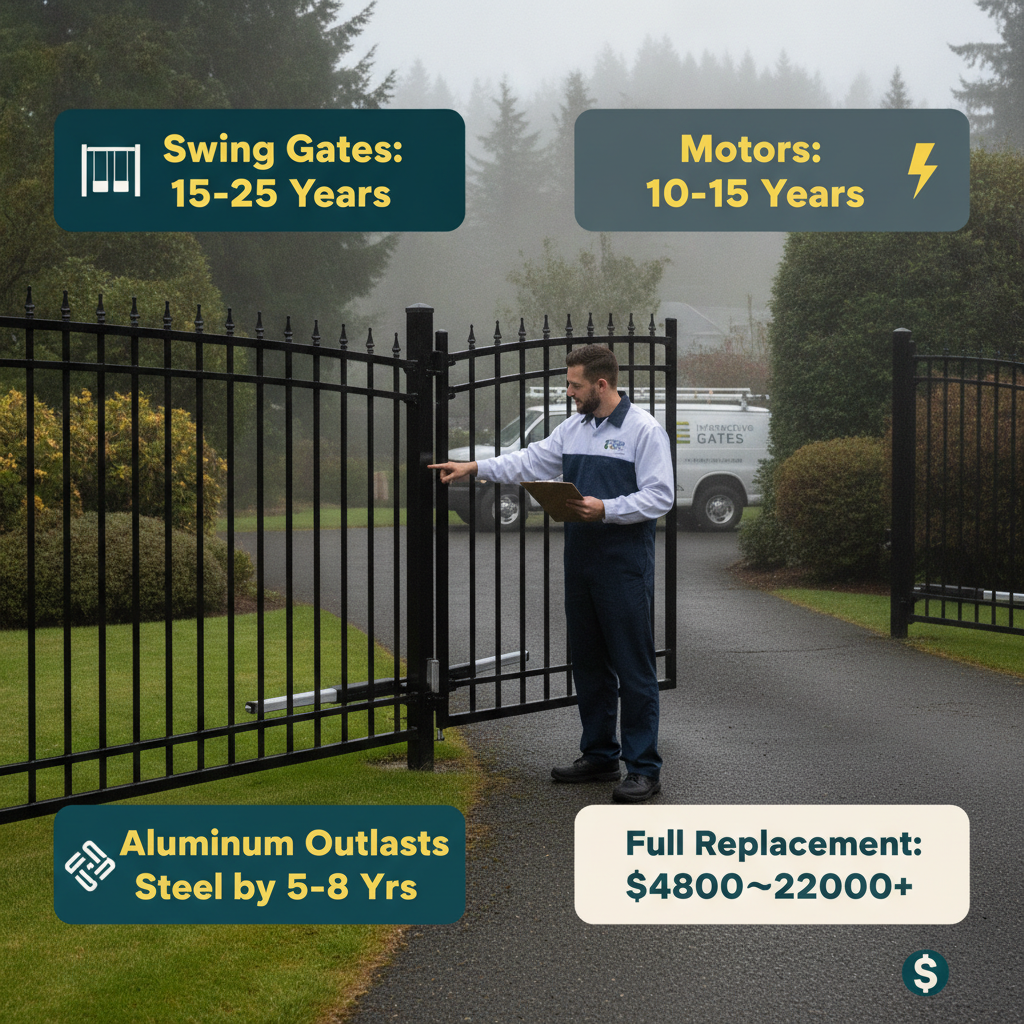
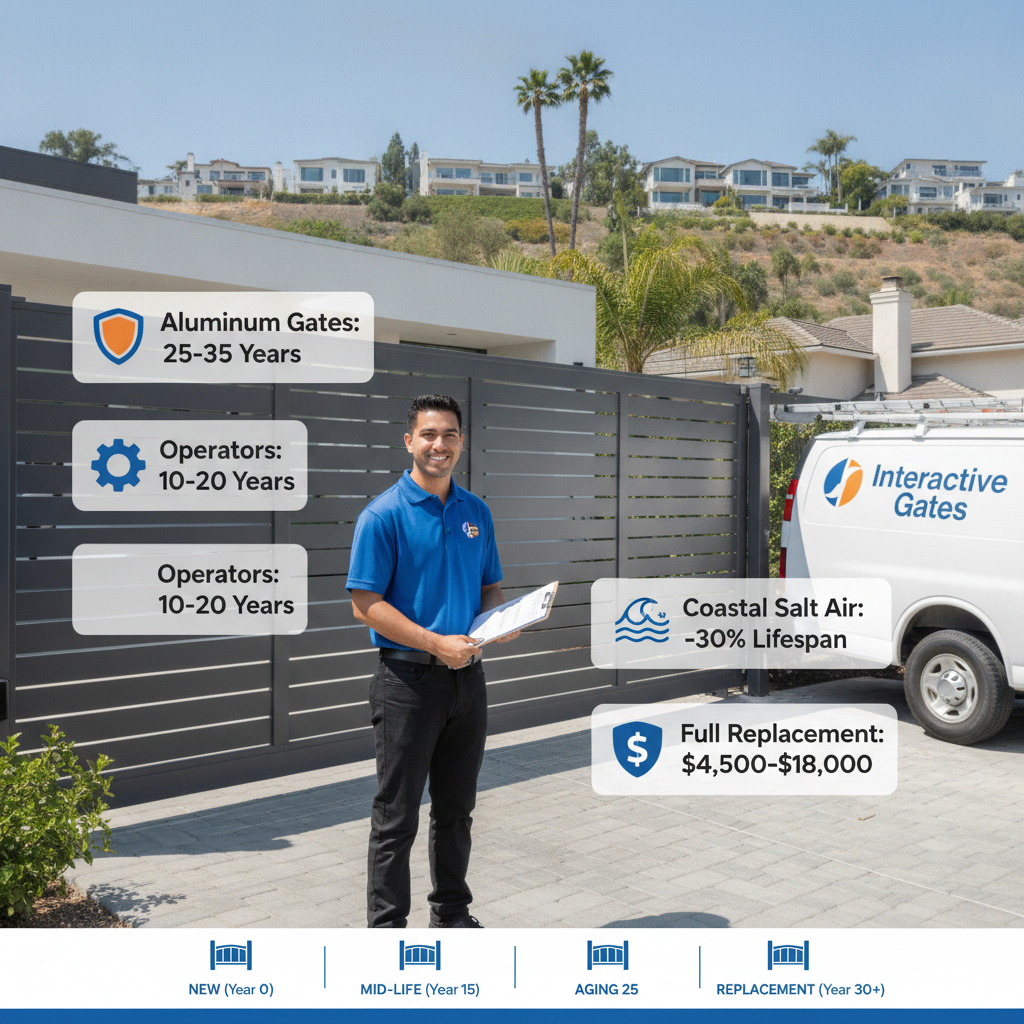
Gate panels: Powder-coated aluminum panels last 20–30 years in Seattle conditions with minimal maintenance. Galvanized steel is similarly durable. Bare wrought iron will show rust pitting within 3–5 years without annual repainting. Avoid untreated mild steel for any community within 5 miles of saltwater.
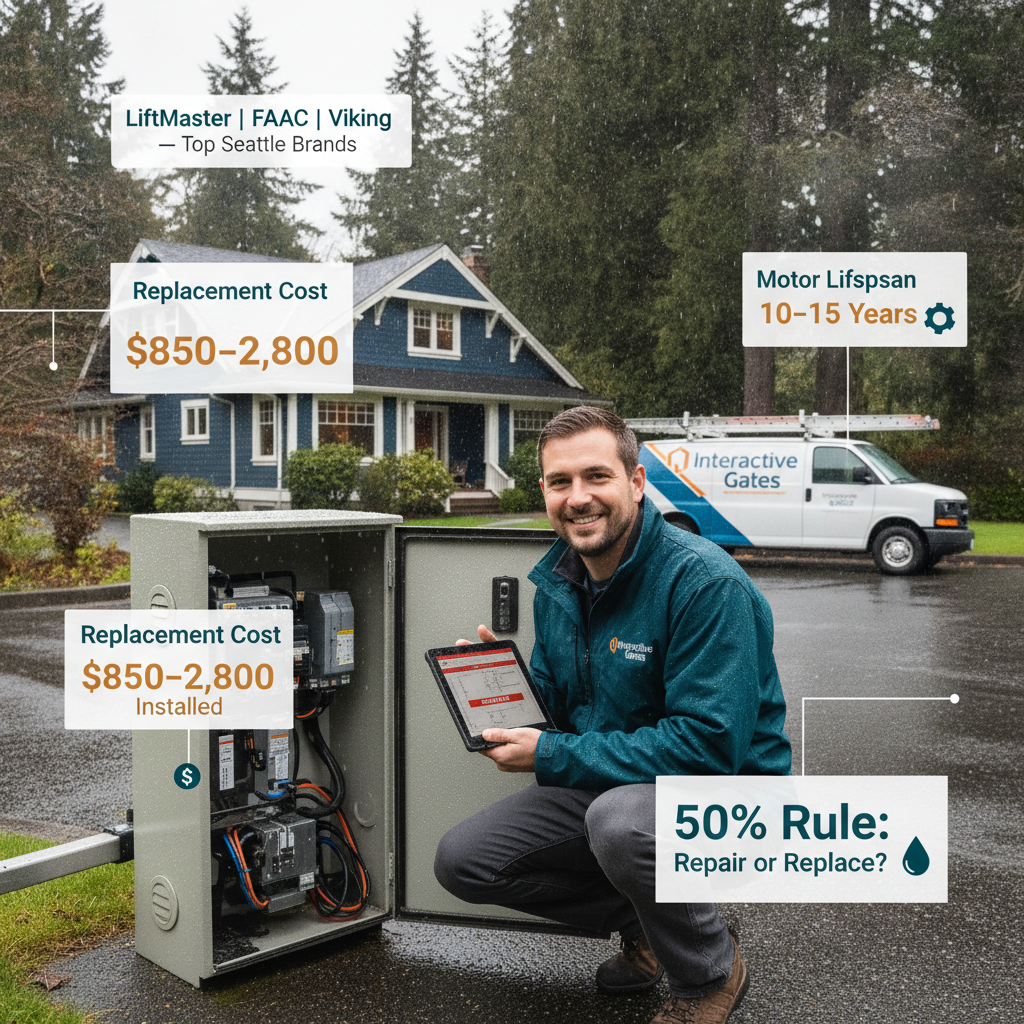
Gate operators: A commercial-grade operator (FAAC, Viking, LiftMaster CSL24U) installed by a certified dealer and maintained on a regular schedule will last 10–15 years in a Seattle HOA application. Budget operators last 5–8 years under the same conditions. Cycle count matters: a 60-home community generating 6 entries + 6 exits per household per day is running roughly 720 cycles/day — choose an operator rated for at least 500 cycles/day (most commercial units are).
Access-control electronics: Keypads and readers have a practical lifespan of 7–10 years before moisture ingress or component obsolescence drives replacement. Intercom systems with cloud platforms are refreshed on a 5–7 year cycle as software platforms evolve.
Pro Tip: Schedule one service visit in late September, before Seattle's rainy season peaks, and a second in April after the heaviest weather has passed. This two-visit annual contract — typically $900–$1,400/year for an HOA gate — catches failing loop detectors, swollen wood posts, and corroding ground wires before they cause a full system failure.
What Should an HOA Board Ask a Gate Contractor Before Signing?
Not all gate contractors have experience with community-scale projects. Here are the six questions every Seattle HOA board should ask before awarding a contract:
- Are you a certified dealer for the operator brand you are recommending? LiftMaster, FAAC, and Viking all have certified-dealer programs. Certification means the tech has factory training and access to warranty parts.
- Will you pull the permit? If the answer is no, walk away.
- What is the rated daily cycle count of the operator you are specifying? Get this in writing. An underpowered operator in a 100-home community will fail within 3 years.
- What is your response time for emergency service? A gate stuck closed at 7 a.m. on a workday is an emergency. Confirm the contractor has a same-day or next-day emergency service option.
- How is access control managed when a homeowner sells their property? The answer should involve a remote-deactivation capability — not a fob swap requiring a site visit.
- Do you offer a multi-year maintenance contract? Community associations benefit from locking in service pricing; ask for a 3-year preventive maintenance agreement alongside the installation quote.
You can browse completed HOA and community projects in our project portfolio and read what other communities said about working with us on our reviews page. If you want to explore gate styles before the board meeting, our interactive gate designer tool lets you visualize panel styles, colors, and configurations in minutes.
In One Minute: HOA Gate Systems in Seattle 2026
A Seattle-area HOA gate project runs $18,000–$85,000 depending on lane count, operator grade, and access-control tier. Slide gates dominate most community applications; swing gates require clear arc space that many subdivision entries do not have. Access-control options range from a basic keypad ($400) to a full LPR/cloud-management system ($14,000). King County and Pierce County both require permits — allow 3–6 weeks. Climate-wise, use powder-coated aluminum or galvanized steel near Puget Sound saltwater zones. Operators from FAAC, Viking, and LiftMaster's commercial line handle the 500+ daily cycles a typical Seattle HOA generates and carry 3–5 year warranties when installed by certified dealers. A two-visit annual maintenance contract ($900–$2,400/year) is the single best investment to protect the community's gate budget long-term.
Frequently Asked Questions: HOA Gate Systems in Seattle
How long does it take to install an HOA gate system in the Seattle area?
From signed contract to operational gate, most Seattle-area HOA gate projects take 6–12 weeks. Permit approval accounts for 3–6 weeks of that timeline. Actual on-site installation — concrete footings, operator mounting, loop detector cutting, and access-control wiring — typically takes 3–5 business days for a standard dual-gate community entry. Larger projects with guard-booth foundations or extensive fencing can run 2–3 weeks of on-site work.
Can our HOA manage gate access remotely without a property manager on site?
Yes. Cloud-based access-control platforms like ButterflyMX, Openpath, and DoorKing's 1837 system allow HOA board members or a management company to add and remove access credentials, view entry logs, and open the gate remotely from any smartphone. Monthly platform fees run $30–$80 for most community-scale accounts. This is the fastest-growing segment of HOA gate upgrades in the Seattle metro as of 2026.
What is the difference between a vehicle loop detector and a photocell on a gate?
A vehicle loop detector is a wire loop embedded in the pavement that senses the metal mass of a vehicle and triggers the gate to open or prevents it from closing on a car. A photocell (photo eye) is a beam sensor mounted at bumper height that detects any obstruction — vehicle, person, or animal — in the gate's path. Most Seattle HOA gate installations use both: loops for vehicle detection and photocells as a safety stop. Replacing a failed loop detector runs $350–$600 in labor and materials.
Is our HOA liable if the gate hits a vehicle or resident?
Gate operators installed after 2016 are required by UL 325 to include entrapment protection — typically reversing edges, photocells, or loop detectors — that automatically stop or reverse the gate if an obstruction is detected. If your community has an older gate without current UL 325 entrapment protection, you carry significant liability exposure. Upgrading entrapment protection on an existing gate runs $800–$1,800 and is one of the most cost-effective risk-management improvements an HOA board can make.
How many residents can a single gate access-control system handle?
Capacity depends on the platform. A standalone DoorKing 1812 system handles up to 9,000 user codes. Cloud-based systems like Openpath and ButterflyMX are effectively unlimited — user count is capped by the subscription tier rather than hardware memory. For most Seattle-area HOAs (under 500 units), any commercial-grade access-control platform installed in 2024 or later will have adequate capacity.
What happens to the gate during a power outage?
All commercial gate operators include a manual-release mechanism that allows the gate to be opened by hand during a power failure. Many HOA installations also include a battery-backup module — the LiftMaster 485LM or FAAC's integrated backup units — that provides 50–200 backup cycles on a single charge. For communities where uninterrupted access is critical (senior communities, high-traffic entries), a transfer switch wired to a community backup generator is the most reliable solution, adding $1,200–$3,500 to the project budget.
Ready to Get a Real Quote for Your HOA?
Bring your site plan — or just your community's address — and our team will walk you through operator options, access-control tiers, and a realistic permit timeline for your specific neighborhood. There is no obligation, and a detailed proposal gives your board something concrete to vote on. Visit our Snohomish County service area page or our Tacoma and Pierce County page to see communities we have served near you, or reach out directly through our contact page to schedule a site assessment.