
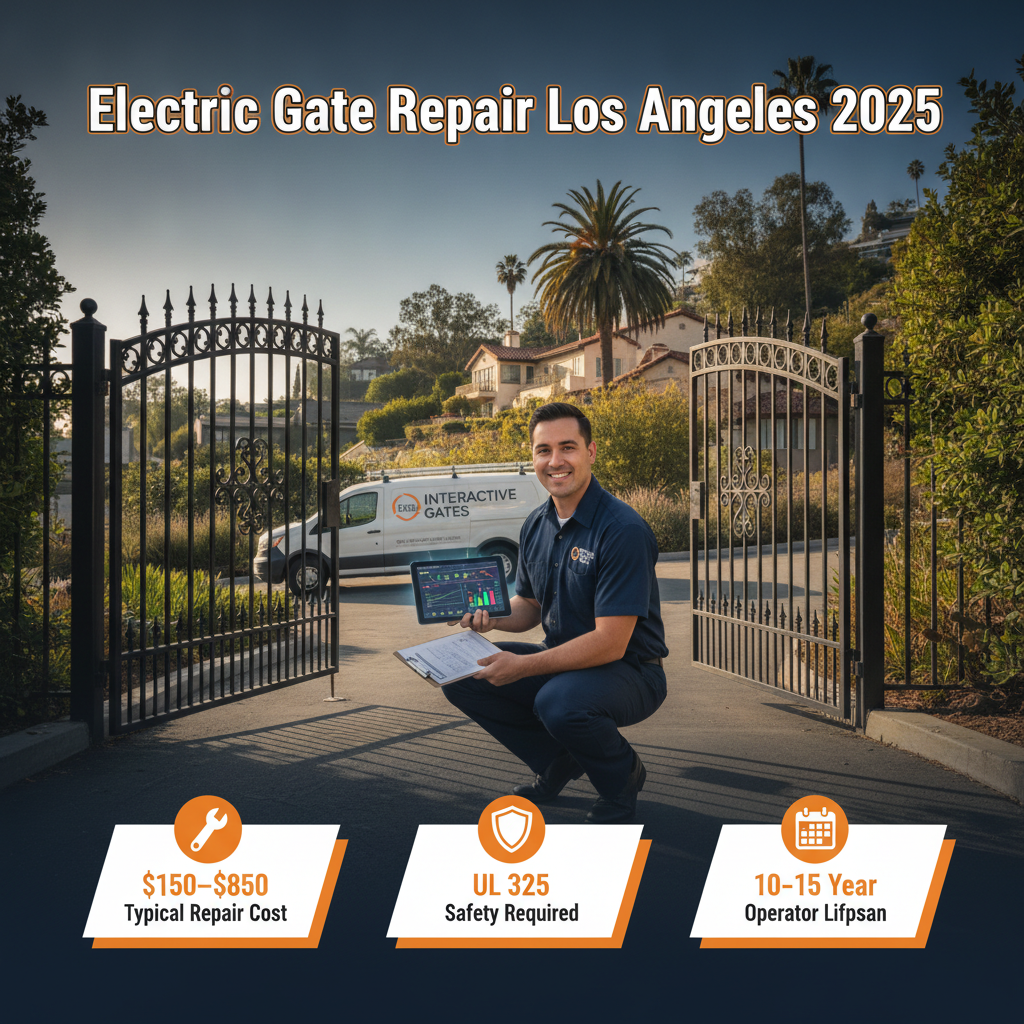
- Most electric gate repairs in Los Angeles cost between $150 and $850, depending on the component and labor involved.
- Swing gate operators last 10–15 years on average, but coastal salt air in areas like Laguna Beach and San Clemente can cut that to 7–10 years.
- The most common repair call is a gate that won't open or close — usually traced to a dead battery backup, faulty loop detector, or worn drive gear.
- A replacement circuit board alone runs $200–$450 parts + labor; a full operator swap runs $900–$1,800 installed.
- LA's Title 24 and UL 325 codes require safety-edge sensors and auto-reverse — non-compliant gates can void your homeowner's insurance claim if someone is injured.
- Preventive maintenance visits ($120–$200/year) can extend operator life by 3–5 years and catch problems before they become $600+ repairs.
- HOAs in master-planned communities like Rolling Hills require board approval before any gate modification — factor in 2–6 weeks for that process.
- Emergency after-hours service calls in the LA metro typically carry a $95–$150 trip-charge surcharge on top of standard labor rates.
Is Your Electric Gate Stuck, Grinding, or Just Dead? Here's What LA Homeowners Need to Know
You tap your remote, nothing happens. Or the gate groans halfway open and stops. Maybe it opens fine but refuses to close — which is its own kind of security nightmare at 11 PM in a hillside neighborhood above Los Angeles. Whatever brought you here, you're probably Googling 'electric gate repair near me Los Angeles,' 'why won't my automatic gate open,' or 'how much does gate repair cost in LA.' This guide gives you straight answers: real price ranges, the most common failure points, what separates a $200 fix from a $1,500 replacement, and how Southern California's unique climate and terrain accelerate wear in ways most homeowners don't anticipate.
What Does Electric Gate Repair Cost in Los Angeles in 2025?
Labor rates in the LA metro run $95–$135 per hour for experienced gate technicians, with a typical service call lasting 1–3 hours. Here's how the most common repairs shake out in total cost:
- Remote/transmitter reprogramming or replacement: $50–$150
- Safety sensor (photo-eye or safety edge) replacement: $120–$280
- Loop detector replacement (vehicle detection under the driveway): $200–$450 including saw-cut and sealant
- Battery backup replacement: $150–$300 (sealed lead-acid or lithium depending on operator brand)
- Drive gear or rack-and-pinion repair (slide gates): $180–$420
- Circuit board / control board replacement: $250–$550 total
- Hinge or post repair (swing gates): $200–$600 depending on concrete work
- Full motor/operator replacement: $900–$1,800 installed (LiftMaster, Viking, FAAC, or BFT brand operators)
- Emergency / after-hours call: Add $95–$150 surcharge to any of the above
These ranges assume a single-gate residential setup. A dual swing gate or a heavy commercial slide gate serving an HOA entrance in Rolling Hills or Orange can push those numbers 30–50% higher due to heavier hardware and longer labor time.
Pro Tip: Always ask for a written estimate that separates parts from labor. A reputable company will list the component brand and part number so you can verify it isn't a gray-market knock-off. Counterfeit LiftMaster circuit boards circulate on the secondary market and typically fail within 6–18 months.
Why Do Electric Gates Break Down Faster in Southern California?
LA seems like easy weather for mechanical equipment — no freezing temps, no ice. But Southern California actually creates its own set of accelerated wear conditions that surprise homeowners who moved here from the Midwest or East Coast.
- UV degradation: The LA basin averages 284 sunny days per year. Plastic gear housings, rubber wiring insulation, and photo-eye lens covers all degrade significantly faster under intense UV. Budget operators show cracks in housings within 4–6 years; commercial-grade units like FAAC 844 or BFT Kustos hold up 10+ years.
- Coastal salt air: If your property is within 3–5 miles of the coast — think Laguna Beach, San Clemente, or Pacific Palisades — salt-laden air accelerates corrosion on exposed terminals, hinges, and rack-and-pinion drives. Stainless steel hardware and dielectric grease are not optional in these locations; they're maintenance requirements.
- Wildfire smoke and ash: Particulate matter from seasonal fires infiltrates operator enclosures, coating circuit boards and sensors. After a heavy smoke event, a compressed-air blow-out of your operator box is cheap insurance.
- Seismic micro-movement: LA sits on multiple active fault systems. Even minor tremors (the 3.0–4.5 range that locals ignore) can shift gate posts and misalign slide-gate tracks over time, creating the mechanical binding that burns out motors prematurely.
- High cycle counts in gated communities: A single-family home might clock 8–12 cycles per day. A busy HOA entrance gate in a 200-unit community can hit 400–600 cycles daily, burning through budget operators in 2–3 years versus the 5–7 year rating.
What Are the Most Common Electric Gate Problems in LA (and What Causes Them)?
After thousands of service calls across the LA metro, these are the failure patterns that show up most often:
- Gate won't open at all: Dead battery backup (most common after a power outage), tripped breaker, failed control board, or a loop detector that has lost its ground wire connection.
- Gate opens but won't close: Obstructed or misaligned photo-eye sensors (a palm frond or garden spider is enough), a faulty close-limit switch, or a timer-to-close feature that got reset during a power blip.
- Gate reverses immediately after starting to close: Safety edge or photo-eye is triggering. Clean the lenses first — LA dust and spider webs are notorious for false triggers.
- Gate moves slowly or grinds: Lubrication failure on the rack (slide gates) or hinge pivot (swing gates), a worn nylon drive gear, or low battery voltage causing the motor to work harder than rated.
- Remote range has shrunk from 30 feet to 5 feet: Weak remote battery (replace first, it's free), but also check for new RF interference sources — a neighbor's new smart-home hub or an LED light fixture near the receiver antenna can dramatically cut range.
- Intercom or keypad works but remote doesn't (or vice versa): This isolates the issue to the specific input channel, not the operator motor itself. Usually a receiver board or antenna wire.
How Do I Know If My Gate Needs Repair vs. Full Replacement?
This is the question technicians get asked on nearly every service call. The honest answer comes down to three factors: operator age, cycle count, and repair cost as a percentage of replacement cost.
A general rule of thumb used by experienced installers: if a repair costs more than 50% of a new operator installed, replacement is usually the smarter financial choice — especially if the existing unit is over 8 years old. A $500 board repair on a 12-year-old operator that's also showing worn gears and a cracked housing is borrowing time.
Conversely, if the operator is a quality brand (LiftMaster LA400, Viking DS series, BFT Kustos, or FAAC 844) and is under 6 years old, a targeted repair almost always makes sense. These units are engineered for 100,000–500,000 cycles and often have 3–5 year warranties on major components.
Pro Tip: Before your technician arrives, note your operator's model number (usually on a label inside the enclosure lid) and count roughly how many times per day the gate cycles. This gives the tech the context to recommend repair vs. replace honestly, rather than defaulting to a full swap because it's easier to quote.
Does LA Have Specific Codes My Gate Has to Meet?
Yes, and this matters more than most homeowners realize. California enforces UL 325, the national safety standard for automatic gate operators, which mandates: at least one primary entrapment protection device (photo-eye or safety edge), auto-reverse functionality, and for vehicular gates, a minimum 16-inch clearance between the gate and any fixed object during operation.
Los Angeles County and most incorporated cities (including Laguna Beach and San Clemente) also require a permit for new gate installations and for operator replacements that change the gate's operating characteristics. Repair of like-for-like components typically does not require a permit, but adding a new access-control system or changing from swing to slide does. When in doubt, a quick call to your city's building department saves you from a stop-work order or an insurance headache later.
HOA communities in gated enclaves like Rolling Hills Estates have an additional layer: CC&R approval before any exterior modification. Most boards meet monthly, so build that 30–60 day window into your timeline if you're planning more than a simple repair.
How Can I Make My Electric Gate Last Longer in the LA Climate?
The single highest-ROI thing you can do is schedule an annual maintenance visit. A qualified technician will: test and adjust limit switches, lubricate all moving contact points, load-test the battery backup, clean photo-eye lenses, inspect wiring for UV or rodent damage, and check mounting hardware torque. This $120–$200/year service typically catches the $50 worn gear before it becomes the $400 motor burnout.
Between professional visits, homeowners can do simple monthly checks: wipe photo-eye lenses with a soft cloth, spray exposed rack-and-pinion with a weather-resistant lubricant like white lithium grease (not WD-40, which attracts debris), and verify the auto-reverse test — place a 2x4 flat on the ground in the gate's path and confirm it reverses on contact.
If you want to browse gate styles or think about an upgrade while you're at it, the Interactive Gates gate designer tool lets you visualize different configurations for your specific driveway layout before committing to anything.
In One Minute: Electric Gate Repair in LA — The Fast Summary
- Most repairs land between $150 and $850; full operator replacement runs $900–$1,800 installed.
- Coastal salt air, intense UV, wildfire particulate, and seismic micro-movement all accelerate wear faster than most homeowners expect.
- The most common call: gate won't open or close — usually a sensor, loop detector, or dead battery backup.
- If repair cost exceeds 50% of replacement cost on a unit over 8 years old, replace it.
- UL 325 compliance (safety sensors, auto-reverse) is required by California law and matters for your homeowner's insurance.
- Annual maintenance at $120–$200/year is the single best investment to avoid big repair bills.
- HOA properties need CC&R board approval before modifications — allow 30–60 days.
Frequently Asked Questions About Electric Gate Repair in Los Angeles
How long does an electric gate repair take?
Most residential repairs are completed in a single visit of 1–3 hours. If a specialty part must be ordered — such as a specific circuit board for an older FAAC or BFT operator — lead times run 2–7 business days depending on distributor stock. A good technician will carry the most common replacement components (photo-eyes, battery backups, limit switches, standard LiftMaster boards) on their service vehicle to resolve the majority of calls same-day.
Can I repair my electric gate myself in Los Angeles?
Simple tasks like replacing a remote battery, reprogramming a transmitter, or cleaning photo-eye sensors are fine as DIY. Anything involving the operator's wiring, circuit board, or structural hardware should be left to a licensed professional. California requires contractors who work on low-voltage access-control systems to hold a C-10 (Electrical) or C-7 (Low Voltage) contractor's license — you can verify a company's license on the CSLB website before you book.
Why does my automatic gate keep reversing before it fully closes?
The most likely culprit is an obstructed or dirty photo-eye sensor — clean both lenses first. If that doesn't fix it, the safety edge (a pressure-sensitive rubber strip along the gate's leading edge) may be damaged or water-infiltrated, sending a constant trigger signal. Third possibility: the close-limit switch is set too far out, causing the gate to think it's hitting an obstacle before it reaches the fully closed position. A technician can diagnose all three in under 30 minutes.
Is an electric gate repair covered by homeowner's insurance in California?
Mechanical breakdown is generally not covered under a standard HO-3 policy — that's a maintenance issue. However, if the gate was damaged by a covered peril (vehicle impact, vandalism, fire, or a falling tree during a windstorm) your dwelling or other-structures coverage typically applies, subject to your deductible. Document damage with photos immediately and call your insurer before authorizing repairs. Note: gates that are non-compliant with UL 325 safety standards can give an insurer grounds to deny a liability claim if a person was injured by the gate.
How do I find a reputable electric gate repair company in Los Angeles?
Look for a company that holds a current California CSLB license (C-10 or C-7), carries general liability and workers' comp insurance, provides a written parts-and-labor estimate before work begins, and can show you real local reviews. Ask specifically whether their technicians are factory-trained on the operator brands they service. You can also review completed local projects at the Interactive Gates portfolio or read customer feedback on the reviews page to get a sense of real-world service quality.
What is the lifespan of an electric gate operator in Southern California?
Quality residential operators (LiftMaster LA400, BFT Kustos, Viking DS200) are rated for 100,000–300,000 cycles and typically last 10–15 years in moderate-use residential applications. In coastal zones within 3 miles of the ocean, expect the lower end of that range — 7–10 years — without diligent corrosion maintenance. Budget import operators often fail within 3–5 years regardless of location. Commercial-grade operators used at HOA entries (FAAC 844ER, BFT Igea) are rated for 500,000+ cycles and, with proper maintenance, can serve 15–20 years in LA conditions.
Ready to Get Your Gate Sorted?
Whether you're dealing with a gate that's been acting up for weeks or one that just died this morning, the best next step is a professional diagnostic — not a guess-and-replace cycle that eats your budget on the wrong parts. If you're a homeowner, property manager, or HOA board member in the Los Angeles area, you can explore residential options at the residential gate page, get details on commercial and HOA solutions at the commercial gate page, or simply reach out directly through the contact page to schedule a service call. A qualified technician — not a call-center script — will give you a straight answer about what your gate actually needs.
FAQs


